FirstNet: Hardened Public Safety Officials wine about Opt-Out States? Who’s team are you on?

In the last week alone I have read a whole lot of articles on the State’s ability to Opt-Out, which leads me to my most recent diatribe. The most interesting article was entitled “State Officials Complain that Rivada Urging States to Opt Out”, which was confusing in one aspect. I couldn’t discern as to how “Rivada” was encouraging them to “Opt-Out” — even though that is the right answer – the States have been looking at “Opt-Out” ever since the law first was enacted. I seem to remember lots of discussion around the term “Opt-Out”, which is stated in section 6203 of the Middle Class Tax Relief and Jobs Creation Act of 2012. If anyone is to blame for the States talking about a real “Opt-Out” it would be me. After all, I alone, was the one spewing all these “fact-less” articles and troublesome “face-to-face” meetings with the States, their Staff, SWICs and their committees, local governing boards, investors and contractors. I take pride in my lone voice of dissent. But, I defer any blame to anyone else if that blame would cause me any pain.
Now that the cat is out of the bag, it has become evident that someone has moved the FirstNet cheese. There seems to be those hardened individuals that are trying to form dissenting ranks within the Public Safety Community, of which has drank the cool-aid that a federal solution is the only solution for FirstNet. In fact, that statement is true. FirstNet was created by a federal entity, is run under a federal entity, and is controlled by a federal board enacting federal acquisition rules. If it talks like a duck and quakes like a duck…well…  As with most political controversies these days it comes down to the 10th Amendment and ideology.
Does FirstNet, as a federal organization, have any say in what a State does? Do you, the individual, believe that the “top-down” centralized federal solution is the right way of doing business for all Americans? Or do you believe that the solution is best delivered from the bottom-up under the control of the States and oversight provided by the feds? I’m not one for pushing politics – I just work in the broadband industry – but the decision, to me, lays within the confines of just getting something done, done right, on-time, and within budget, all while besting the revenue capabilities of the solution we are working on, which in this case leads me to believe that we have way too much bullshit and not enough framework to hold it.
So lets gets this straight, FirstNet comes in to build the solution for the State, what could possibly go wrong with that? Well, lets look at just the tip of the ice-berg. First off, lets say you go with the FirstNet “Opt-In” scenario, what exactly does that roadshow come with?
Your first obstacle to face as a Governor will be a long-wait time – unless you are the first State on the list — if it takes 24 months to complete a statewide (clean) build-out of broadband LTE (RAN), microwave and fiber backhaul connectivity, and the applications introduction stage, and you are State number 25 on the list of States, this means you would have to wait 50 years if they are doing one State at a time. Don’t know about you, but I don’t think I will be around that long, unless they come up with some revolutionized way to extend my life I will probably be dead. But, let’s be more realistic and say we deploy the solution for 5 States simultaneously (which is really complex to do even for a mature broadband deployment company like AT&T) that would mean you would get a start date 10-years from now. God be with those that are 49 and 50 on the list. What if we are visited by aliens within the next 10 years – and I don’t mean the guys from the South – and the aliens share some wildly popular mind control function that allows us to communicate without any infrastructure? Do we still have to deploy LTE in 10 or 50 years? Will it be interoperable?
Let’s say its 20 years from now, and you are the last State or Territory to get your network started as an “Opt-In”; your State will still have to partake in the solution anyway because it will be all State local contractors who will be called upon to build it anyway, why? Because they are “local”. Even the largest Program Manager or EPC in the world will tell you they actually don’t build anything, especially the carriers themselves, it’s the locals that do all the work. But, hey you don’t have to worry about any local contractors doing business in your State do you?
If anyone has ever dealt with a large-scale telecom build-out, they will tell you that the most time consuming and asinine part of the entire deployment of broadband is the environmental and local ordinances controlled by local boards. If you have ever sat in front of a local zoning board and tried to sway a panel of 7-14 board members on why they need a 70” monopole tower, hardened like Fort Knox, in the middle of a residential zone, you will understand that there are just some things in life you would be better suited for, like getting your teeth pulled, or having your skin peeled with a rusty razor blade while soaking your skin with alcohol. State local environmental and site acquisition teams will have to be contracted, thus refer to the previous paragraph and the statement “you don’t have to worry about any local contractors doing business in your State do you?”
Unless FirstNet, or the Program Manager, has some hold on doing local environmental, site acquisition, and zoning roadshow, this is a State thing that has to be dealt with. Take it from experience, you could write a book based on the views of local representatives and their belief that the cosmic rays interfering with their community’s libido is coming from the radiation off that new tower.  Then again, maybe you do want FirstNet to handle it! In the end the delays and the personalities is not a well suited thing, especially, for a Federal entity like FirstNet, or their representing Program Manager.
Which brings up the term “Program Manager”. The Program Manager will be the team that is awarded the FirstNet “Opt-In” solution (from their recent RFP). Instead of the State controlling its own course, it will now be faced with a third party “Program Manager”; who was handpicked and awarded the FirstNet contract with no say from the State? And you have to rely upon this Program Manager to be your face to the State Voters? I don’t know about you, but that would seem to be a little bit of a risk for anyone’s political career. What happens if that Program Manager happens to be AT&T, Verizon, or any carrier, and the service you get from them today is minimal, if not down right crappy? How are you going to convince your voters that the carrier solution is best for them and that you know what you are doing?
In the end, you can count on the fact that you WILL get all the Federal Agency “support” from the Department of Commerce, and the NTIA, even if you didn’t ask for it. Anyone heard of “Obamacare”, or “the Affordable Care Act”? That went well didn’t it? Government has its place, like constructing interstate highways.  Well no, the highway infrastructure has been decaying for years and crumbling in disrepair. What about water infrastructure? Well no again, anybody heard about Michigan and its water problems? Okay, how about our toilet water? Try again, how many people do you know that are fed up with cleaning a 1.5 gallon toilet? For all these issues, who was left holding the bag and spent their own cash to fund the cleanups? The State and their taxpaying voters that’s who.
The least concerning “top of the iceberg” issue will be that someone will still have to physically build and fund the statewide broadband RAN and fiber infrastructure…. supposedly paid for by FirstNet with a measly $6.75 Billion when we know the overall program will cost over $100 Billion. If you have been following the FCC’s Net Neutrality, Title II Reclassification of the Telecommunications Act of 1934, or the American Broadband Act, over the last few years you would have heard about the cost overruns, delays, and under performance of broadband solution being deployed and utilized by the American people. You should note, that the same Federal Government who relied so heavily on the commercial carriers to build out the Broadband America infrastructure, with federally subsidized taxpayer grants, you will undoubtedly recognize that there is a great big lessons learned hear.  
The lesson is: if you are counting on the Federal Government to come into your State and build you a “local” First Responder Network – you will be drastically disappointed. It’s not without a valiant effort that the Federal Government believes it needs to, it must, build the entire Public Safety Broadband Network for the States. But, at some point we need to stop the “man” from slapping us in the face when we ask for help. Let’s be realistic and refocus on a smaller approach, one that still incorporates the standards and technologies approved by FirstNet, but is designed, built, operated, maintained locally and controlled by the State…like everything else the Federal Government flops to succeed when trying to deploy a solution that touches all of America — the State gets left holding the bag. Will the Federal mindset ever be understood that it is most effective when dealing with just the leadership of its member States and that the State – because it controls locally – is best suited to be held responsible for the actual work?
In the end though, who in their right mind really believes that the Federal Government will want to fund this themselves? I can guarantee you that the State taxpayers will be called upon even if the Middle Class Tax Relief and Jobs Creation Act of 2012 mandates a “self-funded” solution. The FirstNet solution is a Federal Acquisition Required program, which means its NOT the “self funded” and “self sustaining” solution that was demanded by Congress and enacted into law. FirstNet is a federally mandated Indefinite Quantities (IDIQ) contract, that’s all. It’s a goal that contradicts everything about the Middles Class Tax Relief and Jobs Creation Act of 2012.
So ask yourself…if you really want to put all your money down on the federal solution for the States to “Opt-In”, you may lose a little money. Even with the federal solution, I will still be right, and so would Rivada, the Opt-Out is the only REAL solution for the Nationwide Public Safety Broadband Network…even after the top-down solution fails.
But who am I other than ….

Just some guy and a blog…….   
FirstNet: a little deception going on or is their a lack of understanding? State Opt-Outs compete with FirstNet (Opt-Ins)?

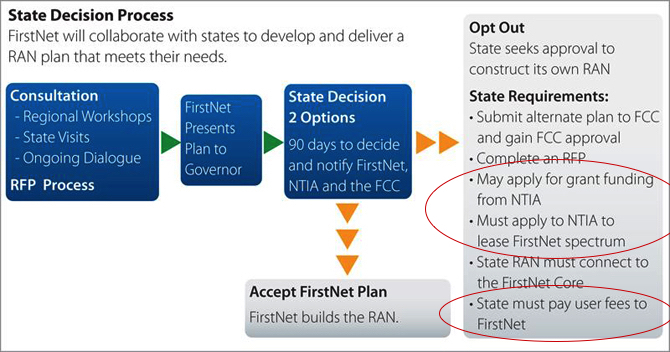
I know a few of you have seen this diagram floating around the circuit (see below). Have you noticed anything wrong with it? Have you noticed a shift in strategy?
 
If you analyze the two red circled areas, you will see what I’m talking about.
The first area is the application for a grant from the NTIA, not FirstNet. You also have an application to lease the spectrum – “FirstNet spectrum” – from the NTIA as well. FirstNet, or the First Responder Network Authority, is not the NTIA and they don’t own the spectrum. The FCC controls the spectrum and it is allocated to Public Safety. These are bogus requirements. FirstNet the organization, really has no say in what an Opt-Out State does. The only party that the Opt-Out State works with is the NTIA.
The second area is that the “State must pay user fees to FirstNet” – this also not true. If you are an “Opt-In” State, then yes you have to pay FirstNet a fee for the service they will run for you. But, if you are an Opt-Out State then all you have to do is apply for the $135 Million grant NTIA and the access to the spectrum from the FCC.  
In actuality, the law is broken into sections. Sections 6204-6212 only address the creation of FirstNet; what it is authorized to do; and what it can perform in the way of creating a national solution for Public Safety Broadband. These sections do not address the States that “Opt-Out” – it only addresses the “Opt-In” States. Section 6302 is the only section that specifically addresses the State “Opt-Out” scenario and does not address FirstNet, thus creating a separation of objectives.
The diagram above tries to illustrate that a State that Opts-Out has to pay a fee to FirstNet, which is not true. Only the Opt-In States pay a fee for the FirstNet service. An Opt-Out State does not pay for service from FirstNet because it is creating its own Public Private Partnership solution that establishes it owns service. The only fee that an Opt-Out State will be faced with, note that I did not say pay for, is the connection to the FirstNet Core Network. The reason I do not state “pay for” is because the shoe will be on the other foot. The State may charge FirstNet to get access to its network that it deployed using its own funding mechanism, thus the “FirstNet fee” may be moot by the charge for FirstNet to access the State network at the local level…or at least negated.
The State that Opt-Outs is in fact creating its own Broadband entity, much like FirstNet is doing on the national level. In essence, the two are competing with each other.  A bigger threat to FirstNet will be those States that choose to work in regions with combine connectivity agreements through adjoining States, this will definitely start to take away the majority share of the network from FirstNet – and quickly – especially as it relates to operating the Cores. If this is indeed the case, then FirstNet will be just left in an oversight mode and forced to manage the standardization and interoperability process — only.
In the end this diagram is wrong and should not be followed. The nationwide effort to build the Public Safety Broadband Network from the top-down will not work and will not meet the “self sustainment” and “self funding” goals required by the law. FirstNet needs to start working with the States to garner a stake in ownership of the State P3’s….good luck with that.
But who am I other than….

Just some guy and a blog….

FirstNet: Opt-Out –vs- Opt-In: oh the struggles we put upon ourselves. Who does FirstNet work for?

It’s now starting to become clear that the Opt-Out scenario is the best choice. A State that creates its own Public Private Partnership to DBOM (Design, Build, Operate and Maintain) its own Public Safety Broadband Network is starting to make sense to many within the industry. Forget about the lack of trust in FirstNet’s ability to build anything from the top-down; or the exorbitant costs associated with a managed service offering; the fact remains a State is better suited to contend with its own money and future goals within Public Safety.
A lot has been spoken about in regards to the “potential revenue” from the PSBN solution. Ask yourself this – why do you think the carriers want the spectrum so bad? It’s not because they just want more coverage, in fact, its all about the revenue potential of providing more services on their already established business. So why are we having all this talk about a State not being able to generate enough revenue to sustain itself? The law states that through a Public Private Partnership a State can collect revenue (ref HR3630 Sec 6302.2.g.1). I think the mix up here is the definition of a “true” Public Private Partnership or P3.
The P3 I am referring to is made up of Private Equity contributors who invest cash into a new broadband entity for the State. The State is a part owner based on what it brings to the table in the way of assets (land, right-of-ways and spectrum). Ownership in this P3 entity is broken up into shares distributed, based on percentage, on what each party brings to the table whether cash or assets. Ownership share is transferred to revenue percentage for the invested party. In short, what you contribute gives you a percentage of the profit. For the State shares, any revenue made for their ownership should be reinvested back into the Pubic Safety. I underlined “should” because the law actually states that the “First Responder Network Authority”, or FirstNet, has to “reinvest any commercial money back into the network — not the Opt-Out State.
SEC. 6212. PROHIBITION ON DIRECT OFFERING OF COMMERCIAL TELECOMMUNICATIONS SERVICE DIRECTLY TO CONSUMERS.
(a) In General.—The First Responder Network Authority shall not offer, provide, or market commercial telecommunications or information services directly to consumers.
In actuality, sections 6204 – 6212 pertains only to the “First Responder Network Authority” or FirstNet, and doesn’t pertain to the States at all. This means that the term “reinvested back into FirstNet” is not mentioned at all in the law and does not even talk about the States, in fact it specifically addresses FirstNet the organization. The law only mentions that a State can’t, on its own, offer commercial services, or have lease agreements, unless done through a P3 – it says nothing about “reinvesting” anything.
Sec. 6302 (g) PROHIBITION.—
(1) IN GENERAL.—A State that chooses to build its own radio access network shall not provide commercial service to consumers or offer wholesale leasing capacity of the network within the State except directly through public-private partnerships for construction, maintenance, operation, and improvement of the network within the State.
Another thing I want to address is the potential revenue. It’s been stated that FirstNet is not obligated to demonstrate the networks potential in revenue creation with the State. The real statement should read, “FirstNet has no capability to demonstrate the revenue capability of the network”. Why? Mainly because FirstNet is still struggling with its own directional control. If FirstNet were acting like a private entity, then addressing all facets of revenue potential would be the driving goal of the entire organization — but its not. FirstNet, “an Independent Authority within the Federal Government (DOC)”, can’t focus on revenue as driver and is in fact acting in the capacity of non-profit Federal entity, thus the reason they can’t collect revenue. The 10th Amendment of the Constitution shields them from intruding on the State’s right to govern its own implementation of the PSBN, thus the split in the law between what FirstNet can do and what the State can do.In the end the term “reinvested back into the network” directly pertains to the First Responder Network Authority – not the State.
But, what does the revenue opportunity look like for an Opt-Out State? The answer to this is actually really simple but hard to describe, unless you have been in the telecom industry for many years and have taken part in running an operators network. As part of the P3 model that a State should consider is the partnering between the DBOM contractor, or EPC, the Private Equity Consortium, the OEM vendor(s), and an Operator. Why an Operator (carrier)? Well, because they bring the operational experience needed to run and maintain the network for the long-term. The EPC brings the design-build aspect and the carrier operator brings the operational and maintenance aspects. With the Operator also comes their ability to commence, or transition, product controls, marketing, product management and development into the equation.
In order to understand your revenue, you need to understand your user-base, demand and market capabilities – something a carrier does daily. An operating partner brings an established creative approach to product portfolios as well as known customer base. Expanding on the Operators product portfolio and its customers base — through the new P3 entity – we can layer more customers from the Federal, State and Public Safety market place, i.e. State and Federal agencies, commercial customer base, with an expanded product portfolio. Products cost money and users pay for their use. Services range from $15 bucks a month to thousands. Services are paid for hourly, daily, weekly, monthly, quarterly and annually based on the user’s needs and the service type. The more expanded product portfolio and user base (customers) the more revenue. In short, whatever your local, regional or national carrier partner collects in revenue currently in the geographic location can be multiplied with the expansion into new solid, long-term, contracts with Federal, State and local entities. Using these contracts and overlapping the user needs onto the entire network will afford ample room for “self sustainment” and profitability.  For example: some customers that need statewide coverage; some will need local coverage; and some will just need intermittent monthly service plans, all of which bring in profit.
To give you an example: if you have an Electric Cooperative that manages 83,000 electric customers and the Electric Cooperative wants to setup broadband service targeting 30% penetration (24,900) and utilizing a $50 a month contract fee; through an MVNO on the P3 network, the Electric Coop could recognize more than $1,245,000 in additional monthly revenue. Subtract a monthly MVNO fee, or script out a revenue sharing deal between the P3 entity and the Electric Cooperative, the Coop and the P3 will both create a new revenue streams – multiply this by all the organizations in the State and you can get the idea. What does an Electric Cooperative actually think it will be able to target in its penetration success?
A States ability to collect revenue and the amount of revenue it should expect is only bound by its own creative approach – the Public Private Partnership approach I have been talking about for the last 4 years is where this needs to go.
But whom am I other than…..

Just some guy and a blog……

FirstNet — FirstNet tangles with the Department of Commerce over Public Safety Broadband?

Just sat through the webinar for the Pre-Proposal Conference hosted by FirstNet. Did you ever see a kid that was about to make a huge mistake? Any parent will tell you that you are faced with the dilemma of whether or not to let him fail so he can learn; or grab him before he falls so you can guide him down the right course.
No one really wants to submit, or spend the time to submit, without understanding the ownership hierarchy. Will the primary direction come from the federal government and the acquisition role? Or will a newly created entity report to a private entity and its shareholders? How will I get my return on investment and who is in control of that process of the returns?
I really like what the CEO Mike Poth is asking for when it comes to the vision statement for FirstNet, unfortunately, I think he is on another planet of higher thinking when it comes to what is actually being executed. First we hear the glorious speech where Mr Poth talks about FirstNet wanting a public private partnership that meets all the demands and lets free the use of the spectrum for the private market place. Ten minutes later you hear Ms Calahan tell us its a Federal Acquisition process and you will be struck by lightning if you step out of bounds of the procurement process. Seems as though there is still a struggle between delivering FirstNet as a private entity versus a federal agency. Until this gets answered the risk factor is out of this world, especially for a private investor. 
Searching the background of Ms Calahan you can easily discern that she reports to the Department of Commerce and Mr Poth reports to an “independent governing agency” — FirstNet. How do you let the creative solutions flow, especially for a P3, when you don’t know where, or who, you should be taking direction from? Why would a private entity want to sign-up to, and fund, a “independent governing agency” if it still reports to the Federal Government? That private entity will tell you to make the taxpayers fund it. I spent 10-years in Military Intelligence and everyone knew MI was real-time oxymoron – but this one takes the cake.
The vision I have is the Federal Government dressing up in sheep’s clothing and inviting the sheep into to eat using sweet talk about a Public Private Partnership. Until the real beast rears its head, all FirstNet will get is a typical IDIQ contract under FAR requirements, which means all its plan for a real “public private partnership” will go down the drain. I would be surprised if FirstNet will even get a Joint Venture out of this. Unfortunately, they are too far down the road to alter course now…and that course is going to be a disaster for the Federal Government… again. Unless, FirstNet grows a pair and takes charge of its own future. We can’t have a federal organization like the Department of Commerce overriding the original plan for FirstNet to be a “separate and distinct governing agency”. If FirstNet wants to see any hint of success, it has to establish itself as a private entity and partner with private investment to make the Public Safety Broadband a reality.
The current path for Poth will be a tough one.  🙂  But, we have an election cycle coming up and there is a lot of talk about downsizing the federal government. What better the opportunity than an organization like FirstNet, who hasn’t gotten off the ground yet, to declare itself a private entity with Public Safety being one of its primary stakeholders. Forget about the federal government side, FirstNet should solicit a commercial P3 RFP, much like Mexico just did, to solicit private equity ownership in creating a private entity to monetize the 20Mhz of spectrum. Heck even the New Hampshire “Opt Out” P3 RFP is better than what this is turning out to be. The FAR process, and the oversight of the government, is going to ruin this whole deal. Mark my words, if this proceeds in this manner it will be a disaster. Then again, if I were someone that didn’t want this whole thing to succeed, this would be the perfect way to do it. What better way than to introduce complexities of the federal procurement process onto an “independent governing body” to further cloud their approach to success. I think the term is “divide and conquer”, but who am I to know. I’m sorry, but the DOC is the exact opposite of what FirstNet needs.
How do we know there is strife between the ranks of FirstNet and the DOC? Ms Calahan said it best, “they (FirstNet Leadership) keep saying the word “partner”, but I see everyone as a contractor”. Meaning, Ms Calahan represents the Federal Procurement Process and ultimately she is the one in control and reports to the Department of Commerce…not FirstNet. Why all the confusion? If FirstNet wants a federal solution, then just put out a typical IDIQ framework to the market place. Or put out an RFP asking for a Joint Venture. Any reason why they can’t? Well, because the law states the need to be “self sustaining” and “self funded”; a law that a federal agency like DOC has never operated under before yet must follow. I believe the leadership of FirstNet understands this and really wants to go the private route, but they are constantly asking the federal government for help – they are looking in the wrong place for help.  Why else would we even be talking about an IDIQ if it weren’t the chosen model of the federal government – they do everything as an IDIQ. Do what the law describes and act like a “separate governing entity” – in essence be that private entrepreneur and start searching for your investors to pay for your proposed solution – like any private company has to do.  The law already stated that the federal government was not going to give you any cash, so go look elsewhere for the cash you need – private industry!
FirstNet really needs to read the Mexico RFP (or the New Hampshire RFP). The Mexico RFP is being processed exactly how FirstNet needs to act. If FirstNet needs cash to DBOM their solution, then put the RFP out to the right market – the Private Equity market. Why must we shotgun blast an RFP to the open market that only creates more questions than answers. Your market is your funding partners, not technology, not the government, and not an industry specific vertical. I say again…”your market is the Private Equity market!” The context of the the FirstNet RFP being a “objectives based RFP” is the right course – now you just need to sell it to the right people.
PS… it will also help if you know what your talking about when it comes to “Public Private Partnerships” – who do you think is best positioned to know all about P3s — other than myself? Have you looked at the major EPCs yet? They do a lot of P3s in the vertical industries of transportation, infrastructure and power markets; they also do a lot of work with major Private Equity partners. Did you know that most States are already adopting the P3 framework as part of the State legislation? That’s a hint.
But whom am I other than…..

Just some guy and a blog….

FirstNet to Join the Bandwagon of the States and "Opt-In" to State generated "Opt-Outs"!

Can I say I told you so! My idea in that the only way to truly meet the demands of the law, in it’s entirety, and to fully “self-fund” and “self-sustain” the complete solution for Public Safety Broadband is finally being recognized. There isn’t a clearer way to put it than to layout exactly what the law says – there is no false interpretation to be had. If you disagree and state that “others interpret the law differently” then you are purposefully trying to curtail the actual goal with your own modified goal, especially when the law is so clear and precise.  This is not a case of who has the better idea, it’s a case of which idea is the right one.

Let’s really look at the law as it was written:  🙂

Step 1: The Law is called – “HR 3630 – Middle Class Tax Relief and Jobs Creation Act of 2012


Step 2: You go into the Law and look for “Subtitle B—Governance of Public Safety Spectrum” (just do a Ctrl-F and put in a piece of the title it will take you right there)


Step 3: Under this section you look for a section entitled “SEC. 6302. STATE AND LOCAL IMPLEMENTATION”

Step 4: You then go down and look for section “(g) PROHIBITION —“


Step 5: Under section (g) you will see — right in front of you – the following, “(1) IN GENERAL — A State that chooses to build its own radio access network (in other words OPT-OUT) shall not provide commercial service to consumers or offer wholesale leasing capacity of the network within the State EXCEPT DIRECTLY THROUGH PUBLIC-PRIVATE PARTNERSHIPS (key word here is EXCEPT) for construction, maintenance, operation, and improvement of the network within the State.”
Step 6: You then specifically read, over and over again, the statement described in the Law that says EXCEPT DIRECTLY THROUGH PUBLIC-PRIVATE PARTNERSHIPS” …EXCEPTDIRECTLY THROUGH PUBLIC-PRIVATE PARTNERSHIPS” …EXCEPT DIRECTLY THROUGH PUBLIC-PRIVATE PARTNERSHIPS”.Eventually you will start to understand what the Law is saying and how it should be interpreted. Simply put, an Opt-Out State can collect revenue through a “Public Private Partnership”. There is no other interpretation to be had.  I mean you can look up the term yourself, you will find that the word “EXCEPT” is a counter argument, or solution, to the statement of “shall not”, but I digress.
From this point forward you need to do what New Hampshire just did, request your own proposal for a Public Private Partnership that you, as an “opt-out” State, will utilize to mandate a solution that will “self-fund” and “self-sustain” your statewide broadband network; then let the private sector takeover and come up with some ingenious and creative ideas for you. It really is that simple.
Now don’t go off feeling sorry for FirstNet just because the idea they proposed from the start was never going to work. The fact is, FirstNet has everything to gain from this; they can keep the $6.75 Billion for themselves to augment their own needs for a national CORE solution; at the same time develop their own centralized operations and long-term data storage necessities. On top of that, FirstNet can just layout its “own” ownership stake in each of the State “opt-out” efforts thus creating their own “self-sustaining” solution long-term. Ahh…the beauty of the Public Private Partnership model.
What New Hampshire is doing will be the catalyst for the rest of the nationwide build-outs. For someone to believe that too many States coming out at once asking for their own RFP seeking a similar P3 like New Hampshire is a bad idea; I would counter that assumption with the notion that such a dilemma will be a GREAT problem to have — much better than what we have today. Have faith in the American People and the industry. I can guarantee you that the industry will morph to meet the needs of such an expanding market place – like a sun dried sponge being dunked into a pale of ice cold water on a hot summer day in Texas.  Such action in the market place will benefit everyone, to include the overall economy, by providing the “middle class with tax-relief” through private investments thus funding “job creation” through the “Action” of economic development for the foreseeable future – thus the “Middle Class Tax Relief and Jobs Creation Act of 2012”.
But who am I other than….
Just some guy and a blog….

FirstNet and the looming battle of a States Rights under the 10th Amendment to "Opt Out"?

I recently read the article about the New Hampshire RFP asking for a P3 entitled “New Hampshire gets five RFP bids for a public-safety LTE system, but no opt-out decision has been made.” (Feb 22, 2016, Donny Jackson | Urgent Communications)
The article got me thinking about a State’s Opt Out decision. Does a State have to wait for the FirstNet solution? The answer is no. In fact, the law only talks about the process that FirstNet has to take and how a State may review the FirstNet plan and then decide on FirstNet’s proposal. Nowhere does it say anything about a States requirement to actually wait for, or even listen to, the FirstNet plan.

Here is what the law states:

HR 3630
(e) STATE NETWORK.—
(1) NOTICE.—Upon the completion of the request for proposal process conducted by the First Responder Network Authority for the construction, operation, maintenance, and improvement of the nationwide public safety broadband network, the First Responder Network Authority shall provide to the Governor of each State, or his designee—
(A) notice of the completion of the request for proposal process;
(B) details of the proposed plan for build out of the nationwide, interoperable broadband network in such State; and
(C) the funding level for the State as determined by the NTIA.
(2) STATE DECISION — Not later than 90 days after the date on which the Governor of a State receives notice under paragraph (1), the Governor shall choose whether to—
(A) participate in the deployment of the nationwide, interoperable broadband network as proposed by the First Responder Network Authority; or
(B) conduct its own deployment of a radio access network in such State.

The law does not say anything about the State requirement to wait for the FirstNet plan, which by all accounts will be a nightmare anyway. If you look at subsection (2) above, you will note that it only addresses how the State should respond to the FirstNet plan; nowhere does it say that the State has to wait. What will you have to wait for, what process is defined, and who is to say which States will be build out first? Who says a State must wait? I can guarantee you that if New Hampshire hadn’t stood up to solicit an RFP asking for a P3 to facilitate the Opt-Out decision, they would not have even been on the radar of FirstNet as one of the initial rollout States. Kudos to the State of New Hampshire — they are now on the radar.
How do we define the “absence of law”? Just trying to define the role will confront the States against the Federal Government and the 10th Amendment of the Constitution. “the federal government possesses only those powers delegated to it by the United States Constitution. All remaining powers are reserved for the states or the people”. Okay, who really wants to go there at this moment? I would prefer we just stay out of that fight and ease off the States ability to do what they want. To much politics now days anyway.
Regardless, the State does have a defined process to fulfill the requirements of an “Opt Put” which are defined below:

(3) PROCESS —
(A) IN GENERAL — Upon making a decision to opt-out under paragraph (2)(B), the Governor shall notify the First Responder Network Authority, the NTIA, and the Commission of such decision.
(B) STATE REQUEST FOR PROPOSALS — Not later than 180 days after the date on which a Governor provides notice under subparagraph (A), the Governor shall develop and complete requests for proposals for the construction, maintenance, and operation of the radio access network within the State.
(C) SUBMISSION AND APPROVAL OF ALTERNATIVE PLAN — (i) IN GENERAL — The State shall submit an alternative plan for the construction, maintenance, operation, and improvements of the radio access network within the State to the Commission, and such plan shall demonstrate —
(I) that the State will be in compliance with the minimum technical interoperability requirements developed under section 6203; and
(II) interoperability with the nationwide public safety broadband network.
(ii) COMMISSION APPROVAL OR DISAPPROVAL —Upon
submission of a State plan under clause (i), the Commission (defined as the FCC) shall either approve or disapprove the plan.
(iii) APPROVAL —If the Commission approves a plan under this subparagraph, the State—
(I) may apply to the NTIA for a grant to construct the radio access network within the State that includes the showing described in subparagraph (D); and
(II) shall apply to the NTIA to lease spectrum capacity from the First Responder Network Authority.
(iv) DISAPPROVAL —If the Commission disapproves a plan under this subparagraph, the construction, maintenance, operation, and improvements of the net- work within the State shall proceed in accordance with the plan proposed by the First Responder Network Authority.
(D) FUNDING REQUIREMENTS —In order to obtain grant funds and spectrum capacity leasing rights under subparagraph (C)(iii), a State shall demonstrate—
(i) that the State has—
(I) the technical capabilities to operate, and the funding to support, the State radio access network;
(II) has the ability to maintain ongoing inter- operability with the nationwide public safety broadband network; and
(III) the ability to complete the project within specified comparable timelines specific to the State; (ii) the cost-effectiveness of the State plan submitted under subparagraph (C)(i); and
(iii) comparable security, coverage, and quality of service to that of the nationwide public safety broadband network.

Once again you can easily see that there is no real connection between the FirstNet required process under the law and the State’s requirements to meet the FCCs requirements for technical and self-funding adherence with the law. In essence, the State can put forth its own plan without even considering the FirstNet solution as long as it meets the demands as laid out for approved vendors and technical capability; interoperable, the ability to be self sustaining and equal to, or better than, broadband coverage.
In the end, the law sets the framework for the commissioning of the Public Safety Broadband Network, but it does not specifically step on the toes of the States in its ability to control its own plan to build, operate and prosper from its own deployment strategy. I would imagine that there will be those who believe that the State must wait, but is this a fight you really want to take on – especially now? We all want to build the PSBN to support our First Responders, lets not get in the way of that progress. If a State wants to do its own thing, and has its own plan, then let them.

Just some guy and a blog….

FirstNet won’t get the players it needs! They still don’t understand the issue

There’s been a lot of activity recently pertaining to the Public Safety Broadband Network. I still can’t get over how naïve some can be in believing that the carriers are the answer to FirstNet. The carriers have a viable solution – for a commercial revenue driven business model – not FirstNet. Have you ever had a crush on a person only to be drastically disappointed after the first date?
With the recent RFP from Mexico, requesting a Public Private Partnership to build its own Public Safety Broadband Network, is a perfect opportunity for FirstNet to see what a real solution may be for its own bid. The size and complexity of the FirstNet solution is way too big for just one little partnership. The FirstNet solution will require a large consortium of private investment to drive the ownership model of FirstNet; the same context to which Mexico is asking for. The fact is the solution for FirstNet does not lay at the feet of the carriers, they are too small, and it clearly does not lay at the feet of just a contractor, the solution will be an ownership structure manifested with a consortium of private investors. It’s not about the technology, or the rollout, its all about the money and the ability to make money – pure and simple.
FirstNet won’t find what its looking for in their RFP. A State can act more expeditiously than a large contracting element run by the Federal Government. If FirstNet finally gets on the bandwagon, and starts to focus on a private equity or concessionaire model, then they will understand that they need to align themselves based on ownership, private funding, and return on investment – not the physical build. The State will have to build its own network anyway even if FirstNet were to be deployed on its own model. The State has all the local resources to construct. By FirstNet refocusing itself on the P3 (Public Private Partnership) ownership the funding and revenue will be come front and center. By making the ownership model front and center then we can augment any FirstNet effort with a financial connection to the State and meet the “self sustaining” mandate in the law. There is no other model that will enable the FirstNet solution to be “self funded” and “self sustaining”.
Focusing on a P3 is not enough, you have to really understand where you stand, where your partners stand, who is delivering what, and what the return will be. A good example would be the Kentucky Broadband project. Here we had the State, under Governor Beshear, solicit a P3 to build its core fiber optic network throughout the State. Unfortunately, the State did not adhere to models correct framework and solicited taxpayer bonds to fund a portion of the P3. In my model the State wouldn’t pay anything. This fiber optic network is in fact the underlining architecture for the Public Safety wireless program. Without the fiber solution the PSBN won’t work. Unfortunately, Macquarie did not fully understand the P3 model that they stole acquired for its deployment. In a State P3 model, specifically for the PSBN solution (which includes the fiber portion), the model I put forth does not require any taxpayer money. In fact, by introducing bonds to help pay for a solution within a State only injects the political process into the deal, something you would think Macquarie would have learned from the State of Utah — another failed model. As you can read for yourself the Kentucky led P3 with Macquarie is now faltering under its own greed. Thank goodness that Kentucky has a new Governor, Governor Bevin, who understands what is happening and is trying to repair the damage already done. The fact is, the P3 for Kentucky was awarded and led under nefarious reasons, thus the reason the solution is failing, much like I warned about sometime ago.
In the end you have to construct the model and balance the needs of the entire partnership; and you must avoid taxpayer funding when it presents itself. Anything the Federal or State Government touches comes with the political engine, so be warned. FirstNet, and the State of Kentucky, can both learn from the RFP in Mexico. It is this lack of understanding, and the political tie-in, as the reason FirstNet will get less than what they were expecting in response to their RFP as written. We can’t sit back anymore and just convince ourselves that the current RFP is just a fact finding mission… again, we need to adopt the same model Mexico is pursuing and stop playing around with all the meetings and data collection.
Just some guy and a blog…..

FirstNet! Look out Mexico is eating your lunch in deploying Public Safety Broadband.

Just when you thought it couldn’t get any worse for FirstNet. FirstNet needs to review the RFP just put out by Mexico. That RFP is exactly what FirstNet needs to do. The RFP for Mexico will be – and mark my words…again – a huge success. Unless the teams trying to bid for it don’t understand how to align with the Public Private Partnership they have requested. Given the size of the network, and the enormous 90 Mhz of pristine spectrum, the Mexican solution will really be a nice solid infrastructure for the future of telecommunications in that country. Hats off to Mexico!
My rough estimate would put that network at a capex program of more than $4.5 Billion and the opex bill at $4.5-$10 Billion annually. Profits will be in the mid 20-30 Billion annually….easily. With 90 Mhz of spectrum they will be able to fit the entire nation on one network, heck they could even build into the United States and out perform FirstNet… don’t count this out but that may just be a requirement in the future. There will be some very happy investors in that deal. This network will be able to do so many things all interoperating together into a solid infrastructure of wireless and wireline access scenarios. Everyone will be able to interface with this solution and prioritized for whatever business there are in.
FirstNet, let go of the past and embrace the future through your own Public Private Partnership. If you don’t know what that really means, then step aside and bring in the real experts. The fate of the national network, and your jobs, is on the line for this one. Then again, as I have said in the past, a State doesn’t need FirstNet to build its own profitable broadband solution for Public Safety – FirstNet needs the States.
But who am I other than…

Just some guy and a blog….

FirstNet — RFP falls far short of intention. Why did it take so long to put out an "objectives based" RFP?

There are some key questions that need to be asked of FirstNet; of which I’m putting the questions together in their advertised template and sending them to the Authority. Can anyone tell me why it took 4 years to put out an “objectives based RFP”? Why all the legal jargon and position in the RFP as well? If its objectives based then how would anyone think they know what will be in any contract, especially when it hasn’t been defined yet? This whole RFP could have been half the amount of fluff. But then again we have a lot of people that need to stay employed and do the busy work. The fact is the terms and conditions that are constructed following the awarded proposal is the only thing that will really count. Putting together objectives can be outlined and fought over in about three months even with such a large program. In actuality, the simpler the objectives the easier it will be to communicate to everyone what you need. Why four years?  
I congratulate FirstNet on realizing that they can’t do this without the use of a Public Private Partnership (P3). I mean it was only written in the law. I took on great personal pain to get the idea of a P3 incorporated into the overall strategy. You wouldn’t believe all the naysayers out there that said the Federal Government would never do a Public Private Partnership. I have to thank them though, because to me naysayers are the propellant to my fire. There was a great deal of lobbying by many people and organizations trying to influence their own plans onto FirstNet, but reality and commonsense will seep in after awhile, especially with so much chaos going on. It’s a wonder FirstNet was able to get this far with all that attention. There will be issues though.
The RFP, as written, essentially only generates more questions. The lack of knowledge of how to construct the P3, or what it should look like, specifically for telecom, or what type of financial arrangement is required, will become a big issue. The over abundance of information and unclear objectives will only confuse eventual respondents who will ultimately see the complexity and just resort to “just put in a proposal and work on the terms and conditions later” mentality – which always seems to work out…right? Alternatively, as written, the RFP will only attract some very complex business models that will be all over the map further camouflaging the right solution.
Little side note: It’s not like I didn’t offer my assistance, but as I said a long time ago, you can lead a horse to water, but you can’t make them drink.
You can have all the Harvard Grads in the world tell you what a P3 is and how it needs to be designed; but if you don’t understand how telecoms works; or how the market plays out; our how the networks are designed and built; or how the relationships are established; I’m afraid it will be a big waste of time. But we have what we have, so lets go along with it.
First, let me put this into perspective: FirstNet’s RFP is for an overarching solution to build, operate and maintain the national CORE solution for the LTE fabric – not the State’s build-out.  This RFP will come from the top-down and will become overly complex interconnecting and integrating multiple state solutions. Be warned! For those States that decide to Opt-In this RFP would allow their partner (awardee) to build-out the RAN in those States. Some RAN may exist through carrier towers, some existing tower owners, but most will have to be greenfield towers – due to the requirement to cover the rural areas — where the carriers do not currently have any towers – plus the hardening demands.
Hardening will be a very big issue. Current towers are not designed for the hardening that will be required, so cost analysis justifications will go through the roof adding time, people and cost.
Just remember if you let them come in and build it, then you have to accept whatever terms of the deal they make; meaning you will have no say and you will have no access to potential revenue within the State or how the network will be built – even after they placate you with all the kumbaya. The only thing you will actually get is a new monthly type of service of broadband access, much like you already have, but in this case it will be from a modified existing provider, not your typical AT&T or Verizon. The resulting solution will fall short leaving you with required taxpayer funding — not including any federal taxpayer support required.
For those States that Opt-Out you will have full access to create your own P3, which has many benefits most specifically the ability for the State to build, operate, and maintain a fully paid solution with private equity that will create a broadband company within the State. In short, you will become a part owner of this new broadband company, thus will be the recipient of revenue, although your share of the revenue has to be re-invested back into the Public Safety Broadband Network to cover public safety needs (to be defined by the Governor). The remaining owners get to NET the remaining revenue for themselves.
The amazing thing is that you actually don’t have to bring any cash whatsoever to the deal, because you will bring the assets – access to existing facilities, land, right of way and most importantly…spectrum. Essentially this brings equilibrium to the P3 deal.
The best thing about this deal is that you will have full control and access for prioritized public safety broadband to First Responders – at the local level – and you will be fully compliant (actually better aligned) with the FirstNet’s Public Private Partnership and their approved technical platforms if they get their solution together. It still needs to be decided if, and/or, how FirstNet will participate. My recommendation is that FirstNet gets a small percentage of ownership of each State based P3 to produce revenue in support of the national footprint, thus outfitting those State’s that decide not to build it themselves and providing the national solution with “self-sustainment”. This is what I would call welfare for Public Safety Broadband.
After reviewing the entire Request For Proposal (RFP) I think the most important shortcoming for FirstNet will be its lack of understanding of the Partnership and how it needs to utilize with the Private side of the P3. For example: a P3 equates ownership with investment and/or resources. In this case FirstNet doesn’t bring anything to the table as it relates to assets. The only power it has on the deal is what is granted to them by the Opt-In States. Being that there will be a lot of States that Opt-Out FirstNet’s national solution will have a hard climb to success. Almost all, if not all, the assets will come from the State. FirstNet is offering up $6.75 Billion of taxpayer money into the partnership — although very attractive falls drastically short of the 100 Billion it will really cost — it kind of goes against the original intent of “The Middle Class TAX RELIEF and Jobs Creation Act of 2012”, but who cares…right? If the investment made by FirstNet is less than 7% ownership stake that would mean they will fall drastically short of any type of majority ownership, thus forcing FirstNet into a government-funded solution in the end. If that’s the case why not just let Home Land Defense operate the national platform — why a private partnership? If FirstNet can’t establish enough revenue to attract private investors all of this will be moot anyway. 
Another issue is that FirstNet believes it owns the D-Block spectrum, which is specifically stated in the law that it belongs to the Public Safety industry, which ultimately means the State.  FirstNet was created to act as the liaison between all the States under the direction of Public Safety to establish the Public Safety Broadband Network. FirstNet was never given the spectrum for their own use. How will this be addressed in any P3 model put forth by FirstNet? After all operating any wireless ether will physically reside locally. I’ve never seen, in my more than 25 years in the industry, any wireless platform specifically owned by the Federal Government except the military — which definitely has their own spectrum.
Another thing to mention is that the “Partner” will actually be a consortium of private investment companies. A large carrier may be part of that investment team, but I can guarantee you they won’t take on all the risk and devote so much cash on their own. With that said, you need to keep in mind that a “Private Investment PARTNER” is only in the deal to bring the cash with an expected return and exit strategy. The “Partner” will therefore want a lot of protection against its investment – to include control over his/her money. FirstNet and the consortium of Private Investors have to outline – contractually – who gets what when it comes to amount of ownership shares; return on revenue; and ultimately who the majority shareholder is. The majority shareholder will be the one in charge, which will not be the United States Government, else why fashion FirstNet as a “privatized” solution to build the network? Just have DHS run the national CORE solution and let the States run their own P3s. For any majority shareholder without the control of its majority share, whomever that may be, will not just sanely give their money over for the cause – that I can guarantee you. Would you?
Majority shareholders tend to be very shortsighted and will hound you for a quick return. I’ve witness some pretty insightful board meetings where the majority shareholders were presented numbers and I can tell you that most were not just complacent mom and pop investors and those meetings tended to be very….colorful. There are a few that don’t mind sticking with the opportunity for sometime, but all will be laser focused on their share of the investment. FirstNet needs to decide how it is going to handle this — they haven’t even started — and it definitely is not addressed in the RFP. If this does not get ironed out now, then the FirstNet initiative will be a disaster before it even gets off the ground. Or was it proof that it has been a disaster before it even got off the ground?
The best part about this whole thing is that an Opt-Out State need not be concerned about the FirstNet plan, because a State can design, build, operate and maintain its own P3 created private entity to run its Public Safety Broadband Network without FirstNet’s involvement. It would be nice for FirstNet to provide some interconnect, interoperable and hardened standards to build against, but in reality this isn’t a red flag for a State’s effort. It’s not rocket science to get the standards established themselves, especially given that we only have two, or three, equipment providers who have all worked together in the past. Plus, I would think a State would feel better about putting its own standards together anyway. The technical solution is not the issue, as I have said from the beginning, the issue will be the partnering arrangement, but who am I other than…

Just some guy and a blog…