Managed Services and the Public Safety Broadband Network

One topic that will be of concern when it comes to the Nations Public Safety Broadband Network will be the long-term operations and maintenance aspects. Who will run the State’s PSBN for the long-term? Who will run the internal State agencies and State entities that will access the States PSBN network? Would it be the carriers? Or the OEMs? Or would it be a State P3?
There are a lot of things that come to mind when thinking about this topic like…will it look like a private-sensitive-classified network, or will it be a private ensemble of statewide networks more relying on the “plumbing factor” and leaving the intelligent classified portions to the entities that ride the piping infrastructure?  If it were just a handful of entities then I would go with the highly classified, but given the necessity of multiple statewide entities requiring the access, I would say its better fashioned to a more open architecture with reliance of protection falling on the entities themselves. With that said one has to ask, “then who will run these networks?” After all it’s a lot more than just deploying layers 1-4 in the State PSBN …most of the hard work will actually be with the application layers 5-7 (reference OSI Stack).
The obvious answer lays in the hardening aspects and control of the entities own proportional network concerns. In essence, it is the entities that ride the network that will depict its hardening features. The beauty of it is they don’t have to rely on pacifying a subscriber business model of a typical carrier. Another area of concern is the actual management of the platform in general. In the context there is a lesson to be learned from the carriers.
The carriers, for the last 3-4 years, have been outsourcing the operational control and maintenance of their own networks to a host of third party vendors. This outsourcing is termed “Managed Services”. The term was coined by the Original Equipment Manufacturers (OEMs) as a way to isolate the actual design and operational services that is required to run their own equipment. The difficulty comes when they integrate the complex relationships of high-level applications across multiple platforms. This is something the OEMs do not do…or at least not very well. But the OEMs managed to convince some of the national carriers that it was in their best interest for them to manage their own product versus someone else.
Why would the carrier do such a thing? There are a host of reasons, but it’s all about consolidation, market potential, cost and the impacts on the ARPU (Average Rate Per User)… as well as the comfort of long-standing relationships. The carriers see more money in the content of the services they provide than the actual commoditized Internet access model. The overhead of their multiple physical infrastructures is loading their capability to affectively keep up with the decline in their ARPUs, which is forcing the carriers to look for ways to off-load their infrastructure to sustain or increase profit margins. The carriers were faced with a dilemma, so they turned to their long-standing OEM relationships to try and fix the issue.  The OEMs and the carriers came up with a plan to relinquish the risk of running the infrastructure by letting the OEMs managed their own gear. The issue with that is that the overheads for an OEM are more than twice the industry average for service providers, so the figures became a wash…and remain a wash today. In fact some of the largest Managed Services contracts out they are actually losing money. But that’s another topic. The big integrators, i.e. IBM, HP and the likes, stepped in, but their overheads exploded even beyond the OEMs, so the issue still exist today. My opinion the only real answer is to sell or dismantle some of that infrastructure. Good luck in finding a buyer for an old 2G or 3G platform when 4G is now the game.  
So why would managed services work for the PSBN?
The PSBN, more specifically the State run P3 entity, is not an OEM. It is in fact a true service provider for the PSBN. It’s overhead will be managed through a cost + Plus model using man-hours and materials. There are no margins to sustain for product development, research, or marketing and sales.  The State P3 only exist for the deployment, operations and management of the State Public Safety Broadband platform. There are no competing business models except for the resources that have “Public Safety Service” responsibilities within the State…and that competition is only limited to prioritization within the LTE solution itself…which is actually not an issue at all. In essence, the State P3 contractor/awardee will be the Build, Operate and Own model of execution whose primary business model is to run the State PSBN for the long-term.
The attraction of the State P3 Managed Service contract will be the terms of service that are established with the State internal agencies and entities. As an example: a State Transportation Department covering the Highways may sign-up for 20 years terms of service for LTE service from the State P3 PSBN; where as a Power Utility may sign up for 30 years terms of service for its LTE Service. These are definitely terms of service that any managed service provider would love to win. On top of the terms of service mandates there will also be mandates for maintenance activities on hardened tower locations or communication nodes throughout the entire State.
What about the data and control center elements? What about Cyber Security controls? There will be a hoist of “other” managed service plays as well. Someone will have to run the various State agency and entities own data and communication solutions. Why wouldn’t there be an opportunity for a Managed Service contract with the Department of Homeland Security, or the Department of Transportation, within the State? There are a host of opportunities that lie within the State’s PSBN effort…all of which are great for the State, great for the economy and great for the Nations employment numbers. 
The necessities to run the physical infrastructure are evident, but what’s more impressive is the opportunity to manage the applications horizontally between the agencies, of which all communicate through the State PSBN. The developments within the application space start to present themselves, structurally, through the process and data control elements that are essential to the hardening/protected applications themselves. There will be a whole ecosystem of data centralization, manipulation and storage requirements that will integrate across multiple functioning enterprise solutions. Developing “Apps” is only a small piece of the much larger picture.
Just some guy and a blog…
Response to the NTIA (FirstNet) Request For Information (RFI) due November 1st

First, I really want to express my gratitude for what this board is undertaking. I know it will be a long journey and I look forward to its future.

In reviewing the presentation for the FirstNet Broadband Public Safety Network I noticed a few things.

  • The proposal was a good presentation outlining the overall goal of FirstNet and then gave a rendition of a model to move forward with.
  • The solution presented a “subscriber based model” which I expected
    • In doing so it required a multi-State, Multi-Regional approach in order to make it work.
    • It brought up the context of Public-Private Partnerships but from I could gather it was not a true P3 concept; it stressed more the relationship of products being introduced into the network.
  • It was clear that a true “Needs Analysis” has not being conducted and was only limited to Public Safety entities; not Public Safety Service entities…there’s a big difference.
  • The presentation outlined a multi-tiered multi-operator framework, which may not be realistic. If we try to focus on too many variables that can contribute to the network we will spin our wheels on trying to execute. We need to focus initially on the FirstNet Private Network first.
  • It also stressed a multi-layer of networks on top of the Band 14 network of FirstNet for resiliency.
To review my NTIA submission follow this link:  Dr. Michael Myers
My primary sticking point on this presentation was the belief that a “Subscriber model” is what FirstNet should concentrate on. This is a good business case for a commercial carrier, but not a private network for the PSBN, especially a private network with multiple layers of commercial networks as backup. If the course is set to go this route the deployment will lack the required funding to make it happen. There simply won’t be enough “subscribers” to make it work. Case in point is the carriers themselves. Why is that they are moving away from the “subscriber model” if their own ARPU’s (Average rate Per User) are declining? It costs more to try maintain the network and to upgrade to new platforms than the ARPUs bring in return. Why would we push this model onto the PSBN?
I am presenting an alternative Public Private Partnership model that not only brings in enough recurring revenue to fund the deployment of the entire PSBN, plus its additional O&M (Operations and Maintenance) cost, but it also avoids taxpayer money. And I don’t need multi-State and multi-Regional input…all it needs is one State and its core Public Safety Service entities.
The reason the “subscriber model” presented requires Multi-State and Multi-Regional coordination is to boost the number of actual subscriber units. My only question is who will benefit from the subscriber costs? FirstNet, the Vendors, or the carriers? Through my model it won’t require a multi-State or multi-Regional aspect to make it work. And the revenue goes to the State and FirstNet –as well as its Public Private Partnership. The handsets become a capital cost measure that is allocated under the overall business case expenditures, thus a Chief of Police doesn’t have to worry about the cost of handsets and the recurring monthly charge for access. Those cost items are inherent to the overall architecture.
Overall the model I am presenting has already been validated with a working business case and thus should be considered for the Band 14 PSBN network business case.
As it relates to the technical solutions of multi-layer networks they are all perfectly doable if FirstNet sees the need. In actuality they integrate easier and become more effective under my model than the prescribed “subscriber model”.  In essence the “Multi-State or Multi-Regional” Band A Operators are the States Public Private Partnership.
Just some guy and a blog…

Should FirstNet go the way of the Commercial Carriers?

Prior to this documents creation I did a financial estimate on the one common element that would connect the statewide initiative for PSBN with the business aspirations of an electric cooperative. But this concept is the same across all the vertical industries, i.e. Transportation, Police, Fire, EMS, Agriculture, Forestry and many others. So if you read this write-up please view it as pliable to all those industries that have “Public Safety Service” requirements during an emergency.

In analyzing this Electric Cooperatives business model against its planned partnership with the State Public Safety Broadband Network (PSBN) I focused on the one common element was the necessity of both parties; that being broadband access, or 4G services. Both parties need this technology to accommodate their individual business plan. One should consider that one of the primary purposes for doing this business case is to demonstrate a viable path for the Electric Co-Op to refocus its intent towards the business of providing power…not being a telecom company. This same concept can be used for a mass transit system or a local police force. In doing so the PSBN presents a great opportunity for this Electric Co-Op to align itself with its core business at the same time off-loading the risk of complex, and costly, telecommunication platforms.

In the past this Electric Co-Op, as did all Utility providers, were forced under market demands to augment their power distribution model with the risk of advanced telecommunication platforms such as T1s, microwave, 3G Cellular, ZigBee, WiFi, WiMax and now LTE. These platforms immediately began to challenge and burden the overall business objective of providing power with unavoidable higher cost of communication deployment’s; plus the introduction of uncontrollable technology curves; and the requirement for high-salaried engineers that really have nothing to do with power. With the introduction of the State’s PSBN now presents the opportunity for this Electric Co-Op, as it does for all power Utilities, the chance to merge its communication needs with one single, private, broadband provider that can administer to the direct needs of all that ride on its airwaves.

The concept of out-sourcing the communication needs of the Utilities is not new. Such out-sourcing strategies have been tried in the past with commercial carriers, and although the commercial carriers are in the business of telecommunication specifically, they do not have the same alignment of business philosophies. In short, it’s not only that the technical aspects have to integrate and interoperate, but also the entire ecosystem of the business case has to align. In this case the carriers are in the business of selling subscriber based services through their telecommunication networks; where as an Electric Co-op is, primarily, only using its telecommunication platform to support its primary business objective of selling power. Thus, it has been the tradition that such relationships, although started with good intentions, end with utter disgrace or chaos where one part is reaping the benefits over another.

Somewhere along the way the Utility market realized it had to build a private network to sustain its own requirements of providing power, thus such rollouts as WiMax and private backhaul decisions, but now unforeseen events are limiting that strategy as well.  With the shortage of spectrum the Utilities, as are others in the vertical markets, are being forced to consider alternatives, but reality is starting to set in that the market forces are against them and that the expenditures of the past, to sustain their own private communication needs, will increase dramatically across the board. These new platforms are so complex and frequency specific that they require a business case in itself to achieve suitable results. But an opportunity presents itself…. the State Public Safety Broadband Network.

The State PSBN is only a sub-set of the much larger National Public Safety Broadband Network. This network has the business philosophies that align perfectly with those of the Utilities market (as with all critical infrastructure based vertical markets). In essence it’s not about sustaining subscribers on the network to generate revenue; it’s about sustaining a vital lifeline of critical communications to protect critical assets of our great nation – in this case those assets being our electrical grid.

The State has been mandated by the Federal Government to use LTE (Long Term Evolution) broadband access as its primary tool for communications for Public Safety. The Federal Government’s decision stems from the alignment, and necessity, for the Public Safety Broadband Network to use consumer based commercial carrier technology that is off-the-shelf capable and that has a proven track record with a sustained foreseeable future. This technology has the potential to ultimately replace all known wireless platforms and will cover 99% of the geographic landmass of the United States. It will also be the primary tool for First Responder communications.

Since the introduction of this effort there are those that pursue the hope that because the technical platform aligns with the commercial carrier market, which is deploying the exact same technology, that it would somehow provide an advantage to building the Nations Public Safety Broadband Network. But, given the nature of the technical hardening requirements, and the federal requirement of “self-funding” capability, it is becoming infeasible for the carriers to sustain a viable business model of revenue collection to sustain its profit margins. Thus the same issue that the Utilities faced in the past, that of alignment of business objectives, still presents an unwinnable situation today…and for the foreseeable future. The only viable solution is a private solution. This is exactly what someone was thinking when they originally put the legislation together to build a separate broadband network for Public Safety.

This Electric Cooperative has similar demands in its requirement for broadband technology and it also has an opportunity before them. It’s inherent that such technology must support, for the long-term, its deployment of sub-station and electrification communications; to include it’s mandated SMART Metering program by the Department of Energy. The original intent of the Utilities Industry was to utilize a broadband technology that was prevalent, and being pushed by industry vendors, as a viable solution that meets those demands. In the more recent past the technologies of 3G and WiMax were being advertised by the vendors, and the commercial carriers, to all of the Utility market as the technology that will win the broadband market over. WiMax is a sister technology of LTE, and was actually the first to market in the commercial carrier world. Although the technology is still deployable for the purposes stated, it has been illustrated that all the commercial carriers in the world, and thus the Original Equipment Manufacturers (OEMS), have chosen the LTE technology for the consumer market. Thus the technologies that were sold, primarily by the same commercial carriers, have now declared end-of-life.

“Since we now know that Sprint plans to build and operate its own LTE network, it’s pretty fair to say that WiMAX is dead as a technology for consumer handsets in the United States. Once Sprint gets its LTE network up and running, it will mean that all three major wireless carriers in the United States support LTE, as both Verizon and AT&T have already commercially deployed LTE in various markets. The chief reason for WiMAX’s downfall in the consumer handset space is a simple one: The tech industry likes uniformity and WiMAX wasn’t adopted by enough carriers to make it the de facto standard for 4G mobile data in the U.S.” (LTE World, 2011)[1]
As was presented in the opening paragraphs of this summary, this Electric Co-op’s decision to go with WiMax stresses the point that the “technology curve” is a risky business model to deal with, especially when it relates to telecommunications and its support implications on the core business of providing electrical services to its client base. Therefore, this Electric Co-op, as should all Electric providers and critical infrastructure players, must utilize its expenditure of the WiMax platform to the extent that it’s viably possible. As for the basis of this Electric Co-Op’s business case; it’s my intention to eliminate any future risk yet stay diverse in our capabilities by aligning the Co-op’s telecommunication needs in support of its core business requirements. The PSBN provides this Co-Op, as well as all others in the vertical markets, that opportunity to diversify that risk pattern under the statewide, and national, PSBN initiative. 

The statewide PSBN initiative will be a “private” LTE broadband network. This is the only viable solution. The network is planned to cover 99% of all the geographic landmass, thus any and all Electric Co-op’s can, not only cover their own client footprints, but also off-set its expenditures to date by rolling them into an annual payment to the State P3 effort. For this one electric Co-Op they can recover the expenditures of the WiMax decision by rolling it into the overall annual payment to the State P3. As with any technology, we can utilize the WiMax platform for additional support services, to include Internet access for the client base. So in essence, not only can we recoup the cost of WiMax, we can continue to generate revenue off its services as long as the commercial OEM market produces products that will work on it.

But, ultimately what this means is that the WiMax platform has now become a proprietary platform. As with proprietary technology the cost impacts start to rise due to the lack of support research and development to expand the technology further into the future. Without the support of the consumer market…the market itself starts to shrink. Given the market acceptance and the amount of WiMax technology deployed there should be a 10-year life expectancy remaining as a viable platform in support of SMART grid.

Being that both the State, and this Electric Cooperative, need the broadband technology to support their individual business aspirations, it becomes evident that by properly aligning the business intentions (not the just the technical) with the needs of both parties, we could help foster a mutual agreement for a shared service platform of LTE. A shared service platform that can expand beyond just Utility market and ultimately to all State internal agencies and entities that have similar demands for broadband technology.  This relationship could explore the topic of shared infrastructure to eliminate, or reduce, cost impacts for the statewide build out as well as align State interests for job creation, private investment and centralization of its communication and IT (Information Technology) platforms, such a platform that would benefit all who interface on it. This is something a commercial carrier agreement, whose intention it is to provide the PSBN solution, cannot provide. 

The only way to foster this relationship, and others, is through a Public Private Partnership.

Just some guy and a blog…


[1] Network World, 2011. “LTE vs. WiMAX: When it comes to the U.S. handset market, LTE has landed a knockout blow”. By Brad Reed, Network World. November 02, 2011 

FirstNet and the Public Safety Broadband Network Requires Public Private Partnerships to be Successful

The key to a successful Public Private Partnership in the Public Safety Broadband Network is a balance between business objectives, needs, technology capabilities and its inherent ability to attract and create cash. These are all elements that the FirstNet Board must consider when rolling out the new network.
Physical Execution of a nationwide broadband network that is targeting 99% geographic landmass of the United States, and its outlying territories, will ride on the successful implementation of a sound Public Private Partnership strategy that starts at the top, yet flexible enough to attract and maintain core aspects of its solution.
The essential elements of a successful P3 for the Pubic Safety Broadband Network will be:
  • ·      Public Safety Service responsibilities
  • ·      Clients that require broadband services to sustain business operations
  • ·      Clients that typically would have to build it themselves
  • ·      Clients willing to pay an a fixed annual operation cost
  • ·      Investors willing to pay for the capital program and build-out
  • ·      Investors willing to create a standalone broadband company for the State
  • ·      Investors willing to take on risk of a Build, Own and Operate model
  • ·      A State willing to lease its spectrum allocations to a private holding P3
  • ·      A State willing to centralize internal entities as customers
  • ·      State and Federal Government support to insure success during tough times

Clients
What exactly is a client? As it pertains to the PSBN (Public Safety Broadband Network) those clients are the internal agencies and entities that have responsibilities during a crisis; such responsibilities must be focused on Public Safety or National Security.
How do you shape such “clients” into a paying client? It’s simple; these clients would require broadband service even if the PSBN did not exists (which it doesn’t today). Most State and Federal Agencies have characteristics of Public Safety Services that are inherent as part of their internal business plans, i.e. Fire has the business plan of fighting fires; Police has the business plan of protecting and serving the citizens; Utilities has the business plan of safely distributing power to the nation, etc.., all of them require broadband services to help fulfill their goals and thus create huge capital budgets to make it happen. If it were me and I had to commit to a 500 million dollar capital budget for the next three years to build out my own communication needs why wouldn’t I prefer to pay a fraction of that and pass the risk onto a State P3 whose primarily goal is to insure I get the same services? 
What would it cost for a client if it had to design, build and pay for their own private broadband solution? The issue today is the lack of spectrum. Without spectrum you can’t build a private LTE network. If you don’t have spectrum you have to get it from somewhere else. You either get the service from a commercial enterprise, or a private entity, but you must also fit your needs with the service you require, i.e. if you require 24 hour power backup generation then that needs to be part of your service agreement from whomever you get the service — with those requirements comes the costs. It’s a common estimate that 60-80% of all the costs associated with major telecommunication builds have to do with the services (not the technology) such things as the cost of construction cost of management cost of design and cost of execution. Less than 15% is usually related to materials (cost and materials contract) and of that 15% less than 7% actually has to do with the broadband technology itself…to include microwave for backhaul, eNodeB’s and even switches.
But why do we need LTE at all? The main reason we need to have LTE has really nothing to do with the technical requirements, but rather an alignment of business objectives and the wave of the commercialization of broadband services. In short, looking 10-15 years down the road a majority of all communication services will be wireless. That wireless will be LTE…but why? Why because that is where the large consumer market is establishing the dominant amount of research, development and market objectives. If you are to deploy a commercially available off the shelf technology, i.e. 4G broadband services, then you need to align your overall business plan with that of the market. If you don’t you risk a great deal.
Investors
As with any good Public Private Partnership is a strong “private” piece. In order to attract the “private” investors there has to be an attractive return on investment. It’s quite simple: if you are to invest some of your hard earned cash — what will you get in return?
How do we create a return off a fixed Public Safety Broadband Network? There has been many within the Public Safety community that have searched for this answer from the best source they know…the commercial carriers. But, this is not a good source of the answers. It’s not just about the money that needs to attract the investors; you need to have a solid alignment of business objectives. Without a solid alignment of business objectives (business cases) you risk one of the parties becoming dominate over the other, which will create consternation and resentment ultimately leading to bad politics and eventually a declared failure in the overall project objectives. The solution is to look within and to create a new business objective with your own aligned partners who have similar requirements. The common variable in this instance is the “Public Safety Service” component. By aligning on this variable you will find your partners. With those partners you can objectively seek out a standard fixed set of requirements that will ultimately establish a payment mechanism for a fixed recurring revenue steam…as well as a design. The best tool for making this happen is the Public Private Partnership.
What other sources of stability can be found for the investors? One of the leading reasons we, in the United States, have never had a Public Private Partnership deliver a large telecommunication program is because telecommunication services generate a lot of cash. With the amount of cash that can be generated the private commercial side never saw the need to establish a Public-Private Partnership. They were willing to spend the cash to build it themselves as long as there was paying clients — then why share in the profits. Technically there is no difference in the PSBN…. but the alignment of business objectives are quite different. The objective of a private PSBN is more about the fixed network solution that will render aid during emergency service situations — the heart of its business case. A commercial service provider is all about subscribers that bring in revenue that creates profit that pleases its investors. If a commercial business cannot create a profit from the business it is in, then it won’t be in that business anymore.  The beauty of this relationship though is the longevity of the recurring service requirements from the Public Safety community.
The Public Safety community, in this case market, is not a typical subscriber, or service level contract. A police force or Mass transit Operator just can’t cut off its broadband service because it found a cheaper cell phone, more features or a lower payment. The clients require long-term investment, strategy and infrastructure assurance. Such requirements is music to the ears of the private investor…long-term recurring revenue with a fixed hardened client that won’t change his mind every time a new technology bump happens. Management of this solution also presents some great opportunities.
One of the “big” industry terms these days is “Managed Services”. In the past the commercial carriers basically wanted to off-load the costly maintenance and management of its own telecom infrastructure and assets. To do so they relied heavily on their primary OEM (Original Equipment Manufacturer) to come in, with a fixed price, to manage their own gear. The only difficulty with this, and I won’t go into it here, but you must consider the overheads of the OEM before you ask them to manage their own gear…. they don’t come cheap. But for the PSBN this becomes more manageable.
The PSBN Managed Services opportunities are long-term and sustained…. but not positioned well for OEMs. The technology curve is too rampant to consider it viable. Remember the OEM business model is about selling gear, and primarily to whoever will buy it, they are not in the business (because they tend to be too expensive) of managing their solution for the long haul. But such an opportunity is prime for a P3 created Special Purpose Vehicle.
You should note that those that rely heavily on the carriers to provide their broadband service, to include FirstNet, must realize they will only complicate the process and push the problems further down the line. Eventually it will come to fruition in that the needs of the Public Safety market do not align with what the needs of a commercial carrier.
Through a P3 the State could setup a private entity whose sole purpose is to run the State PSBN and nothing else, thus creating a low overhead and high margin service based off the long-term service level agreements. In essence the P3 would create a Build, Own and Operate model of execution paid by private investment and pulling in long-term recurring revenue from fixed clientele. Notice there is no mention of “subscriber based billing”. That model just won’t work here.
Just some guy and a blog….

“American Civil Liberties Union is questioning whether a long-awaited national Public Safety Broadband Network could become a tool for a domestic secret police force.”

“You’re either part of the solution or you’re part of the problem.” Eldridge Cleaver
I recently read an article by Josh Smith of the National Journal titled, “ACLU: Public-Safety Network Raises Police-Surveillance Concerns.” I knew it was a matter of time before the essential elements of our societies safety will come under fire.
The main issue with the ACLU’s view of Public Safety is that it is way to narrow minded in its approach. First off the Police don’t need the Public Safety Broadband Network (PSBN) to perform the types of actions they claim. They can do that today. All the Commercial Carriers support these services today for the police. Having spent sometime in the Intelligence business I can also tell you that there are many other tools at their disposal. Second, the PSBN is about Public Safety Services, which is a lot more than just the police…it includes EMS, Fire, and many others. As an example the entire SMART Grid and electrical distribution system is also part of Public Safety. The Intelligent Transportation Systems that secure our highways and mass transit solutions are also part of Public Safety. The Fire Command Centers that establish communication support to fight Forest Fires also utilize the same Public Safety Services. These are just a few….I can go on and on.
By the ACLU rearing this approach, without knowing the facts, is just one more piece of uselessness that can, and should, be avoided. If you aren’t part of the solution then get out of the way and let the big people get things done. By bringing up such ill-supporter meaningless jargon only puts the society and the citizens in greater danger, especially those citizens the ACLU states it’s trying to represent. Will the ACLU take the legal risk of responsibility if another major hurricane hits Louisiana and the solution is not built, especially when the solution is already available through commercial carriers? Or maybe that’s what the ACLU wants…that is to make sure the commercial carriers are the ones that really get the benefit of not having a private, protected and hardened Public Safety Network for the safety of Americans? It may be just me but by my interpretation that could be construed as the ACLU trying to support the 1%.
Just some guy and a blog….

The Battles for Control of the Public Safety Broadband Network Start to Roll

“A bad beginning makes a bad ending”, Euripides, Aeolus
I was reading a recent article, titled, “Sarasota County Commission splits on public-safety radio initiative”, posted on September 13, 2012 by Rachel Brown Hackney. Even though the article may be talking about some type of an LMR or P25 network the article does manage to highlight a critical point that all States should start to be aware of; that is the difficulty in building the Nations Public Safety Broadband Network if you don’t create a business case first…especially when deploying the next generation of technology.
Essentially Chairwoman Christine Robinson and Commissioner Joe Barbetta voted against an RFP to bring on a consultant to start the process of analyzing the States Public Safety Broadband plan. One thing that sticks out is the amount of technical discussion clouding the necessity of the business case. What I mean is that I agree with both parties viewpoint about an RFP, but I think they are mixing apples with oranges.  Confused?
As written in Ms. Hackney’s article she stated that Robert Stuckey, Sarasota County’s General Manager of Public Safety Communications “made a presentation to the [Sarasota County] board about the type of equipment staff and public safety officials felt would work best for the future, Barbetta pointed out that Hillsborough and Pinellas counties had purchased about 2,000 radios of the type proposed”. Why do we need a consultant to help the State with this? Why are we already talking about purchasing? To this point I agree with Chairwoman Robinson and Commissioner Barbetta in that, at this time, we should not be concerned with painting the pants on the ants; nor what pants we purchased. This type of technical detail is what the interoperability board, under the NTIA, has already done for the State and, with a properly executed business case, will be covered when it comes to cost issues.
I also agree with Boards approval for an RFP, but not for what I interpret this scope is to cover. The county does need a consultant. But this consultant needs to come in to analyze its business case, thus their Public Private Partnership (P3), and its requirements to fund the build and to lay out a plan as to how each of the Counties inner agencies will interface, especially as it connects to State parent organizations. The RFP should dictate that the consultant would analyze all the available, and potential, “Public Safety Service” organizations and figure out how they can play together — both financially and technically. Such a consultant needs to understand the technology — to a point — but only so that it can administer the service level agreements that each of the State’s agencies will require when getting the broadband they need. The consultant should also be able to build a business case on how they will pay for such access and the administration of their agreements. Such a consultant essential needs to be fully educated in the execution of a Telecommunications Public Private Partnership and how the county will play a role in the overall State Public Safety Plan.
If the county does decide to move forward with an RFP it must demonstrate a desire for the county to sufficiently model a business case that can generate working capital to maintain the solution for long term…and in coordination with the State. I believe this is where the Board, Chairwoman Robinson and Commissioner Barbetta differ. The Board is actually asking for this, but haven’t the knowledge enough to express it. At the same time Chairman Robinson, and Commissioner Barbetta, are trying not to address technical requirements the county doesn’t need at this time.
What concerns me is that none of the discussion to date, even outside of this county board session, has expressed anything about the “States” requirement for a Public Private Partnerships, or how it plans to “self fund” (mandated in the legislation). If we don’t start discussing this topic, what is going on at this county session, will happen throughout their entire State. And if it starts to happen with this State, then what happens with all the other States? 
You should note, that I have personally been working on just such business cases and they are proving to be very valuable — not only administering all the needs of all the “Public Safety Service” agencies — but they also demonstrate a great amount of cost savings. In addition they are inherently designed to generate enough revenue that attracts private equity investors. In this case the State doesn’t even need to use taxpayer money to fund and maintain their solution. The private equity firms are willing to pay for it all as long as they can tap into the long-term, recurring, revenue from the fixed agencies that require the service. With enough knowledge of the technical capabilities of the broadband solution it is easy to create a viable solution for all parties.
With that said, I would highly recommend that the Sarasota County Commission advertise an RFP, but it should address the need for the consultant to analyze their business case (P3) requirements as it applies to the overall State requirement. Or, better yet, they could just advertise their RFP for a consultant, like me, to just come and explain it all. 
In conclusion, why am I writing about this? Because, what is being played out in the Sarasota County Commission sessions will happen all across the country. If we don’t set a standard of governance and execution from the top (FirstNet), then the entire solution will fall into a state of disrepair and ultimately a waste of money…taxpayer money. Most importantly, what is needed is a standard set by FirstNet for executing a solid roadmap of Public Private Partnerships.
Just some guy and a blog…

Tribute to 9-11: Packing Parachutes for Public Safety (why I blog about the Public Safety Broadband Network)

In reflection of 9-11 I wanted to share why I do what I do. A lot of people ask why I post to this blog and specifically to the tune of Public Safety. It’s simple, this is my way of supporting those that died during the attacks on the World Trade Center in New York, the Pentagon in Washington DC and Flight 93 in Shanksville, Pennsylvania.
I have spent more than 20 years in the telecommunications industry and 10 years prior in the Armed Forces. Had I not had a change of a meeting scheduled that day I’m convinced my Dad and I would have perished in Building 1 (North Tower). We had plans to eat breakfast that morning at the “Windows of the World” on top of Tower 1. Nobody above the 91st floor survived. In tribute to what transpired I felt a need to dedicate myself, like many others, to finding a way to help our great Nation anyway I could. At that point in my life the only thing I had was my ability and passion for the telecommunications. Like many others I could not predict what path was set for me that day.

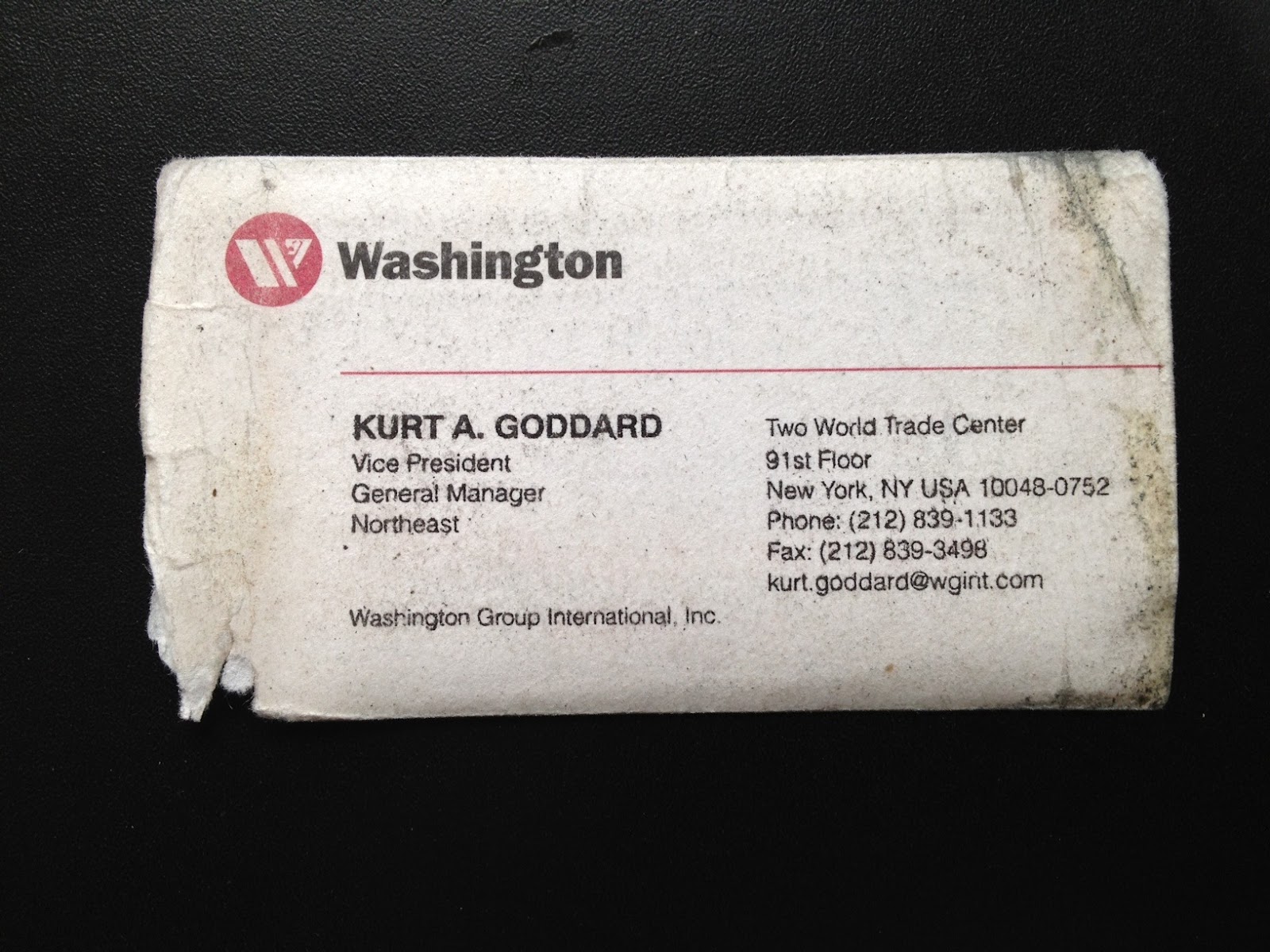
Business Card for South Tower
Following the disaster I was given the chance to take over an oversight role as Project Manager for MTA’s SONET ATM project assigned to Washington Group International (WGI). WGI’s main offices were located on the 91stFloor of Tower 2 (South Tower).
WGI lost twelve souls that terrible day and a majority of them were on this project I just took over. It was an honor to be called upon and to do what I could to repair the damage and restore moral.
My Dad was the General Manager for the New York City Office for WGI and ran their operations from there. The change in my schedule saved his life as well by allowing him to divert his schedule to the Princeton Office that day. He, like myself, has a passion of riding his Harley, so when my schedule changed, it gave him a chance to ride to the Princeton Office instead. I remember the toll it took on my father having to go to all those funerals. I know he had to deal with some sort of posttraumatic stress that fostered an overwhelming amount of guilt whenever the topic came up. I know it shaped me forever as well.
In my effort to do something that could help our efforts, and to get back at those that perpetrated such evil acts, this PM job was a start. The scope of this job was to install the cities new fiber optic backbone that would eventually connect, not just the transit system itself, but also the cities First Responders. What better thing to do than to use all my experience and knowledge to help make this network a possibility…. so I began the process of “packing parachutes”. (Cpt. Charles Plumb, USN Ret and Viet Nam POW)
As the PM I was in constant meetings trying to provide insight and direction in getting the complex communications solution off the ground. This network was going to be the backbone for one of the most advanced communications solutions in Manhattan and in direct support of First Responders…. the same First Responders who lost 342 brothers and sisters in the terrorist attack. In fighting through all the chaos I found the entire process of building large-scale communications deficient in many ways. This gave me the idea to culminate all my experience into one thing I could do that would help the entire system. In 2003 I dedicated myself to a doctoral program addressing the topic of advancing telecommunications in a manner that can be successfully managed and deployed. I would go on to publish my dissertation in 2009 and was accepted into the academy of professionals as the sole expert on the topic of advancing telecommunications using Public Private Partnerships. Until someone expands on my topic I remain the expert to this day.
My experience gained from my work for the MTA became the case study to validate my assertions and theory.  With the passage of the Middle Class Tax Relief and Job Creation Act of 2012 (“Public Safety Spectrum Act” or “Act”), governing the deployment of a nationwide public safety broadband network in the 700 MHz band, became a validation to my theory. As part of this legislation it states the use of Public Private Partnerships (P3) as a necessary tool to help fund the deployment, and self-sustainment, of this great national asset. Given that there has never been a successful P3 for telecommunications in the United States lends credibility to my dissertation and, thus, personal satisfaction that I am contributing to something greater than myself. Even if not assigned to the very top, and leading the charge, at least I now know that my theory of Public Private Partnerships is taking hold and I must offer my expertise to those that are appointed…thus the term “packing parachutes”. I can help pack parachutes for those high-flying appointees hoping that if, and when, the time comes that parachute will save their lives. Now we just need to make it happen.
In going back to all those chaotic meetings at the MTA, I would have to recommend that clarity at the very top, and unwavering support from all the members of the FirstNet Board, will be essential to its success. So, in preparation, I submit myself to the cause of making this network a reality and I hope others will follow…in fact I know others do the same already. It’s time to start packing your own parachutes.
Just some guy and a blog…

FCC Re-adjust its Terminology: “Public Safety Service” will fuel the FirstNet Boards ability to pay for the Nations First Responder Broadband Network. Supporting the return on investment for “Public Safety Services” just improved a lot.

One of the overarching discussions surrounding the Nations First Responder Public Safety Broadband Network, or Public Safety Broadband Network (PSBN), is the necessity to find the cash to build it. We can have all the discussions we want about the technical viability and interoperability of the solution, but without a driving business case to push those technical characteristics into an operational model that depicts a return on investment; it’s useless jargon, or a great way to create chaos.
Just recently I completed a business case for an electric provider that demonstrates why having a Public Private Partnership (P3) to power the financial planning of the PSBN is such a great idea. I would highly recommend others follow suit….that is using me to build their business case. In short, this electric cooperative covers about 3 counties, small in relative terms, but they too require the LTE broadband technology to replace its already end-of-life 3G deployment that supports its SMART Grid. To do so would cost this co-op about $30 Million dollars to build their own solution…if they could actually get the spectrum to build it on. To lease the service from a carrier is too costly and doesn’t meet the hardening requirements for such a tepid location.
In analyzing the situation this electrical provider would actually save about $3 Million a year, or roughly $250K a month, by leasing the broadband service from the PSBN. In return they have offsetting costs of roughly $2.4 Million annually by leasing back their own tower, fiber and backhaul assets to the PSBN footprint covering their area; which actually saves the State a tremendous amount of time, energy and costs.  This co-op is willing to relinquish the necessity of their own capital program to build a private LTE solution by paying a fixed annual payment of roughly $5.2 Million annually with 20-30 year terms to the PSBN P3 entity for the State (we used a 10% target of total capital costs). With an estimated cost of $31 Million, and a depreciation schedule of 6 years on the LTE solution, they would amortize their cost to a fixed $5.2 Million annual payment.  At six years the technology is risky, so the savings could actually be higher, just depends on what the schedule is for LTE advancements. This fixed annual payment is based on a Service Level Agreement (SLA) between the Co-op and the State P3 entity, which addresses their hardening requirements, as well as advanced placement of services. By aligning itself, this electric co-op opens the door to expanded service offerings as well.
To explain; it should be a given that the PSBN will be broken into, at least, three levels of priority; Level 1 is for Police, Fire, EMS types; Level 2 is for SMART Grids, highway ITS, rail communications, etc..; Level 3 would be for Rural Broadband coverage. In an incident the commander of a response scenario would free up available spectrum by prioritizing the level of communications for the given incident within a given geographical space. This means that if there isn’t an emergency response happening (which will be a lot of the time) then all the traffic is isolated back to its original paths. This opens another great opportunity that the electric co-op could benefit from — that being to utilize the Level 3 traffic to lend Internet access to its rural customers. By doing so this electric co-op could actually see an additional $500K a month it added services at $50 dollars a month access to charge with a penetration target of 75%. By outfitting its own business model this co-op would actually increase its costs savings, and the potential additional revenue, to almost $8.8 Million annually, or $733K monthly.  Not bad for not having to spend $31 Million to get it’s broadband.
This is just one small electric co-op business case; now imagine if a State has 36 such entities that all have “Public Safety Services” as part of their daily lives. I can easily make this same business case model for a major Class 1 Railway, High-speed Rail, Statewide Power Utility, or major Transportation Department running the highways and inter-modal port facilities. All of these entities have elements of “Public Safety Service” requirements that come into play when a major incident happens; and all have broadband technology demands to make the technical aspects of their business case successful. They also come with deep pockets and alternative funding sources that require them to build just such technological platforms into their own business model. This is the heart of “My Model” in executing a P3 that can, not only build, but also maintain the self-preservation for many years to come.
This co-op’s LTE needs, as I am discussing, would cost roughly $31 Million. Picture a power Utility that spends traditionally $1 Billion every three years for much more geographically disperse footprints…imagine what they would save. I can think of one major electrical provider who spent roughly $630 Million to build its SMART Metering infrastructure. Upon completion their major commercial broadband service provider informed them that the 3G services they just signed up for, to power their SMART Meters, would be moving to LTE. It may be just me, but deploying 3G cellular services to rollout a SMART Meter means that the SMART Meter itself has an internal 3G modem. Wouldn’t that modem have to be upgraded to LTE as well? Just a thought.
But imagine if that same Utility were to get their broadband service from a State P3 entity instead — an entity that builds its network just for Public Safety Services to which this Utility is part of…and meets its hardening requirements. Imagine if they, like the smaller co-op, were able to eliminate costs, by let’s say — $630 Million upgrade — by instituting a fixed annual payment of $63 Million for the service with 20-30 year terms. How much money do you think they would save? Let alone, what if this same Utility were able to sell Internet service to its customers much like the small co-op?  
Just theoretical, but what if they had 2.2 Million customers and targeted a 30% penetration rate for Internet Access at $50 a connection…now this is just me and remember I have a PhD in Business not math, but that would mean $33 Million a month in additional revenue.  At $33 Million a month, I may be mistaken, but that would pay back the original $630 Million in roughly 19 months. It would also eliminate the need for this Utility to fight with the State Legislators in asking for an additional $2 or $3 dollars to everyone’s bill just to try and build its SMART Metering Network in the first place. Sounds like a match made in heaven for this Utility provider and the PSBN.
But don’t forget the P3 created by the State, they too would benefit. The PSBN P3 entity would also see a $63 Million dollar annual payment for broadband service with a fixed contract for 30 years. That sounds pretty good to me. Combine that with all the State entities who could access the PSBN and I think we may have a great way to pay for the PSBN all together….and maintain it for a long, long time.
Just some guy and a blog….

PTC (Positive Train Control) and why it’s important to Public Safety Broadband Plans

This is a topic I can guarantee that most within the Public Safety world have heard nothing about. PTC, or Positive Train Control, is a $11 Billion dollar Federally funded supported consortium of the nations largest rail lines to build a nationwide communications network that controls trains in real-time. Its footprint impacts the deepest of the rural territories and mountain ranges.
Picture this: a class 1 heavy train with a multi-engine consist, something like a BNSF or Union Pacific, pulling a train a mile long through the mountains and rural deserts of the United States. Imagine that train needs to stop because of an obstruction on the track. While stopped a rove of terrorists, who have penetrated our border in a remote location, slithers up to the train and places a timed or remote explosive on about 5 or 6 high pressure propane, or other highly combustive tanker cars with hydrochloric acid. They have set the devices to explode when the train commutes through a city center…like Dallas or Kansas City. Or worse yet, through a rural town to which a local high school or elementary school sits along the tracks. I probably don’t need to explain the results. Here is a youtube video clip of just such a situation, but in this instance it was just a derailment. Imagine if it were intentional.
(the entire video is interesting but the bulk of the explosion happens around the 6 minute mark. Would have been nice if the officer had a vehicle deployed UAV.)

The possible answer to this solution may reside in the Nations First Responder Broadband Network or Public Safety Broadband Network using multiple platforms of technology, i.e. LMR, P25, LTE, etc. It’s a relationship that would have many advantages — both ways — where as both parties can get what they need out of the deal. How that relationship needs to be formed — can best be married in a Public Private Partnership!
Another thing to remember is that, much like Utilities, Class 1 Railroads make a lot of money — money that can be spent to help support the Public Safety Broadband Network deployment and sustainment.
Just some guy and a blog….