Public Safety Broadband, FirstNet and the need to Commoditize Internet Access…..a perfect fit?

It is time for a change!
In with the New Year comes the possibility of transition that we have seen in the last 3 years, that is the commoditization of the Internet. I am not the only one that sees the connection between the utilities, the Internet and the Public Safety Broadband Network. As was written in a recent Bloomberg articles titled, “U.S.Internet Users Pay More for Slower Service. By Susan Crawford Dec 27, 2012 5:30PM CT” it is clear to see that there exist a connection.
Monetization is a crucial part of the deployment of the Public Safety Broadband Network and by doing so comes the necessity to build customer base. As has been laid out in the preliminary discussions of FirstNet there is a necessity to prioritize users on the network. There also exist in the legislation the need to provide rural broadband service to those that need it. Undoubtedly those users would be priority three type users. Priority one-users being First Responders and priority two-users being the likes of the Utilities, Transportation, etc..
By the legislation laying out the necessity to provide rural broadband service, and the alignment of the three base priority users, promotes a perfect incentive to commoditize the Internet Access scenario. To a commercial carrier commoditization is a bad word. It cuts their ability to manipulate the margins on the service thus eliminating further advantages of more service offerings. But, in this case the actual commoditized infrastructure will come from the Public Safety Broadband Network. In the context of commoditizing the access piece  this could actually be the turning point. 
Eventually the cost of support starts to outweigh the profit margins, thus commoditization starts to happen. This may be the point we face today when it comes to Internet Access. The balance of market competition, affordable price margins and the demand for service may be at a transition point where as the commoditization of the Internet Access is the best solution. For the carriers they will need to shed infrastructure due to the shift towards content and services as being their prime driver of revenue. For the Public Safety Broadband Network (PSBN) this would be the opportunity for partnering with Utilities to institute the commoditization process of the Internet service model.  What better partner than a Utility who has been playing in commoditized services through its power distribution business?
Being that the business model of the Public Safety Broadband Network will be of a social context rather than strict revenue bearing operation; it only plays too well for a commoditized Internet Access service model to grow roots. Through a State sponsored Public Private Partnership the creation of revenue will come from the stalwart clients that require broadband service and that maintain a Public Safety Service responsibility in times of disaster or emergency response. These clients will not bother with the traditional subscription based model but would rather see a long-term (20-30 year) contract for services that includes their requirements for hardening and coverage. Such contracts would be based on long-term SLAs (Service Level Agreements) fixed on operational cost models. Through those fixed contracts we could see the opportunity of providing commoditized Internet Access service models via the Utility itself, or bid to the commercial Telco markets. It is through the PSBN architecture that the commoditized Internet Access will be garnered yet virtually managed through a commercial service model. Yet one has to remember that these rural broadband users will be priority 3 users thus always under the gun for interruption during an emergency…. which is really no difference than what happens today anyway.
Just some guy and a blog….

BTOP Grant to FirstNet? What About the FCC’s Connect America Fund as well?

Wednesday, 05 Dec 2012 11:26 PM By Todd Beamon and Kathleen Walter
When it comes to the $135 Million promised alluded to by the Feds to help fund the State’s “planning and audits” of the Public Safety Broadband Network…how many people really think it will come to fruition anyway? After all the Federal Government allocated $7 Billion of which $2 Billion would be in the form of direct grants. The remaining $5 Billion has to come from auctioning off spectrum already in use. How long has it taken to get narrow-banding completed? Oh sorry it hasn’t been completed yet. Didn’t that start in the 1990’s? How would one anticipate that $5 Billion in anticipated funds from auctioning off spectrum, that is still in use, would be available anytime soon? Regardless can anyone please tell me what the term “Fiscal Cliff” actually means anyway?
But, if it is imperative that a State must have the grant money then we still have a solution right in front of us. Last year the Broadband Technologies Opportunities Program – better known as BTOP – was in full cycle. Then came FirstNet, which put a halt to all the BTOP grants. As it stands the only “realistic” proportion of federal grants available under FirstNet would be $36 Million ($2 Billion / 56 States and Territories). The original promise (hearsay) was $135 Million per State and Territory ($7 Billion / 56 State and Territories). But if we add the already allocated BTOP grants we could actually see roughly $185 Million for PSBN planning and audits ($150 Million + $35 Million). That’s not all, if we are so captivated in the belief that we can’t build a nationwide broadband network for Public Safety without Government funding then why not allocate the $4.5 Billion from the FCC’s Connect America Fund as well? Realistically though renaming the BTOP as the PSBN grant makes more sense. At least we can rest assured we are looking at reinstalling the $135 million that was already being utilized. It still won’t be enough to even come close to funding a full national build out of LTE in support of Public Safety.
Having been in the industry for over 20 years I can safely ascertain that this is going to cost somewhere between $50-$100 Billion, easily, to build this nationwide solution. To put it in realistic terms just look at the assets in the 10K filings of Verizon, or AT&T, of whom only covers 40% of the United States (96% of the “population mass”). With a FirstNet target of 99% of “geographic landmass” of the United States it doesn’t take a rocket scientist to understand the proportional differences between the terms “geography” and “population”.
If we were to be conservative and depict a $50 Billion price tag, that would mean that each State would be looking at $892 Million as there share to help build it (State taxpayer money), with of course we could see a reduction of the $135 Million from the BTOP (or just $35 Million allocated from the $2 Billion NTIA grant for PSBN). So in essence the States could see a bill of roughly $757 Million trying to be passed through their State Legislature. Don’t know about you, but I saw some pretty vicious fights in the State Legislative sessions just to get approval for a few more dollars to cover SMART Metering alone, which by the way had $4.5 Billion in funding from the Title XIII of the Energy Independence and Security Act of 2007 (EISA), and was a matching funds act that was topped at $200 Million per application. Too bad they used it to also fund WiMax and 3G services to connect their SMART Meters. Now we have all used the term “BetaMax” in the past, but this topic is a whole other article. 
But there is a solution! I’m the type that doesn’t like to complain unless I also come bearing solutions. As I have promoted in the past the secret lies in the Public Private Partnership. How do you turn this entire funding debacle into a positive? By using Public Private Partnerships. Now I just have to figure out how to promote this so that people start to listen.
Just some guy and a blog…

Can the Electric Utilities play in the Public Safety Broadband initiative being led by the FirstNet Board?

There has been a lot of noise defining the Priority (1-3) users of the PSBN and who the residing members can be within those priority schemes. In order to help clear things up I would propose the following that can be found in the legislation already signed by the President back in January.
The primary question I will cover is whether or not a Utility, or Electric Cooperative, is a “Public Safety Services” organization, but the same can be construed for any related State entity that falls beyond the typical realm of “First Responder”. Those entities may be Transportation, Utilities, Forestry, Agriculture, Land Management, etc..
Per the legislation itself it is clear to see that the inclusion of these entities has already been written into the legislation.
Through the Middle Class Tax Relief and Job Creation Act of 2012 (Act) became Public Law 112-96, 126 Stat. 156 (2012). It states in section (27) PUBLIC SAFETY SERVICES —The term ‘‘public safety services’’—
(A) has the meaning given the term in section 337(f) of the Communications Act of 1934 (47 U.S.C. 337(f)); and
(B) includes services provided by emergency response providers, as that term is defined in section 2 of the Homeland Security Act of 2002 (6 U.S.C. 101).
In short, section 337(f) of the Communications Act of 1934 (47 USC), it states under sub-section
(f) Definitions: The term ‘‘public safety services’’ means services-

(A) The sole or principal purpose of which is to protect the safety of life, health, or property;
(B) That are provided-
(i) by State or local government entities;
or
(ii) by non-governmental organizations
that are authorized by a governmental entity whose primary mission is the provision 
of such services; and

(C) That are not made commercially available to the public by the provider
The Law Flow Diagram by Scott Foster

So in closing, it would be nice to hear some clarification by the FirstNet Board that addresses these players in more light. Why is this important? It’s important because these State entities, most selectively the Utilities and Electric Cooperatives alone, cover more than 80% of the geographic landmass of the United States with advanced communication solutions and are deep into the thrills of deploying the latest and greatest. They are coming to realize that they need FirstNet as much as FirstNet needs them. It’s a great opportunity – one that would be too costly to avoid. If FirstNet wants to create a great LTE broadband solution for Public Safety then it needs to bring these organizations into the fold…. officially. The best way to bring them into the fold is via a sound business model that is executed at the State level and within the confines of a sound Public Private Partnership.  

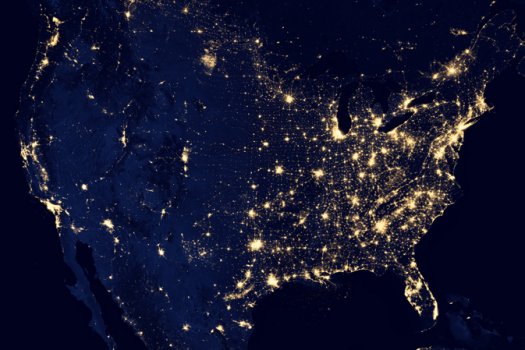
Everyone of these lights in this image below requires power. Everywhere there is power communications is needed. That looks like a pretty good footprint to me. And when those lights go out…who are the first people the First Responders call to help?

Just some guy and a blog…

What should NTIA do with the BTOP Grants?

Now I’m just some guy and a blog, but my two cents is that the NTIA should refashion the BTOP Grants to help the States plan and audit their business case, asset inventory and physical requirements for a statewide PSBN build out. They can simply combine it with the $135 Million planned for FirstNet. The NTIA (FirstNet) could then expand the usage of the grant money to utilize any remaining funds, after the planning and audits, to expand application, or cloud development, in support if IT centralization under the PSBN deployment… or even pay for more handset development. 
If FirstNet goes with my model for the Public Private Partnership (see past blog entries or my response to the NTIA NOI back in November) the additional BTOP won’t be necessary being that Private Equity would actually pay for the entire State build out. It may be just me, but seems useless to continue with State sponsored rollouts of LTE trials and pilots when the more important aspect is planning a States business case that may change or modify those very same plans. Plus, this ultimately saves the taxpayers more money. In addition the work in Denver should be basis for any trials or pilot testing of the vendor solutions.
Just some guy and a blog…

Webinar: Public Private Partnership for FirstNet

Here is a link to the recorded webinar that took place on November 30th, 2012. It was a great session and had some really good questions asked.

Updated Link: Friday, November 30 at 1 p.m. Central time ­ Public PrivatePartnerships and PSBN: How the Co-op Fits In


Reminder, today’s webcast will begin at 1 p.m. Below is the link and instructions for attending the webcast.
Online event access
Event URL: http://arkadinoneplace-nh.adobeconnect.com/r74bksa0i62/

Choose the option for ‘guest’ when you click the link for the webcast.

You may listen to the event through your computer’s speakers or you may use the conference bridge below for audio.

Conference Bridge (Only if you don’t use your computer’s audio)
Dial in: (646) 560-7802Participant Code: 31879166#

We look forward to your attendance.

FirstNet and an Oversimplification of What Has to Happen

What will be crucial for the insured success of the Nations Public Safety Broadband Network and FirstNet will be its modeling templates for all the States and the territories to execute on. Most importantly will be FirstNet’s ability to convey a strong a business model that is self-sustaining and even capable to create jobs, revenue and advance the technical integration of all the Public Safety Service organizations…thus the reason for the “Middle Class Tax Relief and Job Creation Act of 2012” and I underscore “Job Creation Act”.
Hopefully it is starting to settle in that the execution of this entire deployment will depend on the States ability to execute a solid Public Private Partnership solicited with a standard RFP process to the private equity market, especially if we actually want to pay for the entire network. There are 4 major points I see that need to be addressed, and provided, by FirstNet to the States:
      1.     Public Private Partnership Business (P3) Model for the States can follow
      2.     A fixed template of guidelines for the States to generate solid RFPs (Request for Proposals)
      3.     Technical Solution standards to follow
      4.     Technical integration standards incorporating a centralized model of “core” implementation and     operation
Point 1 – All the States will need to execute under the same P3 model to make this successful. FirstNet should champion one “fixed model” to be implemented across the board. If we don’t then can you imagine the plethora of original ideas coming up across the United States trying to build a combined integrated solution? Sounds like a lot of wasted money and time to me.
That model (refer to my past writings to see the full model) should use the State’s owns internal agencies and entities as clients to ride the network (not a subscription model); incorporation of all those entity assets and infrastructure; fixed recurring payments based on comparable solutions had the entities been forced to build a similar solution; acquired technical requirements from entities; incorporated technical and recurring revenue solicited in a State sponsored RFP; and ultimately responding private equity and investment. The P3 model must create the ability to attract private equity to invest and buy the States demand for broadband access using the State’s Public Safety Broadband Network.
In the end we are building an exact duplicate of a commercial network, so as a private network, there is no reason this network should not be able to make just as much money, if not more, as the carriers typical do.
Point 2 – FirstNet can generate a fixed template of guidelines that lays out this model and the relationships required. FirstNet can then dictate the procurement ethics and the requirements needed by the State’s individual entities in return private equity will be able to see recurring fixed revenue from the State entity contracts. By collecting the required technical hardening requirements, and the inclusion of existing infrastructure assets from the State entities, the State can illustrate the needed technical design and the map the recurring revenue possibilities to attract private equity. This information can be incorporated into a standard template of an RFP, supported by FirstNet yet executed by the State, which can be solicited to the Private Equity market. In return private equity will bid (buy) for 49% ownership of the recurring revenue stream as an incentive to pay for the entire statewide build out and long-term management. The remaining 51% would remain with the State for re-investment into the State’s PSBN solution (could pay for the First Responder handsets and communication gear).
Point 3 – FirstNet has already collected enough technical design standards to date. What FirstNet needs to do now is incorporate those technical standards into the RFP mandates that the States can follow.
Point 4 – The centralized “core” model, as with the technical design specifications, just needs to be conveyed into the States RFP demands as well.
I know this is an oversimplification of a much bigger solution, but I believe that making it easy insures better success in its implementation. After all why do we need to complicate things…its just another 4G network being built?

PS.. We also need FirstNet to release the $135 Million grants to the State to start the planning and audits. In return the State’s need to allow their internal State entities to start their own planning and audits of their own facilities and assets then be reimbursed by the grant funding that will be allocated. Those planning and audits need to include the cost justification and business case of how that entity will be included in the State P3, its client SLA contract framework and its potential recurring annual payment terms for the the PSBN broadband service over its footprint. All of which can be reimbursed by the State.

Just some guy and a blog….

Tri-County Electric Cooperative Featured in 700 MHz Webinar Series


The issue of rural deployment of the 700 MHz public safety broadband network (PSBN) is increasingly being debated in Washington, DC and across the country, as FirstNet and state/local authorities grapple with constructing, maintaining and operating a nationwide network that meets the needs of public safety. Leveraging the infrastructure of rural electric utilities has been identified by FirstNet as one means of covering rural areas. In that context, Tri-County Electric Cooperative will be featured in a series of webinars around the issue of sharing the 700 MHz PSBN with utilities. UTC encourages UTC members to participate in these webinars, and members can register by clicking on the links below:


How can First Responders get FREE Handsets and Handhelds for the Public Safety Broadband Network: it’s in my model!

An interesting side affect of my Public Private Partnership model is its ability to pay for ALL the First Responders communication equipment. The model I presented to the NTIA in response to their public inquiry allocates 51% ownership with the State and FirstNet; the remaining 49% is open to private equity to invest in. How does this happen?
Example:
Conceptually if a State has:
·      20 Electric Cooperatives that cover the majority of rural areas
·      Average $5 million a year for broadband network service that fully covers all their service territory with hardened LTE Service.
·      Equates to $100 Million Annually just from the electric cooperatives
·      51% = $51 Million annually to the State
·      49% = $49 Million annually to the private equity players who pay for the statewide build out
·      The State’s/FirstNet’s $51 Million could be reinvested back into the network to help pay for all First Responder radios and communication gear
·      The $49 Million for private investment would allocate a percentage to fund the long-term operations by reinvesting portions of its revenue back into the broadband company for the State — simultaneously paying its investors.
PS… nothing to stop some of the private State entities to invest as well.
This is just the electric cooperative; we haven’t started talking about
Transportation, Agriculture, Forestry, or the Investor Owned Utilities
What does the Electric Cooperatives Gain?

  •           The electric cooperative (which really could be any State entity that needs large-scale broadband access) can eliminate the need to build its own LTE broadband solution
  •           Can move to a solid-fixed, long-term, operational expense via an annual payment
  •           Can push off risk to the new broadband company for the State
  •           Can further improve that bottom line they can also offset existing communications assets by releasing them to the State PSBN effort, further reducing their OpEx annual payment
  •           Can re-capture the capital already spent on existing 3G and WiMax deployments by leasing those solutions as potential backhaul for the PSBN
  •           Can generate revenue by leasing tower and backhaul infrastructure to the State
  •           Can generate revenue by providing wholesale or direct rural broadband service on a priority-3 basis (allocated as part of the legislation)

No taxpayer money spent!
Just some guy and a blog….

Webinar Series on how the Utilities can play with the Public Safety Broadband Network

A really good webinar series on Public Safety Broadband and the tie into the Utilities. Sign-up! It’s an open online event. Essentially the event illustrates a model to which the electric coops (and others) can join in on the Public Safety Broadband initiative. It will give you a chance to here some of the creative scenarios being brought up.
Tri-County Electric Cooperative Featured in 700 MHz Webinar Series
The issue of rural deployment of the 700 MHz public safety broadband network (PSBN) is being increasingly debated in Washington, DC and across the country, as FirstNet and state/local authorities grapple with constructing, maintaining and operating a nationwide network that meets the needs of public safety.  Leveraging the infrastructure of rural electric utilities has been identified by FirstNet as one means of covering rural areas.   In that context, Tri-County Electric Cooperative will be featured in a series of webinars around the issue of sharing the 700 MHz PSBN with utilities.  UTC encourages UTC members to participate in these webinars, and members can register by clicking on the links below:

Just some guy and a blog…

Is it time for High-Speed Rail in the Northeast? What about a partnership with the State’s Public Safety Broadband Network?

Why not given the damage of Hurricane Sandy we may be faced with rebuilding the Northeast Corridor anyway. I had a recent link sent to me that illustrates the extent of the damage of Hurricane Sandy and its impact on the Northeast Corridor rail system. This may be a perfect opportunity to rebuild the system to accommodate true High-Speed rail.
By the way this same rail system would require input and support to the National Public Safety Broadband Network. As was posted in an earlier article HSR needs broadband technology as well. Given the extent of the New Jersey’s plan to build their own Public Safety Broadband Network, as part of the national plan, maybe its time to start talking about a joint support role tied together with a Public Private Partnership for the State to funds its PSBN and rail system rebuild.
Here is the link to the pictures of the damage: http://www.flickr.com/photos/89454930@N07/sets/72157631895879101/show/
Just some guy and a blog…