A State can form its own Public Private Partnership to reap the benefits of leasing the spectrum and the rights to operate.

In researching the topic of how a State can create its own Public Private Partnership, plus reap the benefits of leasing the spectrum allocated to a partnership I came across the following. You should note that all the elements are there for a State to commission its own “real” Public Private Partnership and to bring in private equity to invest in a given State’s PSBN solution.

In short, why can a State put together its own Public Private Partnership so that they can get Private Equity to pay for the State’s deployment of Public Safety Broadband; and why is it best to utilize the SGLIP funds to help pay for your State’s RFP to bring in Private Equity to pay for your entire network?

FirstNet: Fee Income and Other Revenue
FirstNet has the authority to obtain grants and to receive payment for the use of network capacity licensed to FirstNet and of network infrastructure “constructed, owned, or operated” by FirstNet.23 Specifically, FirstNet is authorized to collect network user fees from public safety and secondary users24 and to receive payments under leasing agreements in public-private partnerships.25 These partnerships may be formed between FirstNet and a secondary user for the purpose of constructing, managing, and operating the network. The agreements may allow access to the network on a secondary basis for services other than public safety. FirstNet and its partners may also receive payments for leasing access to infrastructure, such as towers.26 The act requires that these fees be sufficient each year to cover annual expenses of FirstNet to carry out required activities,27 with any remaining revenue going to network construction, operation, maintenance, and improvement.28 There is a prohibition on providing service directly to consumers; this does not impact the right to collect fees from a secondary user or enter into leasing agreements.29
Public-Private Partnerships
Partnerships are expected to play a critical role in building and operating the network. Electric utility companies, for example, are upgrading their networks to meet Smart Grid requirements,70 and some companies have expressed an interest in partnering with FirstNet or state authorities. Some commercial wireless service providers have also expressed an interest in working in partnership with public safety entities to develop and operate new broadband networks.
The Middle Class Tax Relief and Job Creation Act of 2012 requires FirstNet to issue “open, transparent, and competitive” requests for proposals to private sector entities for building, operating, and maintaining the network71 that leverage to the extent “economically desirable” existing commercial wireless infrastructure, in order to expedite network deployment.72 It is charged with managing and overseeing the resulting contracts or agreements. As part of a separate requirement to assure substantial rural coverage during all phases of deployment, the act requires that industry proposals and contracts include, if possible, partnerships with existing commercial mobile providers.73
Decisions by FirstNet about the network’s design, construction, and operation are likely to have a significant impact on commercial participation in a public safety broadband network or networks. These decisions may also influence decision-making by states as to whether or not to pursue radio area network construction independently or through their own partnerships.
Congress may be interested in the composition of private sector partnerships formed by FirstNet and individual states, not only for their business plans but also for the inclusion of a wide variety of stakeholders. For example, are rural and tribal wireless carriers included as business partners? Do secondary access agreements support services that meet social goals, such as for telemedicine, or are they exclusively for commercial purposes? Is competition in providing wireless services being enhanced or hindered?
21 P.L. 112-96, Section 6206 (e).

22 P.L. 112-96, Section 6207 (b).
23 P.L. 112-96, Section 6206 (b) (4).
24 P.L. 112-96, Section 6208 (a) (1).
25 P.L. 112-96, Section 6208 (a) (2).
26 P.L. 112-96, Section 6208 (a) (3).
27 P.L. 112-96, Section 6208 (b).
28 P.L. 112-96, Section 6208 (d).
29 P.L. 112-96, Section 6212.

30 P.L. 112-96, Section 6301.
65 P.L. 112-96, Section 6201 (b).
66 P.L. 112-96, Section 6206 (g).
67 P.L. 112-96, Section 6208 (c).
68 P.L. 112-96, Section 6209.
69 P.L. 112-96, Section 6210.
70 “Smart Grid” is the name given to the evolving electric power network as new information technology systems and capabilities are incorporated. See also CRS Report R41886, The Smart Grid and Cybersecurity—Regulatory Policy and Issues, by Richard J. Campbell.
71 P.L. 112-96, Section 6206 (b) (1) (B).
72 P.L. 112-96, Section 6206 (b) (1) (C).

Response to Comment Request: State and Local Implementation Grant Program Application Documentation and Reporting Requirements


The following write-up is my response to A Notice by the National Telecommunications and Information Administration on 02/12/2013, titled “Proposed Information Collection; Comment Request; State and Local Implementation Grant Program Application Documentation and Reporting Requirements”

You can download the file from here

___________________________________________________________________________

Summary

In summary, I still find no indication of a business model, specifically associated with a Public Private Partnership model[1],[2], which can adequately address funding a national build-out of the National Public Safety Broadband Network (PSBN) — most specifically the “self-funding” aspects using Public Private Partnerships as pre-determined in the legislation1. Until we can get a sense for what that model is, and how it is to be applied within the States, as well as its potential customers, then we should be concerned that there currently does not exist any framework for justification, nor clarification, as to what should be collected, for whom, from whom, and for what purpose. We can’t just start collecting inventories of assets, knowledge of business processes, and workflows, if we haven’t established a structure of what the entire solution is going to look like; whom its customers will be; and what the framework of a Public Private Partnership model that the States need to execute against.
As with the construct of a commercial, or private, telecommunications company it’s important that a new business follow its desired course of a model that ultimately leads to a gainful and cost-effective outcome; as well as balance the needs and desires of its clients with its functionality and capabilities as to create a demand for service. In this case that service is LTE Broadband provisioned under a private network and should be administered through a framework of a Public Private Partnership (P3). It is my recommendation, that through a business model, FirstNet becomes the National Headquarters (HQ) entity to all the statewide deployments of the PSBN architecture.  As the HQ element they will also provide oversight of the governance, technical interoperability and financial controls that will be executed under the jurisdiction of the established State and its respective P3 entity.
As part of any business, whether small or large, they all start with a seed of an idea that is ultimately driven by the elements of fiscal responsibility, and prudent attitudes that ultimately align with its long-term, short-term and immediate goals. In short we need to be creative in establishing the groundwork of a financial governance model that can be duplicated with the States and Territories. A solution that not only meets our demands of capital expense to design, build and deploy the network, but also the ability to sustain its operations costs for the long-term. What better way to do that than to capitalize on the use of the spectrum and the technology of LTE itself?
There is a great demand for broadband services within every entity that resides and operates within a given State and Territory. By capitalizing on the capabilities of the network we can monetize that demand. By monetizing that demand we can offer cheaper, more resilient and capable broadband services than the traditional commercial carrier market; as well as balance the needs of those organizations that require the service for their own business goals. Such a network business model is not fashioned solely on revenue producing goals, but primarily on the goal of balancing the business objectives and needs of all that partake. As a part of my recommended business model, the recurring income is there to balance the attraction and is used only to help fuse the interest of private equity to concentrate on a common goal with the State and the Nation.
In fusing the ambitions of all entities that take part in the business model, we can simultaneously bring value to the their past investments in existing communication infrastructures by renewing and utilizing existing assets that can support a solid infrastructure of backhaul and advanced service functionalities for a statewide PSBN, i.e. LMR, P25, Microwave, Towers, Fiber, etc.[3]By combining the specific demands of the users within the network, as well as a solid projection of recurring revenue, we can formulate a standardized RFP (Request For Proposal)[4][5]process that will invigorate the private market to invest into, and build, our entire network solution, thus avoiding taxation. This is more than just a typical investment — in reality, it’s an investment into our nations infrastructure and national security that will allow us to lower our dependence on taxation through the State and Federal Government, which in the end helps us all by improving our economic outlook as well as eliminates a lot of procedural “red-tape”.
  
Comments are invited on:
(a)           Whether the proposed collection of information is necessary for the proper performance of the functions of the agency, including whether the information shall have practical utility;
For the benefit of FirstNet, or the NTIA, which I believe to mean the “Agency”, I feel the collected data can be useful, but more importantly its application at the State level carries more importance. It’s imperative to point out that such collection of data cannot effectively be used unless there is a structure of a business model that deploys an active Public Private Partnership (P3) model (per the legislation). If it is the intention of the Agency to formulate a business model based on the directives of the legislative passed in February, then it is also written that “Public Private Partnerships” should be utilized[6]. As of this date we have not seen any attention focused on any formulation of a business model using Public Private Partnerships…. at least not that has been made transparent to the public. Therefore it will be difficult for the Agency to layout a standardized approach for the States to follow when collecting such data.
Intrinsically that data must have a reason for being collected. To collect such data just for the purpose of seeing what is available is counterintuitive to the practicality of its implementation to a Public Private Partnership model or business case. We may go through an entire process of collection only to find out that the data was actually not needed due to the fact that the Public Private Partnership and the business model ultimately affects the design and the revenue objectives, which may, or may not, include a lot of the data in its initial application.
It is my recommendation that once the Agency has formulated a policy for implementing a sound business plan, which envelops a Public Private Partnership strategy, and that can be conveyed to the States, it is at that time that guidelines for collecting the necessary inventory of assets can be made.  This will insure that we have a solid business model that can be used to fulfill the requirements of self-funded and self-sustaining operations. After all, what if we collect data from only four major Public Safety organizations and then later find out we need to collect from 86 (which happened to be the case in Oklahoma).
Therefore it is necessary to collect a certain amount of information to validate a structural relationship between all the States, and Territories, that can establish a framework of correspondence when applying the business model; ultimately delivering those guidelines to a State for the basis of initiating controlled Public Private Partnership. This data will highlight the interface with the controlling element of FirstNet yet at the same time maintain the business objectives of the State born P3.
But undoubtedly the most importantly step prior to the data collection period — FirstNet must market its adoption of a Public Private Partnership model that the States can follow. Keeping in mind that the data collected must represent five primary steps (simplified version), FirstNet must:
1.     Formulate a Governance structure of Program Management controls.
2.     Formulate a Business Model using a Public Private Partnership methodology
3.     Establish the framework and templates for the States to use in implementing their own Public Private Partnership that is standardized and adopted by FirstNet and the NTIA.
4.     Establish the framework for State initiated RFPs that will be advertised to the Private Equity market.
5.     Finally, FirstNet must execute its governance approach to conduct oversight of the State’s progress in adopting and implementing the P3 model.
Once these steps are established then collection of State assets can begin (simplified version), States must:
1.     Collect data on all currently defined “Public Safety Services” Organizations[7] within a given State as defined by the Federal regulations.
2.     Solicit current operations and programs within the given State and how they will interface into the newly established company of the P3. Highlight an established alignment of business objectives between the State entities[8] and the PSBN solution where supporting causal effect is associated with broadband goals.
3.     For the given State outline projected recurring revenue from possible State entities that will pay for access to the PSBN solution. Use a two step process:
a.     Conduct a preliminary LTE Broadband design to meet their immediate business needs and use interoperability and design criteria as stated by FirstNet. The goal for this design is so that it meets the entities needs as well as can be assimilated into a statewide design.
b.     Perform a cost analysis of the entities preliminary design and convert annual cost of operations to a fixed annual payment for PSBN broadband service. Offset any existing infrastructure that the entity has by subtracting leasing or buy arrangements with the State P3. Provide this information to the State for incorporation into a State generated RFP as to demonstrate a projection of a recurring revenue stream that will attract Private Equity.
4.     Gather coverage requirements, broadband speeds and hardening requirements to be used in the State RFP that will be advertised to the Private Equity market. 
5.     Using the preliminary designs and inventories of entity assets the State can catalog those available assets from the entities, and the State itself — that would include an inventory of enterprise based solutions, backhaul, towers, fiber routes and any other communication based assets — that can be used in the infrastructure of the State PSBN. These become the available assets and reusable infrastructure and are conscripted into the State generated RFP that will be advertised to the Private Equity market.
6.     Combine and analyze the design, coverage and broadband speed desires from the entities and script them into the technical requirements section of the State’s RFP to Private Equity market.
7.     Combine and analyze each of the State’s recurring revenue projections into a financial market document to be incorporated into the State’s RFP to the Private Equity market.
8.     Execute and advertise State born RFPs to the Private Equity market for investment into a State sponsored Public Private Partnership that will accommodate for the capital and operational expenses associated with its deployment, and “self-sustaining” long-term operation of the PSBN solution, thus meeting the demands of the Federal Legislation.
(b) The accuracy of the agency’s estimate of the burden (including hours and cost) of the proposed collection of information;
In reviewing the calculations I find that the numbers are grossly underestimated. They do not include all the necessary steps of collecting data from all the States and the State’s internal agencies and entities. Through a defined business model such elements of necessity would become apparent. With FirstNet’s adoption of a Public Private Partnership model; proper allocation of funding can be administered to the States to provide enough resources to fund the data collection process as well as the means to generate a Request For Proposal (RFP) that would be advertised by the State to the Private Equity market. Therefore, the accuracy of the agency’s estimate may be premature and flawed in its initial scope.
Such cost burdens must incorporate the data collection process from not only the State organizations itself, but the State Agencies and Entities that reside within it borders. On average you can estimate roughly 1-months worth of work for each entity within the State at a cost that is indicative of the entities complexities and size.
Note: We have conducted a paid data collection analysis that follows the outlined data collection process for one of 31 State electric cooperatives within the State of Oklahoma… that being Tri-County Electric Cooperative that covers the 3-county area of the Panhandle between Texas and Oklahoma. Through the State Electric Cooperative Association we also performed outreach to the remaining 30 electric cooperatives and have full buy-in to move forward with the same process provided that the State issues an MOU per the guidelines of the Public Private Partnership model as laid out by FirstNet and/or NTIA. You should further note that using our preliminary designs, cost estimates, inventory collection and cost modeling we project that the electric cooperatives would bring in as much as $155 Million annually in recurring revenue to the State P3 in Oklahoma using fixed annual contracts of broadband service over the State PSBN[9]. The electric cooperatives make up only one of the many Priority 2 Public Safety Service and Support organizations within the State. Plus, by having them as clients on the PSBN P3 opportunity they also manage to cover more than 70% of the States rural geography. Following the completion of this study it was presented to the Lt. Governor Todd Lamb, and was reviewed by the State CIO Alex Pettit, who ultimately presented it to Governor Fallon honoring full support. Now it is in a “wait and see” mode as to what business model FirstNet will act upon. This may also drive the discussion for the “Opt Out” issue.
Following the example above, it is with a very strong recommendation that this same model can be adopted and executed in every State and territory in the Nation.
(c) Ways to enhance the quality, utility, and clarity of the information to be collected; and
As was outlined above the quality, utility and clarity of the information to be collected will be best administered once the adoption of a Public Private Partnership model that the States can follow. It should be known that most of this data is best collected at the State level and that each State, who is operating under the guidelines of a Federally supported Public Private Partnership model, will hold the responsibility to make sure its business objectives can be clarified in a State advertised RFP. That process of the RFP needs to be established by the FirstNet Board or the NTIA as well. By doing so will insure that the “quality, utility and the clarity” of the collected data can be affectively displayed to the public and the Private Equity respondents. We won’t know what data is needed to be collected until the State has a better idea of who, what and how the solution needs to address when it comes to meeting the business case objectives. 
(d) Ways to minimize the burden of the collection of information on respondents, including through the use of automated collection techniques or other forms of information technology.
As with any large telecommunications deployment there are pre-established data base applications that specifically meet these objectives (nothing new within the telecommunications vertical). The sub-contracted construction firms and integrators use these tools on a daily basis.
Each of the State’s internal agencies and entities will have to submit viable data that has to be fed into such applications. Unfortunately there is no way around the footwork that has to be done. Frankly, you may not want to just trust the data that comes from automated means. In past experiences such data tends to lack the essentials needed for a particular requirement. These collection methods must follow a strategy of conceptual design, detailed design, and ultimately aligned business needs of the data itself. Every entity within a State is going to be different. Case in point: Electric Cooperatives cover more than 60% of the entire geography of the Nation. Small company boards usually run these coops therefor don’t have a standard way of collecting their data, nor storing their data. In order to collect data from these types of organizations there will need to be some type of a standard template for them to follow. It should be envisioned that this kind of standard template would come from the State, who is ultimately working on the premise of what FirstNet provides them.  But, formulating this standard template needs to match the needs of the State Public Private Partnership arrangement. Therefore, the burden of collection will be outlined once the specifics of the business needs are known – which hasn’t been established yet by FirstNet
Ultimately a database of assets is a crucial piece to any broadband service company — which a State generated P3 entity is.  Such information will be stored in varying degrees of data and network operating scenarios, which would be controlled, or interfaced, via typical IT infrastructures within the P3. This will also be duplicated throughout the State and the State’s entities. In essence we are building the piping infrastructure for all the entities that need the broadband service, but in reality each of these entities will be building their own Managed Virtual Network Operation (MVNO) on top of the broadband infrastructure deployed by the State P3. To further complicate the matter, you will even have MVNO type architectures covering multi-state implementations, or regional based solutions, i.e. DHS, DOD, etc., so the process flows and information flows between multiple agencies and entities starts to multiply – which is just another form of managed service opportunities controlled by information management processes and procedures for the industry in whole.


Conclusion
To succinctly recap, I would refer you back to a concept of envisioning FirstNet, and the PSBN itself, as just another national broadband company that happens to be a consortium of multiple state operating broadband companies. As with any such company it needs to know what assets it has and how these assets operate so that decisions can be made for the advancement of the company in whole. But in this case we can be inundated with information flow unless we first manage to articulate what the business is about so that the information that comes back is specifically addressing the needs of the new company. Therefore, I would plead that the NTIA, and FirstNet, truly consider the outcome and the affect of its decisions when trying to move forward without scoping its business model, plus its intent to relay that modeling approach to each of the States and Territories. By not considering the true path of a functional Public Private Partnership will only create a path of long-term confusion and waste that will ultimately lose the support of its potential clients as well as the constituents that support them.


[1] HR 3630 – Sec. 6208 (B) COVERED LEASING AGREEMENT.—For purposes of subparagraph (A), a ‘‘covered leasing agreement’’ means a written agreement resulting from a public-private arrangement to construct, manage, and operate the nationwide public safety broadband network between the First Responder Network Authority and secondary user to permit— (i) access to network capacity on a secondary basis for non-public safety services; and (ii) the spectrum allocated to such entity to be used for commercial transmissions along the dark fiber of the long-haul network of such entity.

 [2] The Public Private Partnership Model is in effect the Business Case/Model.
 [3]  “Specifically, the Act requires FirstNet to consult with State, regional, tribal, and local governments about the distribution and expenditure of any amounts required to carry out its responsibilities, including (i) The construction of a core network and any radio access network build-out; (ii) placement of towers; (iii) coverage areas of the network; (iv) adequacy of hardware, security, reliability, and resiliency requirements; (v) assignment of priority to local users and selection of entities seeking network access; and (vi) training needs of local users.” (Federal Registry, 2013)
 [4] HR 3630 – Sec. 6206 (B) issuing open, transparent, and competitive requests for proposals to private sector entities for the purposes of building, operating, and maintaining the network that use, without materially changing, the minimum technical requirements developed under section 6203;
 [5] “FirstNet is responsible for, at a minimum, ensuring nationwide standards for the use of and access to the network; issuing open, transparent, and competitive requests for proposals (RFPs) to build, operate, and maintain the network; encouraging these RFPs to leverage, to the maximum extent economically desirable, existing commercial wireless infrastructure to speed deployment of the network; and overseeing contracts with non-federal entities to build, operate, and maintain the network.” (Federal Registry, 2013)

 [6]HR 3630 – Sec. 6208 (B) COVERED LEASING AGREEMENT.—For purposes of subparagraph (A), a ‘‘covered leasing agreement’’ means a written agreement resulting from a public-private arrangement to construct, manage, and operate the nationwide public safety broadband network between the First Responder Network Authority and secondary user to permit— (i) access to network capacity on a secondary basis for non-public safety services; and (ii) the spectrum allocated to such entity to be used for commercial transmissions along the dark fiber of the long-haul network of such entity.


 [7] The Middle Class Tax Relief and Job Creation Act of 2012 (Act) became Public Law 112-96, 126 Stat. 156 (2012). It states in section (27) PUBLIC SAFETY SERVICES —The term ‘‘public safety services’’—
(A) has the meaning given the term in section 337(f) of the Communications Act of 1934 (47 U.S.C. 337(f)); and
(B) includes services provided by emergency response providers, as that term is defined in section 2 of the Homeland Security Act of 2002 (6 U.S.C. 101). Section 337(f) of the Communications Act of 1934 (47 USC), it states under sub-section (f) Definitions: The term ‘‘public safety services’’ means services-
 (A) The sole or principal purpose of which is to protect the safety of life, health, or property;(B) That are provided-
(i) by State or local government entities;
or
(ii) by non-governmental organizations
that are authorized by a governmental entity whose primary mission is the provision 
of such services; and
(C) That are not made commercially available to the public by the provider

[8] State “entities” can be defined as any State Agency or private organization. Typical entities could be priority 1 and 2 users of the network such as; Police, Fire, EMS, Utilities, Transportation, Agriculture and Forestry. Each State has a number of State entities that can be classified as Priority 1 or Priority 2 users during any given incident.

[9]HR 3630 – Sec. 6208 (B) COVERED LEASING AGREEMENT.—For purposes of subparagraph (A), a ‘‘covered leasing agreement’’ means a written agreement resulting from a public-private arrangement to construct, manage, and operate the nationwide public safety broadband network between the First Responder Network Authority and secondary user to permit— (i) access to network capacity on a secondary basis for non-public safety services; and (ii) the spectrum allocated to such entity to be used for commercial transmissions along the dark fiber of the long-haul network of such entity.
 

FirstNet Board Meeting and a business model to success…oh so we thought?

Having just listened to the FirstNet Board meeting, one thing strikes me the most; it seems as though the square peg of a carrier model is being forced into the round hole of a Public Safety Broadband Network…and we will all pay for it. I will stake my professional opinion that where this business model is going, from FirstNet’s modeling perspective, there is no realistic way for the network to be funded, constructed, let alone operated self-sufficiently for the long-term. I have to obligate myself to the faith that the one thing that is protecting us from these all too familiar lobbying efforts for the commercial carriers … is the lack of knowledge of how a private network gets built and who ultimately the customer is. This is a network for Public Safety… not for expanding the coverage of the commercial carrier model. We need to move beyond this now. It’s only going to kill or frustrate this entire build-out.
They talk about how models are being considered and I have to say that I have spoken with no one in the context of how a proper Public Private Partnership model can be administered for FirstNet. Yet I hear about the outreach and inclusion of certain models that are already producing some results for a preliminary model in April. I have spoken, and presented to certain members of the NTIA prior to the FirstNet Board being installed; I have even single-handedly reached out to certain pre-selected members of the FirstNet Board and successfully presented my model of which overwhelming thought the idea was great. I have spoken with over 15 States now and all found the P3 model I am proposing to be sound and a great way to fulfill all their requirements. I even submitted the model through the NOI response as well as numerous writings through blogation.  Yet, I have heard nothing from the Board, nor seen any requests for information either (except for the NOI, of which everything fell silent) from FirstNet or the NTIA. How can the FirstNet Board say they have what they need to construct a business model by April unless they are only considering the model in the context of the commercial carriers? Which makes sense in that the commercial carrier industry is where the Acting GM comes from. Can’t blame a guy for what he knows. 
Patching together already disparate networks, i.e. satellite and existing carrier infrastructure, will not solve the question of meeting the critical support infrastructure of Public Safety. By introducing, and then progressing, a model associated with a commercial carrier network is only going to hurt the States and the constituents who will be forced to pay for the inadequacies of the network coverage – that being the taxpayers.
The business model for FirstNet must include the Public Private Partnership model as laid out in the legislation. As we have experienced in any large infrastructure job such as; highways, toll-ways, rail and large construction programs, we know that the properly defined role of the Public Private Partnership works. What I’m afraid is happening is that blinders have been installed by certain members of the FirstNet Board who believe that “Public Private Partnership” means the Public Safety and Private commercial carriers; which has nothing to do with the correct Public Private Partnership model that many industries use – to include large telecom projects internationally. We aren’t doing anything new here! It’s all too confusing as to why we are being forced fed a commercial carrier model that won’t work for this Public Safety Broadband initiative. I would pose one question: do we have the wrong people trying to formulate a business model?
As you can tell it is very frustrating that a sound business model for the requirements of the Public Safety Broadband Network are not being considered, especially its impact on the States and the Public Safety Service Organizations that reside within them. As for many within our nation, as was the case for Chris Kyle, the most decorated Sniper in our nations history, we all have a goal to help protect our nation. My experience and dedication to the development of telecommunications in the vertical industries, and my ultimate goal of progressing the advancement of telecommunications for the sake of Public Safety, drives me to “call-out” the insanity that we face as it conflicts with our overall goal.
As it pertains to the business model for FirstNet…they just need to start a real process of listening and accruing the ideas and let go of their personal ambitions and initiative to make it happen on their watch. As a highly decorated Pilot in the Viet Nam War, and ultimate Prisoner of War for many years, CPT Charlie Plumb says, “we are all parachute packers and we need to understand that we are all part of a much larger picture of success”. Without the parachute packers he would have been killed in Viet Nam, yet he managed to survive on the contributions of thousands. In this case many minds are far better than one.

Me and CPT Plumber 2012
(even though he retired as a Colonel he goes by CPT Plumber)

Just some guy and a blog…

State and Local Implementation Grant Program (SLIGP)

Just in case anyone missed the FFO for the NTIA Grant money.

ANNOUNCEMENT OF FEDERAL FUNDING OPPORTUNITYEXECUTIVE SUMMARY
Federal Agency Name: National Telecommunications and Information Administration (NTIA), U.S. Department of Commerce
Funding Opportunity Title: State and Local Implementation Grant Program (SLIGP) Announcement Type: Initial Announcement
Catalog of Federal Domestic Assistance (CFDA) Number(s): 11.549, State and Local Implementation Grant Program
Funding Opportunity Number: 2013-NTIA-SLIGP-01
Dates: Applications will be accepted from February 6, 2013 until March 19, 2013 at 11:59 p.m.
Eastern Daylight Time (EDT).


Why FirstNet and the Public Safety Broadband Needs Private Equity

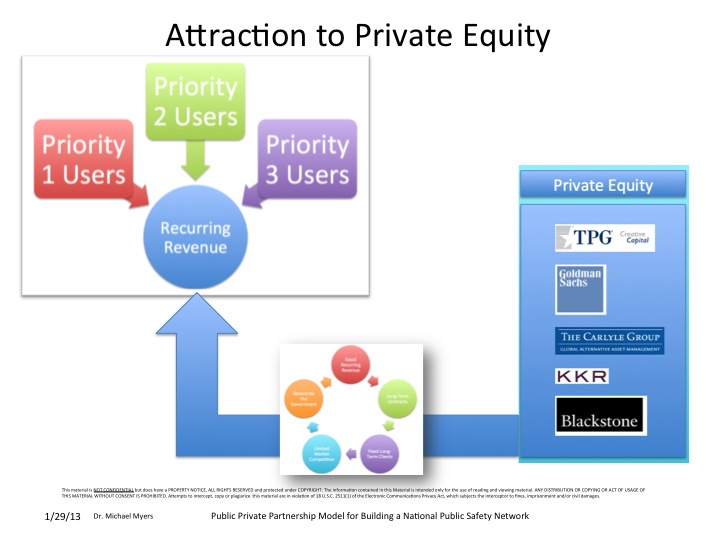
One of the main questions I get when it comes to a Public Private Partnerships, and their ability to fund the Nations Public Safety Broadband Network, is the makeup of a potential Private Equity team and how it functions.
The process is quite simple: typically for large-scale telecommunication projects; a State would put together its funding sources; construct an RFP; and advertise it to the market. Then traditionally companies like Raytheon, Motorola, Alcatel, Siemens, etc… would make a responding proposal. The all-to-familiar failings of this setup is that the business aspirations of those responding vendors, as well as the markets they typically play in, don’t align with the ultimate aspirations of the State’s intended RFP. 
For example: Motorola is a big player in Public Safety Radios (probably the biggest); Alcatel-Lucent is one of the leading OEMs for the broadband technology and Siemens is just…. well… big…they’re everywhere. Whenever you have such firms respond to your needs they also respond with their overheads and their driving force of the organizations own desires — which is typically to make money off their products.
What needs to happen is an alignment of business needs and the way to do this is by putting an intermediary into the picture…that being Private Equity.  In essence Private Equity would be the responding party to any RFP for Public Safety Broadband. All of the traditional players, such as Motorola or Alcatel-Lucent, would interface directly through a Private Equity team, established by the primary Private Equity players, rather than trying to force the State to perform anti-competitive practices in having the OEM act as the lead to deliver the solution to the State.

Capital Build

Long-Term Operations

As an example: if Motorola were to be the prime to build a State’s PSBN architecture, then naturally their competition would be precluded from playing, which means the client ultimately looses out. Why drive a broadband solution based on one or two possible hardware configurations. I mean Motorola is mainly a product-producing player not a General Contractor, thus wouldn’t be the strongest player. But…. one has to ruminate that any company can be considered a prime if they manage to sell the client on the idea. One has to also remember that a product producing company is in the business of selling products and unfortunately selling an hourly wage on a cost + material job isn’t very marketable if you carry product producing overheads in those hourly rates.
One thing that always strikes me as odd is when a client, like a State, hires an OEM, like Motorola, to build their entire communications solution. To clarify, a $100 Million dollar LTE project will have more than 80% of the scope tied up in services (Project Management, Construction Management, Engineering, Controls, Governance, etc.) and less than 20% has to do with materials (gravel, concrete, steel, radios, servers, etc.) – of that 20% less than 3% is actually related to a vendor OEM solution, i.e. LTE radios (of which Motorola doesn’t produce…yet). Why would I have a company in charge of my entire project when they only bring 3% of the total cost to the project? Seems kind of asinine as well from the OEM’s perspective. Why would I take on all the risk of a $100 Million dollar project when I only have $10 Million in product placement? Why would I then try to sell an hourly rate that is twice the average market rate? Somewhere along the way I must be paying for the project rather than the project paying me.  
Just some guy and a blog….

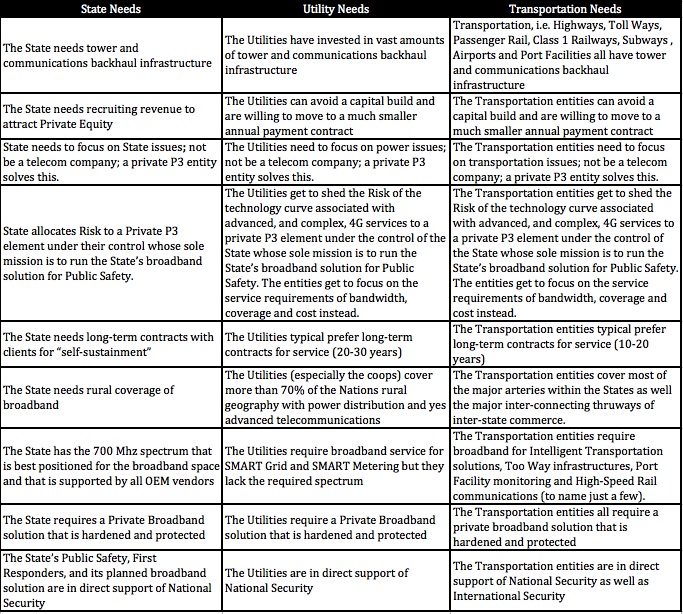
Why does Priority 2 Users make the best clients for the Nations Public Safety Broadband Network? Its’ more than just a stable revenue stream of their existing lines of business…. its about aligning the business needs of all involved.

The internal State agencies and entities, that are defined as Public Safety Support and Services organizations, are considered a great recurring revenue stream for a Public Private Partnership model to deploy a statewide Public Safety Broadband solution, which is definitely a great starting point, but its more than just that. The primary reason for Priority 2 Users is an alignment of their business needs that fit perfectly with a business partnership with the State.
As a short list of an example:

I was going to add DoD and the National Guard as well, but I make the point with just these three relationships alone in justifying the build-out of a National Security Interest such as the Public Safety Broadband Network. By not truly incorporating the needs of these players we are only justifying a desire for sadomasochistic tendencies of self inflicted pain and agony associated with the scheduling, timeline and ultimate build out of the Nations Public Safety Broadband Network without the full support of the States and the Public Safety community.  
To put things into perspective; I have six kids and I would not buy an automobile just to satisfy my needs for just one kid.
Just some guy and a blog…

Where will the funding come from to build the Nations Public Safety Broadband Network — FirstNet?

Outside of the fact that the FirstNet Board is now starting to realize that a majority of their time will probably be spent in more of a political role than appointed positions to actually build an executable framework maybe they should really start to look at a business model. One of those templates for execution should be the business model that any given State can follow…. I am talking about a framework for a Public Private Partnership arrangement that the State can use to successfully build its statewide Public Safety Broadband Network. As part of that business plan there needs to be a clear and simple context of where the revenue will come from.

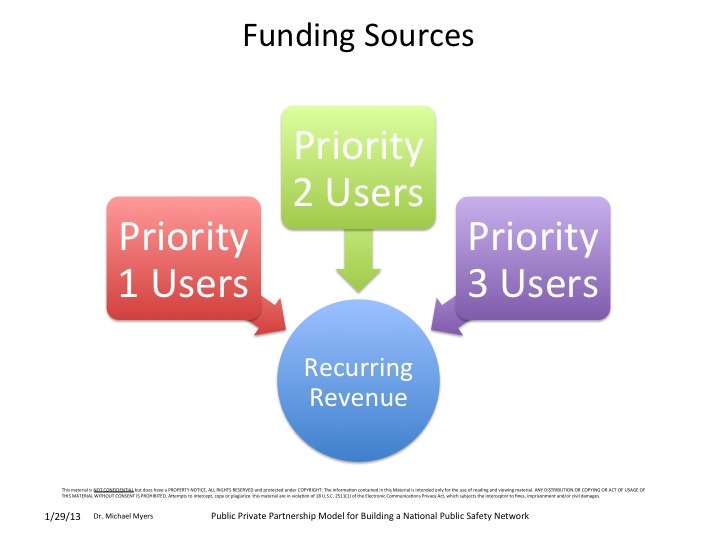
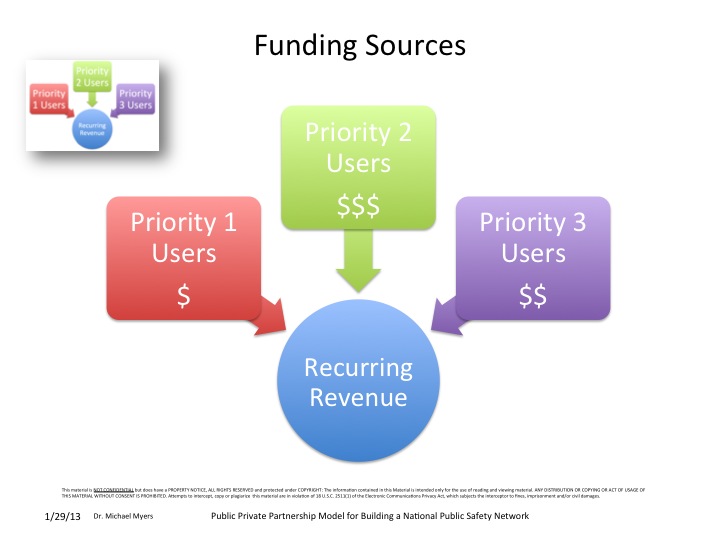
Having spent the better part of the last 10 years putting a Public Private Partnership model together that FirstNet and the State’s can use, I decided to post some easy slides so that everyone can get an idea of where the money will come from to fund this Nationwide Public Safety Broadband Network.

These slides are quite simple to understand but contextually they mold quite well with setting a course for where the money needs to come from.

The funding sources will come from the Prioritized “Public Safety Service” responsible organizations as outlined by the legislation itself it is clear to see that the inclusion of these entities has already been written into the legislation.

Through the Middle Class Tax Relief and Job Creation Act of 2012 (Act) became Public Law 112-96, 126 Stat. 156 (2012). It states in section (27) PUBLIC SAFETY SERVICES —The term ‘‘public safety services’’—
(A) has the meaning given the term in section 337(f) of the Communications Act of 1934 (47 U.S.C. 337(f)); and
(B) includes services provided by emergency response providers, as that term is defined in section 2 of the Homeland Security Act of 2002 (6 U.S.C. 101).In short, section 337(f) of the Communications Act of 1934 (47 USC), it states under sub-section(f) Definitions: The term ‘‘public safety services’’ means services-
(A) The sole or principal purpose of which is to protect the safety of life, health, or property;(B) That are provided-
(i) by State or local government entities;
or
(ii) by non-governmental organizations
that are authorized by a governmental entity whose primary mission is the provision 
of such services; and
(C) That are not made commercially available to the public by the provider

The primary element for funding the National Public Safety Broadband Network will have to come from the inclusion of Private Equity. But Private Equity needs to have a reason for coming to the table. The primary reason Private Equity would be interested is with a long-term recurring revenue stream, but they will also look for fixed string clients that are backed by the Government’s financial support. 
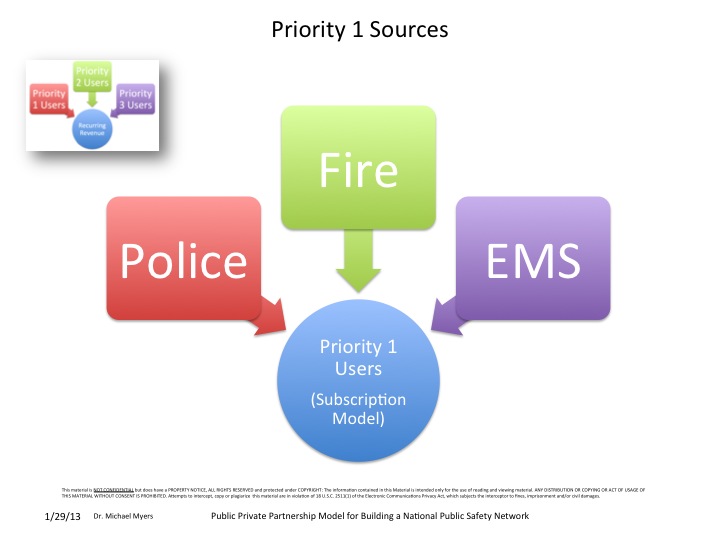
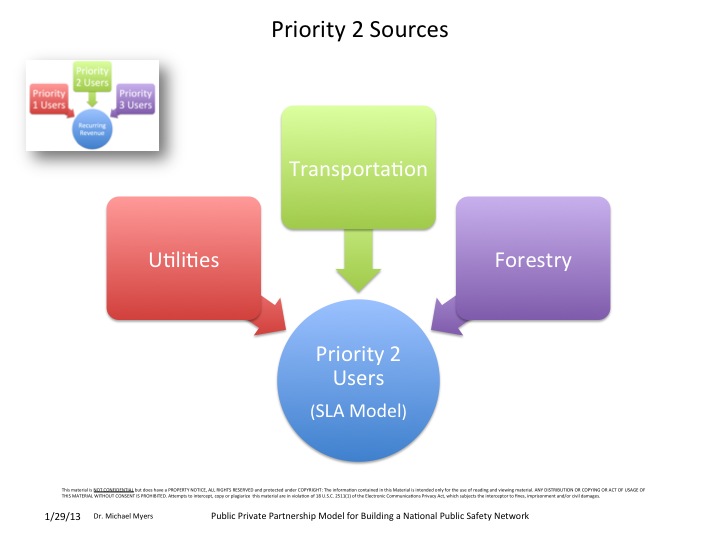
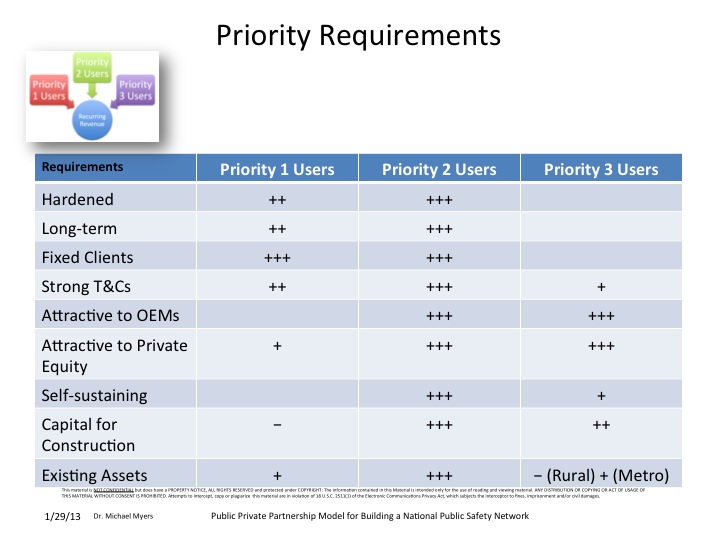
In breaking down the recurring revenue stream Private Equity will be interested in the primary sources of revenue (this is not a complete list but illustrates enough to break-even on the business model). Using the Priority scheme laid out by FirstNet in its original presentation by Craig Farrell, Priority 1 Users are made up of First Responders, i.e. Police, Fire and EMS types (short list). The primary issue with these players is their use of “subscription based” handset sales and monthly usage characteristics. This is the result of having to rely on the commercial carriers to provide them their gear. In essence they had to align with the original business model of a commercial carrier which is a “subscription model”. 

Priority 2 users are actually the new “primary source” of the funding needed to support a statewide build-out of the PSBN. In the end this is a “Private Network” no matter how we look at it, thus we are not restricted to the “subscription model” that the carriers use. What is more attractive is the standing long-term lease arrangement (20-30 years) for broadband services that eliminates the users requirement to spend capital on building their own solution and moving to a fixed operational cost model that strengthens their own internal business needs. Additionally  these Priority 2 users can off-set any existing investments for past communication infrastructure assets as available assets to the statewide PSBN plan. By moving to a fixed “OpEx” model the Priority 2 user also signs up for a fixed SLA (Service Level Agreement) with the State PSBN P3 entity that becomes the primary basis for the recurring revenue stream that attracts Private Equity. 
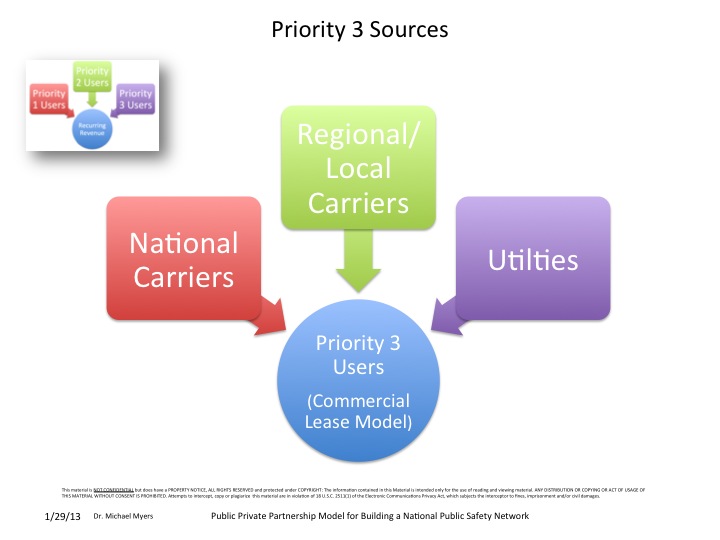
Priority 3 users are the interesting part. Through the PSBN hardened architecture and its P3 entity the commercial carriers (as well as the Utilities) can compete to access the rural broadband customers that fall within the coverage area of the PSBN network. In short, the commercial carriers would bid for the right to access these rural customers, to provide commercial broadband service, through the established architecture of the State’s PSBN architecture. Ingenious! This would mean that we can solve multiple problems with our current “Connect America” plan of which also helps pay for the PSBN architecture itself. Although, this money would not be significant it will be enough to help fulfill the State’s P3 entity with continued re-investment into the statewide PSBN architecture. 

Using the Connect America Fund and the Universal Service Fund to Commoditize Rural Broadband Access Through the National Public Safety Broadband Network (FirstNet)

Just read an interesting article by Walter McCormick of USTelecom Associates, titled “FCC Receives Boost from Sen. Schumer to Advance Broadband Investment”, dated 01-17-2013. I also read an article titled, “FCC Takes Heat For NewBroadband Subsidy Plans As AgencyTries to Give Away $185 Million”. By Karl Brody of DSL Reports. 

As written, “In a letter to Chairman Genachowski, Sen. Schumer requested the Commission to release $485 million from the Connect America Fund (CAF) to expand broadband Internet deployment, some of which could be invested in places like New York’s Hudson Valley region. Of the $485 million, Sen. Schumer noted that $185 million is left over from unspent 2012 funds and $300 million is available this year.  He applauded Chairman Genachowski for proposing new ideas for getting these CAF funds flowing into the economy.”
I have a proposal as well, that is that the FCC should consider the fact that with the commoditization of Internet access maybe it is better served as a common utility rather than a service offering from a commercial carrier carried on commercial infrastructure.
It’s a fact that the commercial carriers are desperately trying to shed pre-existing infrastructure to improve their ROI (return on investment), which is not a bad thing. But it limits their ability to build out to areas that produce little to no return on investment. Yes, the CAF and USF (Universal Service Fund) is supposed to help eliminate this problem, but in reality it just aggravates the issue. Why? Because if the commercial carriers use the money to help build out to these areas they still have to maintain and manage those assets for the long-term, which means they become responsible for the long-term future. In essence they are “left holding the bag”. In reality though you still do not eliminate the issue of ROI…it just prolongs the inevitable.
If we allow the service to be commoditized as a utility service then we envelop the issue of ROI into a much larger asset base of utilities; or into a financially doable model where as the commercial carrier can bid for transport access to the customers as Priority 3 users a consolidated Public Safety Broadband Network (PSBN). In short, we can use the already existing infrastructure of commoditization of the Utilities; and/or we can allow the carriers to access these rural clients through the PSBN infrastructure, thus they avoid the ROI problem by not having to build anything…. just a pure revenue deal. Did you know that there are 31 State Electric Cooperatives in the State of Oklahoma and they cover more than 75% of the rural geographic landmass of the State…and they all have extensive communication infrastructure?
It just makes sense to use the underutilized bandwidth and spectrum on the PSBN (termed as priority 3 usage by the NTIA/FirstNet) for rural broadband access, which means the ability to allow rural, or local regional carriers, national carriers, or even the Utilities to sell broadband access to the rural Americans that lack broadband coverage. How we can achieve such a solution is quite simple…. through a State generated Public Private Partnership that will help build the statewide portion of the National Public Safety Broadband Network.
Regardless of the valiant efforts of Sen. Schumer maybe we should consider that the funds associated with the CAF and the USF should be utilized to extend rural broadband coverage through the National Public Safety Broadband Network as Priority 3 users. Sounds like a great way to fiscally save some money, align better priorities, and adjust the course to where the market is heading. But what do I know I’m…
Just some guy and a blog….

In a short and succinct couple of paragraphs; How do the Carriers and the Utilities play in the Public Safety Broadband Public Private Partnership?

A recent question was asked of me; that is, in a short paragraph, can I explain how the commercial carriers (AT&T, Verizon, etc..) and the Utilities can play in the PSBN Public Private Partnership arrangement? The topics will be presented in a webinar on the 10th of January by FORCE.

Here are those paragraphs:

How the commercial carriers play in the Public Safety Broadband Network is quite simple. The primary reason of the contention today is because of the cost to build out cellular coverage for commercial users to the rural areas. The associated cost doesn’t justify the ROI on the investment. A solution to that, not talking about major metropolitan areas, is for the carriers to wait for the PSBN architecture to be built then, using the priority scheme addressed by FirstNet (that being priority 1-3 users), focus on bidding for access to those priority 3 commercial broadband users that fall within the coverage area of the PSBN. This eliminates the need for the commercial carriers to spend money on building any of the infrastructure, yet at the same time allows them to reap the benefits of pure revenue from new commercial customers further increasing their ARPU profit margins. 
How do the Utilities play in the PSBN? This is a more complex arrangement in that the Utilities will see a great cost advantage in partnering with the State PSBN effort. In short, they can write-off investments made in existing communication infrastructure by leasing or selling those assets to the State P3 PSBN solution; avoid the costly exercise of a capital program to build it themselves which would be in the millions of dollars; they can define the hardening requirements for the State P3 RFP itself; they can fixate on a fixed annual operational payment for service thus eliminating the chaotic behavior of cost overruns for new advancements and upgrades; they can pass the risk of the network upgrades and advancements to the State P3 entity whose business it will be to run the State PSBN solution for them as clients; they can align with the market movers in influencing the OEM manufacturing process for new technology in handsets, radios and the assorted user devices; and ultimately they can access a rich field of broadband spectrum that is in a controlled private, hardened, environment and that meets their requirements that align with their own business goals. 
A third part that both the carriers and the Utilities can prosper from, as well as others, is the ability to also take the stand as a potential private investor in the State’s P3 itself. In essence they could invest money for a proportionate share of the company while in return acquiring a return on their investment of being a client on the network itself. 
of course….
Just some guy and a blog…

FirstNet, a Business Model, and the only way we can build and self-sustain this big network?

It should be easily to see that a simplistic view of what the Public Safety Broadband Network is going to be. In short it’s nothing other than a private LTE network, much like AT&T and Verizon…only in this case you don’t have all the existing old 2G and 3G infrastructure to deal with, no margins on subscription fees, plus we don’t have to be weighted down by the OEMs…or do we?
There is a lot of confusing talk about the complexities associated with feature-sets, interconnectivity and interoperability, but realistically its just a cell phone network on steroids. It has a lot of potential and has the ability to drive a lot of customization and technical advancements that we have never seen. But will we really see them?
In the real world it takes money to make things happen. The only reason we have the advancements of LTE today is due to the fact that the carriers sell services that users want (most of the time). That demand creates revenue, which drives the OEM manufacturing process (equipment manufacturing). In order to differentiate themselves the OEMs create new and better technology advancements that the carriers can use and that the users demand…but what happens when the network is limited to just a few types of users?
If the Public Safety Broadband Network, FirstNet in this case, does not adopt a business model that taps into all its available, potential, clients then how do they expect to create the demand? Sure we can put money out there, taxpayer money, to build the solution, but how do you create the “self sustaining” element? By “self sustaining” I mean the entire ecosystem that is driven by user demands which manipulates the OEM process. We can’t just expect that we will build the network, and even fund its long-term operations, without having the user demand side drive the research and development of the OEM process. If we do then we will have a really big and overly complex broadband network that we can’t even begin to fully use. It’s like we just bought a Ferrari but drive it like a shopping cart around the Walmart parking lot.
After spending the better part of 10 years researching and publishing on this topic; I have the luxury to promote my professional opinion… that there is only one real way to successfully deploy this network, align all the business goals, plus still have enough generated revenue to provide for the network for the foreseeable future…. a Public Private Partnership that is funded by Private Equity and controlled by a representative board of elected share holders. This is the business model that the States are beginning to explore and it’s the best solution that FirstNet should adopt….but…I’m…
Just some guy and a blog….