There is a lot to understand about the upfront process that a State must perform before FirstNet presents its plan – in November! You should note that FirstNet isn’t making it any easier for the States to “Opt-Out”. Pushing their schedule forward to come up with a solution that will be presented in November is not done by mistake – it’s done by design. FirstNet knows the State will have to accommodate a lot of information before a Governor can make a decision, and that the 90-day period following FirstNet’s presentation to the Governor is way too short for such a decision, thus their pushing the timeline so expeditiously. It’s not to FirstNet’s advantage that the Governor get a competing bid.
“September 30, 2016 for consideration in State plans. During the meeting, participants were reminded that if a State Governor does not make a decision to opt in or out during the 90-day period following the finalization of the State Plans, FirstNet will move forward with implementing the network deployment in that State.” (ref: National Law Review Article)
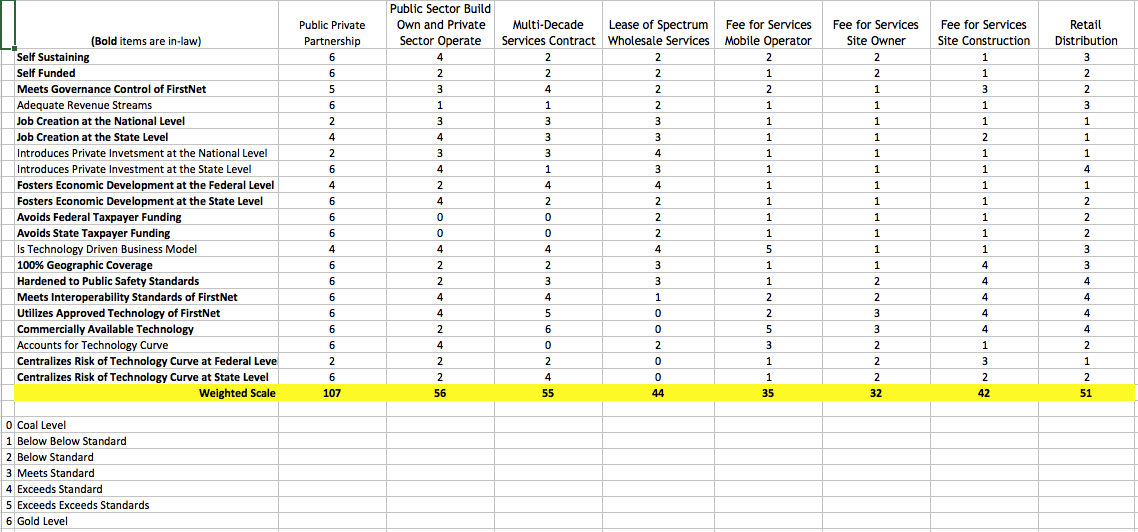
If a State wants to really investigate its “Opt-Out” solution against the “Opt-In” solution, then it needs to get the ball rolling. That ball needs to start with a good conceptual understanding of how their P3 (Public Private Partnership) will be put together; which equity players are interested; what is the capability of your EPC (Engineer, Procure and Construct) contractor; and what technical roadmaps will be established. If you go by FirstNet’s rules that means a State only has 10-11 months to put together a viable “Opt-Out” solution to compare against FirstNet’s plan.
Once you have your P3 strategized, and your team selected that you want to move forward with, then you can start to focus on deliverables. Using your selected EPC (this is the entity that is really putting the team together) the State will need to fund the Analysis stage. The Analysis Stage is the phase where we formulate package deliverables that will be utilized for the Governor and the follow on phases of work. These deliverables will be required for the Governor to make a sound call on either “Opt-Out” or “Opt-In”. Some of the deliverables, and probably the most important, will be the Revenue Projections and Product Forecast; Market Analysis; a resulting schedule for rollout using the marketing material and the projected revenue; and the overall design solution based on the projections and requirements laid out.
When the Governor makes the “Opt-Out’ decision, which I’m only going to discuss because it’s the only real option that makes any sense, it becomes the catalyst for the P3 to really start engaging with Private Investors to fund the DBOM (Design, Build, Operate and Maintain) solution for the State. Most importantly outlining the Revenue Projections and the Product Portfolios for the newly established broadband company within the State. Nobody is going to invest without knowing what the market is, how much revenue they will get back, and over how much time. At the same time the EPC contractor will start the Approval stage for the State with the NTIA. Once the approval is granted, then the EPC will help the State apply for its grant[1]from the NTIA to help build its solution (you should note that in the “Opt-In” scenario the State actually has to help fund the FirstNet’s build using the State tax-base[2]). Simultaneously the EPC will also file for the use of the spectrum for the State with the FCC.
Once the Approval is granted, not the Grant approval, the P3 consortium will execute under a new broadband company for the State, with the State being part owner, thus acquiring revenue to re-inject its equitable proceeds back into the State’s Public Safety needs. You should note that the law does not say anything about the State not putting its share towards Public Safety. The law only states that “FirstNet” has to re-invest any money it brings in – the law says nothing about the State. But to be fair I would encourage any revenue the State makes through its P3 be re-invested back into First Responders.
So in short, if the State Governor decides to “Opt-In”, then it will be facing the issue of helping to fund FirstNet’s plan. If the Governor decides to “Opt-Out”, then the State would get funding from the NTIA (part of the $7 Billion that FirstNet got from the sale of other spectrum assets). That’s a hard decision to be made? What would you do with that Grant?
There are many possible scenarios on what to do with the Grant money, but one thing is for sure, the funding has to be used for the DBOM of the State’s Public Safety Broadband Network.
As an example, once the Grant is approved, those funds would go to help the State design-build its interoperable solution. The injection of the cash could be in the way of an availability payment to cover Priority 1 First Responder using the access of the new broadband company; or it could be priced equity shares within the NewCo for the State to increase its share of ownership, thus more revenue. There are many ways we can fry up this fish.
The important thing to remember out of all of this — if the Governor wants to have apples-to-apples comparison between “Opt-Out” versus “Opt-In”, then it needs to start developing this strategy quickly. You don’t want to be left behind when all the States start crashing the party to do the same thing.
Here is a flow of what seems to be working:
- 1 RFP
- State puts out RFP asking for a P3 solution (just like New Hampshire did)
- State picks its solution team
- 2 Development
- State funds the 10-11 months
- EPC puts together all the packages for the State Governor to make a decision.
- 3 Approval
- Governor makes decision to “Opt-Out”
- State seeks approval from the NTIA (using the same EPC to do the footwork).
- Plan approved
- 4 Apply
- Once approval is granted then EPC and the State apply for the Grant from the NTIA.
- The EPC helps the State apply for its spectrum usage from the FCC.
- 5 Execute
- The EPC then goes to work for the P3 entity created (funded by the P3 entity)
- The investors are aligned (including the State)
- Funding is put in place
- Construction begins
But what do I know I’m…
Just some guy and a blog…
[1]HR 3620 Section 6302 (C) (iii) APPROVAL — If the Commission (FCC) approves a plan under this subparagraph, the State— (I) may apply to the NTIA for a grant to construct the radio access network within the State…
[2]HR 3620 Section 6302 (e) STATE NETWORK —(1) NOTICE — Upon the completion of the request for proposal process conducted by the First Responder Network Authority for the construction, operation, maintenance, and improvement of the nationwide public safety broadband network, the First Responder Network Authority shall provide to the Governor of each State, or his designee—(A) notice of the completion of the request for proposal process (B) details of the proposed plan for build out of the nationwide, interoperable broadband network in such State; and (C) the funding level for the State as determined by the NTIA.
 Advancing Telecom