Looking for that next gig!

Yes, I’m looking for the next gig. I really like doing consulting work, and can definitely help out a few States, companies, and/or Federal organizations, when it comes to understanding FirstNet, what has to be done, and when things will get started, and when you need to take action — essentially where you need to spend your time and money.

At the same time, as you can imagine, I have accumulated a lot of contacts and respondents on the topic of FirstNet, and the Public Private Partnership framework. As of today, I have conversed with more than 30+ States (Governors, SWICs and SEIC committees), 2 Territories, 5 major Private Investment players,  and an assortment of OEMs and vendors. I have briefed them all on the P3 model and have blogged to more than 23,000+. I have also presented, and communicated, with most of the FirstNet Board and Bill D’Agostino’s organization. They are a great bunch of Americans who have high hopes of making this a success.

Let me know if you would like some expertise to help your organization out.

If you need some background, just check out my blog or email me.

Dr.Myers@me.com

Just some guy and a blog….

FirstNet Public Safety Broadband – State OptOut directions!

On the FirstNet website you can find out about their consideration for the “Opt Out” process through the following document entitled, “The Process for Working with FirstNet“. I cut and pasted the bottom portion of that material so that I can address it straight on.

Funding the Build-out

If the state’s plan is approved by the FCC, the state may apply for grant funding from NTIA. To obtain federal funding to construct a RAN, a state must demonstrate it can:


For this first part you must understand that even if you come up with a plan, and file for grant assistance, it is already well known that their is not enough cash in grants offered by the Federal Government to accomplish the national build-out — let alone long term “self-sustainment”. The only way to fulfill these requirements will be with the State’s taxpayer base to fund the rest, essentially hitting the taxpayers with State and Federal robbing Paul to pay Peter. At $7 Billion dollars — if we get the full $7 Billion from the spectrum auctions — it only equates to $125 Million per State and Territory (if distributed equally). The reality of even getting the full amount we should expect will fall short, thus that $125 Million will probably be even less, thus, the State will have to pay more.

Through a State based Public Private Partnership, the State can generate enough cash by sharing the revenue collected with Private Equity. Private Equity steps in a funds the entire build, and its long term operations, thus avoiding any taxpayer requirements, or grant dependency.

Provide the technical capability to operate and fund the RAN

When it comes to the technical capability, the State will use the specifications laid out by FirstNet, from there it will also follow operating procedures of the Core solutions and interoperability standards. Given that there is only a few viable LTE, and Core solutions, it will be uncomplicated in the technical adoption. This only accounts for the LTE and the backhaul solutions, the mobility and access piece will be a different beast.

Mobility and access will, most likely, follow the demands and requirements of the State. Every state, and territory, has an installed base of LMR solutions, thus, a reliance on certain vendors, i.e. Motorola, Cassidian, Harris, etc.. This is where it starts to get interesting, at least for the Public Safety piece. For the “other Public Safety Service Organizations”, such as Utilities, Transportation, and any other vertical industry, can take it a step further by aligning with their committed vendors as well, i.e. Cisco, Juniper, and others, but these users are only paying for bandwidth and coverage of broadband service, and are limited to Priority 2 scenarios. This provides the Priority 1 interruption solutions that are required for Public Safety, plus, it is controlled by Public Safety as well.

In the end the users of the network will bring in the recurring revenue to attract Private Equity, who in turn will pay for the capital to build and maintain the network statewide, at the same time sharing in the revenue. There is no better plan that meets these characteristics.

Maintain ongoing interoperability with the FirstNet network

Through the Public Private Partnership, the State is in control of the Special Purpose Vehicle (new company or SPV) that will design, build, operate and maintain the State’s Public Safety Broadband Network…for the long-term. As part of that long term plan is the utilization of FirstNet’s interoperability standards as laid out. By doing so will allow the State to operate its SPV just like a typical carrier, of which it can envelope commercial carrier roaming agreements as well as cross State agreements for network roaming. It really is no different than a carrier, except this network will be private, hardened and managed under the guidelines of Public Safety first.

Complete the project within specified comparable timelines

This part is quite easy, in fact, it will be a lot easier to deploy than any other model, reason being  is that the contractors and vendors will be working for a Private Equity team rather than a government run capital construction outfit. In short, the contractors, and vendors, will feel more comfortable in that they know the project is solidly funded; they will get paid; and will be able to make more expedient decisions in the deployment and operation — less red tape. With such characteristics the network will, most undoubtedly, have faster timelines towards a successful build out.

Execute its plan cost effectively

As you may already surmise, what better way to be cost effective when the State, Federal, taxpayers don’t have to pay for the network and its long operation. How much more efficient can you get? Plus, it will be in the best interest for the Private Equity teams to utilize as much as the existing assets as they can, it will cut down on capital needed for the build, as long as the State approves those assets for use. Just remember, as I have said in the past, sometimes its more expensive to remediate an existing tower than it is to just build greenfield, especially when you have such robust hardening needs. The beauty of the State’s P3 model, is that it takes all this into consideration, and will use the most efficient manner possible in insuring it’s cost effectiveness.

Deliver security, coverage and quality of service comparable to the FirstNet network

As compared to the FirstNet proposed carrier relationship model, the P3 model is way more capable of delivering the exact needs of Public Safety and the users. It is Public Safety and “those users” that dictate the design, and structural hardening requirements, right from the beginning. The entire network design will be based on the collected needs of its users and will utilize the most stringent design requirement needs as the basis for the entire design, thus, capturing all the lesser user requirements holistically. The alternative is to use the carrier infrastructure, funded by the taxpayers, to augment their infrastructure, which it turn benefits the commercial side more than Public Safety, while at the same time putting the bill on the taxpayers, as was discussed above, which ultimately impacts the State more than the Feds.

Plus, we haven’t even addressed long-term operations and maintenance of the national control center and data center requirements, who will pay for that? Actually this is where the $7 Billion can be utilized, but even the $7 Billion won’t be able to cover the long-term O&M. The P3 model at the State level can! It’s all part of the terms and conditions that will be laid out by the State to the Private Equity respondents.

There are additional funding implications if a state receives approval to build its own RAN:

States pay any fees associated with using FirstNet core elements

Why is it we put so much attention on the Cores? It’s not because they cost too much, in fact they will be less than 1% of the total capital program. The real reason is all about who controls the network. The fact of the matter is the attention really needs to focus on the Accounting and Billing platforms, this is what the State’s need to control. FirstNet can control the Core’s all they want. The real important stuff will be in collecting the revenue of the user base within a State’s boundaries. Technically you can deploy the Core solutions, based off the FEMA Regions, as planned by FirstNet, but, financially the State needs to be in control of its billing and revenue collecting operations. Actually, the State must control its own financial governance. Outside of the obvious point that revenue must be collected from a State’s own user base, it also needs to fulfill it’s P3 obligations with Private Equity. The State’s business model will be a disaster if they let the Federal Government come in and control the State’s revenue collecting operations. Why would anyone want to give all their revenue controls to someone else? That would be like Verizon allowing the Federal Government to come in a control all their revenue. Don’t think there would be too many happy investors wanting to play in that business.

As for fees for using the Core, they will be minimal compared to the revenue operations. In fact, how does one State pay the Feds for a Core that was paid for by an adjoining State? Why would the State that houses the Core, to which they also paid for the Core, why would they need to pay a fee for their own asset they purchased? If anything, FirstNet just needs to be a part of the State’s P3 model, they will make more money that way than any other model, probably enough to run their long-term O&M nationally.

Grant program specifics are not developed yet

What’s new?

NTIA will determine: eligible costs of the grant program; whether a match will be required; and funding levels

Won’t be necessary if the State deploys the P3 model. What would be the matching fund requirement if grants aren’t used and private investment pays for the entire build — and O&M? Short answer….none!

Licensing FirstNet Spectrum

If the state plan is not approved, the construction, operation and maintenance of the state RAN will proceed in accordance with the FirstNet plan. If a state receives approval to build its own RAN, the state then needs to negotiate a lease for the use of FirstNet spectrum.

Sounds fair to me.
FirstNet — Are they making a decision on moving forward?

Picture yourself in the middle of a room, there are no windows and there is only one other man in the room who is holding a gun. You notice that he is very nervous and twitching as he walks around, then the lights go out. That’s what it feels like right now with FirstNet.
As with any new market, in the beginning we see a huge upturn in the amount of activity, then we see a drastic down turn, then we start to see a gradual upturn that is sustainable. For the time being we are at the bottom of the drastic downturn. I envision that we will start see that gradual upturn now. The only thing that is holding us back is FirstNet, which is odd given the fact that they want to build this network so badly. Well, sometimes you are your worst enemy.
My suggestion to FirstNet, come to realize that you need to pick your model and move forward. Things change all the time, so expect that the change will impact you in the future, that’s business.  The carrier model is going to be fraught with problems. The only viable solution, for such a large build out, is through the Public Private Partnership at the State level. Nothing is perfect, but it is your best chance at success. Even if you do the carrier model, joined at the hip with the carriers to deploy the network, you still come to realize that you aren’t meeting a few of your prime directives – funding, self-sustainment, hardening and coverage. Actually I think those are the only real directives.
Carriers won’t give you any funding and the taxpaying base will be a huge issue for the foreseeable future. The only way to truly get the money you need to build the network will be with Private Equity.
Self-sustainment will be an issue with the carriers as well. If you think the carriers are going to convince their shareholders that they should just maintain the network without any real return, think again. The carriers work on a subscriber base, which is not even close to being achievable with Public Safety. You need the support of all the Public Safety Service organizations to make this work, and think again if you think these players really want to do business with just the carriers. If we stick to the rules of hardening, that alone will sink that ship.
Hardening will be an issue with the carriers because they limit themselves to just enough back up generation to accommodate their ROIs, that would mean someone has to pay for all of the carriers and tower company upgrades. Sounds like a sweet deal…. if you are a carrier or tower company. Plus, who will maintain it? Better yet, who will pay to maintain it?  Well with the carrier model it will be the taxpayers. With the Public Private Partnership you base your design off the needs of its users, not what asset the carrier or tower company has, and, you can generate enough usage and revenue from the users to attract private equity, thus avoiding the State, or the Feds, having to pay for the build and its long-term management. To add to that, the carriers can actually become a client themselves of the PSBN by focusing on the transport of rural commercial traffic to their network – another source of revenue for the P3 model, which in the end solves another problem – broadband access to rural Americans.  Imagine that. The carrier model won’t do that. In fact you even solve the carriers problem of trying to break into the rural markets without overspending on assets to areas that generate very little revenue in return — in the P3 model they actually go straight to revenue. 
And finally, coverage, we need to stick to our guns and target 100% of geographic landmass. By partnering with the carriers you will only cover 40% of the geography, and, it will only be targeted on the metro environments. The metro environments will not really be an issue. All we will do with the carrier model is add capacity to their business, yet Public Safety will still face the same issues we face today – hardening, self-sustainment and funding. With the P3 model it is to the benefit of Private Equity to build 100% coverage, more users, and we are not just talking about any users. These users are fixed and stalwart and have no issues with payments. These clients also have a direct need for broadband-access – LTE access – to maintain their own business models, in fact, for some of these clients it is mandated (reference ARRA funding per DOE for SMART GRID for example). Plus, some of these clients have more telecom infrastructure than the carriers themselves. To add to all this, we can even sell the under-utilized bandwidth, or usage, to the carriers to help them in the metro environments as well — all be it on a Priority 3 basis — just like we would in the rural markets.  
All we need is for FirstNet to grab hold of the Public Private Partnership model, and its execution at the State level, by doing so, FirstNet can implement best lessons learned from each of the statewide build-outs as they progress and administer any changes to the follow-on State installations. Plus, this model uses the spectrum to its maximum benefit of creating revenue, revenue that can be shared between the State and FirstNet if they want.
In the end, if FirstNet does not accept the model, then they risk missing out on such plans and certain States will commence on their own, netting all the benefits.  Then again why would you listen to me?

I’m just some guy and a blog….

Anybody need a good consultant on FirstNet or deploying large telecom programs? I’m available.

Public Safety Broadband and FirstNet — Down to two LTE vendors — Governor, what are you going to do?

As I predicted in my earlier posting on July 17th entitled, “FirstNet: we only have three LTE vendor choices that make sense…allow me to explain.” Those three viable companies will now shrink to 2 if Alcatel-Lucent doesn’t get it’s act together. You can read for yourself in a recent article in Fierce-wireless, “Alcatel-Lucent’s Combes: ‘This company could disappear“.

This would mean an Ericsson and NSN market for the majority of the build. This makes things less complicated. It would be even nicer if NSN were to buy out ALU, reference “FierceWireless Reports: Nokia’s board considering NSN deal with Alcatel-Lucent“. Together their product lines for LTE would be able to dominate the market to no end, leaving Ericsson with some real competition, but what about Motorola? Where do they play in all this? Unfortunately, much like the case was with LA-RICS and Raytheon, the scope just doesn’t match Motorola’s business. That doesn’t mean Motorola will let anyone get close to their turf without a fight though, thus, the bad press for Motorola lately. Motorola has deep and entrenched relationships throughout the entire Public Safety space, but they aren’t a data IP company. They will make a big splash in the handset and mobility market though, but they will face steep intervention and competition from players like, Cassidian, Harris and others. I would actually anticipate that these players will eventually see a consolidation as well, just like the telecom OEM space. For the time being, we just need to concentrate on the build out of LTE, and that means Ericsson and NSN (with ALU?).

So what next? Well FirstNet needs to get its act together, and some States need to grow a pair. The build is not that difficult to manage, what’s complicating the matter is money. Whether its about how much it will cost, or how much the government will pay; or a State’s decision to use a P3 (Public Private Partnership) to monetize a State’s spectrum, this is what is holding things up. Everyone claiming they have the best business model. In reality, it really is quite simple — just think like a wireless company that is being formed from scratch and then execute. All of your scope in the beginning will be about building towers, and less to do with, if any, Public Safety. The fight is all about who will control that company, both nationally, and in the State. It may be hard for a Governor to understand this, but he, or she, can create a private company that falls under his/her control, of which controls their own internal piece of the nationwide Public Safety Broadband Network.

The question is simple: Governor, do you want to control your own fate and create your own economic boom? Or, do you want the Federal Government to come in and do it without you — at the same time taking your tax dollars to fund it?

Just some guy and a blog…

Public Safety Broadband – FirstNet – What is the real reason people think the carriers should build the PSBN?

I just read Fierce Mobiles article “Slow Rollout of FirstNet could doom nationwide interoperability”. It was an interesting read, but I don’t agree with Mr Peha. In a short phrase from one of my earlier mentors, George Cirolini, I can hear him say, “well that’s a bunch of bull larky!”
Just because you do a deal with the “devil” (one of my earlier entries) doesn’t mean the network will be up and running any faster with the carriers. Remember, we are using new spectrum, spectrum that even the carriers aren’t deployed on, that means antennas need to be installed, towers need to be retrofitted, backhaul needs to be upgraded and coverage maps need to be redrawn….just like a new network. Plus, imagine all the “interoperability” that needs to be designed into the carrier’s already existing topology and network process architectures, such requirements alone will over complicate a carrier solution for FirstNet. How do you keep this new network, which would be, supposedly, delivered by the carriers, seperate from the revenue business of a carrier? You wouldn’t, because that is where the gotcha is….the carriers gotcha at that point in time, and there is no easy way out from then on because all of your infrastructure, and requirements, will be entrenched into the carriers revenue generating architecture.  The only way you can even consider a deal with the carriers to be quicker than a statewide deployment, would be through an MVNO (Managed Virtual Network), which, if that were the case, why dedicate spectrum to Public Safety? The whole reason we have separate spectrum is because this will be a protected, private and secure network, not just another virtual network. But what do you expect when a bunch of lawyers are designing a network, if that were the case then I should be able to script law.
Why do we need to deploy the network in such an expedient manner anyway? Once consruction gets started, it is what it is. The truth is, it would actually be faster to build at the state level anyway, and for those that think the network will end up being a mish-mash of networks, think again. For the past 40 years we have been building towers for backhaul. Microwave and fiber transport connections haven’t change all that much in how they are installed. Even the cellular networks have been installed, built and designed the same way since our first generation cellular towers. So why do some within the industry think it won’t be feasible for us to build a private network, and that only the carreirs can do this? Like I said the carriers haven’t been building their own networks for years, heck, AT&T is selling off their infrastructure of towers to the tower companies in order to get away from owning the assets. Why would a carrier suddenly decide to reverse course just for Public Safety? 

We mustn’t over complicate this — all we are doing is building a wireless network that happens to cover more ground. In the past our designs and coverage maps were developed to get market penetration for the most handset subscribers, with Public Safety Broadband we don’t have those complications — it’s all about complete geographic coverage. Mr Peha brings up some good points, but he is all over the map on providing any real guidance as to how to build the network. It’s way to easy to overcomplicate this network rollout, when in reality its just another wireless construction job.

The most expedient way to build this network will have to start from a center point (regionally) and built outward, that means project schedules, design timelines, sub contractor agreements, local resourcing and tower construction from the ground up. The only thing that would delay “Greenfield” is site acquisition, but site acquisition is a problem for the carriers as well, so the gains are moot. In this case we are talking about a national security interest, so we are actually positioned better than a carrier in that we can get site acquisition and zoning approved faster. Building a site from scratch would be the best, in that you don’t have to redesign different tower solutions. You just set a few standard templates for tower sites, with slight modifications, you can build a new tower quicker than trying to retrofit an old, especially when it has to be hardened, thus was the case for LA-RICS. This doesn’t mean we just abandon all the existing towers assets, you just pick them based on the design needs and their hardening characteristics, no need to waste past investments. 
And this thing about handsets being more capable on commercial networks is not true either. You have to create new handsets anyway for hardening characteristics and the band 14 usage. Existing radios and handsets aren’t equipped with such needs. Face it, this thing is best designed and built from the ground up, we just need to get over it and get the network started. Hat’s off to Pat Mallon and the LA-RICS for making that a reality and I look forward to New Mexico. Let the actual guys who build LTE do their job….carriers will do better just waiting for the PSBN to be built, then come in to bid on all the rural commercial users through the newly installed tower base.
Oh, and by the way, drop the talk about satellite for the time being, we got enough to focus on when it comes to LTE. Of course we will find a solution for the very remote areas using such technology, but, we shouldn’t mix project goals. We should focus on layers and phasing of the rollout of the network. 
Then again….
I’m just some guy and a blog……

FirstNet to give spectrum to the carriers!?

Well, I’m on a flight back to Dallas from the PCIA conference in Miami. It was a, how should I put it, quaint conference. I really enjoyed meeting all the people. I seem to be in my 15 minutes of fame, because people are starting to recognize me, especially the FirstNet guys.;)

Which, speaking about FirstNet, I have a topic I would like to talk about. That topic is about FirstNet’s possible plans to give the spectrum away to the carriers, as a means for them to build FirstNet — if that were such a great idea, then why didn’t the first auction work? Why is it we think its a better idea to just give it to them instead? At least before we made some money off it.

By granting the use of the spectrum to the commercial carriers, we would be robbing the States of some badly needed economic recovery. Plus, a carrier delivered solution will be a disaster.You will never be able to mix business models on this one. The carriers are in it for the revenue and Public Safety is not. By allocating the spectrum over to the carriers, all we will be doing is lining their pockets with more cash based on their business model. Why is it so hard to understand that it’s in our best interest to let the States build their own networks based on their own Public Private Partnerships?  This does not discount the carriers as non-players, in fact, it actually benefits the carriers more on what their ultimate objective is — that is to improve margins, and bring in more revenue, without having to own, and maintain, more infrastructure that detracts from their bottom line. Hellloooo, anybody in there?

Let’s make it simple; Public Safety needs hardening and total coverage. The carriers only need just enough hardening to insure service, and don’t need total geographic coverage. Population wise the carrier already covers 98% (40% geographic), of which, Public Safety already covers 100% of the population with LMR. To any simple minded person, it would seem logical that partnering with the carriers would be a good idea, but, in fact, it would be a disaster, because Public Safety needs a HARDENED NETWORK THAT COVERS 100% OF THE GEOGRAPHIC LANDMASS — NOT 40%! The business needs do not align. Who pays for the areas that aren’t being covered? So its OK to just give the spectrum away, cover only the metro environments, and then let the taxpayers pay for building the carriers network into the rural areas, so that the carrier can spread their commercial model even more?

If you want to do a deal with the carriers, so you can cover 40% of the Nation, then just buy a total solution MVNO (Managed Virtual Network Operation) from the carrier you want to work with, why do we need to give them spectrum? Do we honestly think that just because we give them the spectrum that they would do anything different in how they collect revenue for their business, or how they manage their move away from owning the infrastructure? They will get the spectrum, then build it to their needs, and yes, they will give you some service out of it as well. But, in reality, all we would be doing is fulfilling their corporate dreams of commercial service, not Public Safety’s need. After 10-15 years of waste and abuse the State, Congress, or the Federal government will have to step in, then what happens? What happens to all that co-mingled communication gear on commercial carrier networks within the metro environments? What happens to all the needed rural tower maintenance and upgrades? Who will pay for all of this?

I’m afraid to say it, but a State based Public Private Partnership is the only real way to make this a success. If you aren’t getting this message yet, then it’s starting to become obvious that alternative motives are at play, and issues more credibility to the claims of Board abuse within FirstNet. I think we may becoming to a point in time where we start seeing State’s take action on their own…after all why should they wait? It will be a call to arms for the State to take on its own build, and use the spectrum to the benefit of the State and its constituents….not another Federal organization. What happens in the next government shutdown where FirstNet could experience its own furloughs? What will the State’s do then?

But then again, I’m…

Just some guy and a blog….

FirstNet — How many towers and what will it cost?

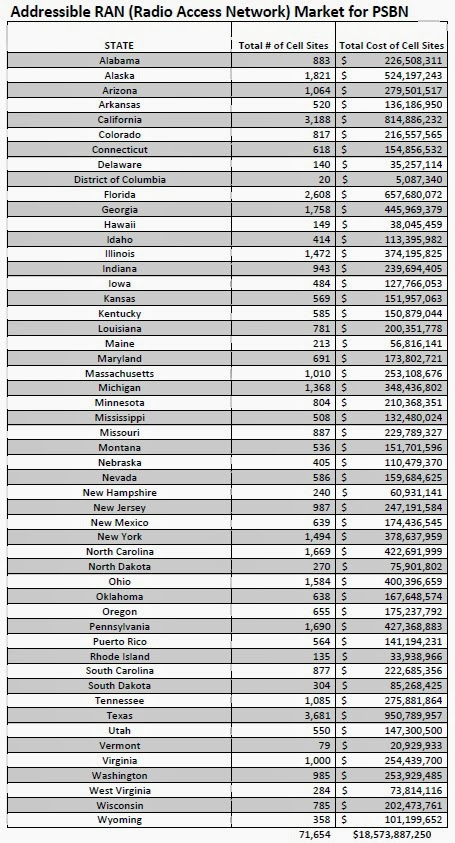
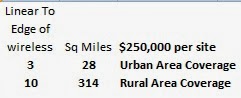
Here is an interesting fact: if you take the square footage of the United States, from the US Geological website, it breaks down how many square feet we have in our Metro versus Rural environments. By using those figures, and mathematically accounting for your fixed tower coverage at 100% with LTE (Long term Evolution), then multiplying it by an average of $250K per site, you can figure out just how much it will cost (roughly) to build just the radio access (RAN) portion of FirstNet. I have listed that calculation broken down to the State level. This gives you an idea of what it will cost and how many towers will be needed per each State (no territories at this time). The RAN is just the tower portion, and does not include fiber access, microwave (although it could on this piece),Data Centers, Control Centers, mobility or handsets….not even long-term maintenance.
We need to understand that, using the LA-RICS as an example, we all believe that the use of existing towers is a must, but, you must also understand that the cost of remediation (fixup an old site) may cost more than just building a new one. Plus, existing sites will most likely not fit the bill for coverage requirements, or techical functionality. You should only anticipate using about 10-20% of existing towers if your lucky. The LA-RICs project has 232 sites and all are brandnew, greenfield sites on existing Police and Fire lands (to avoid leasing and zoning…to a point). 
The thing that is disconcerting is the fact the Middle Class Tax Relief and Jobs Creation Act of 2012, that authorized the use of the D-Block spectrum to FirstNet, only allocates $7Billion (actually $2 Billion in grants and $5 Billion in future sales of spectrum). That’s not even half of what’s needed to construct just the RAN portion of FirstNet – what about Cyber Security, Control Centers, Data Centers or even just the management to get it built? And we haven’t even started talking about the cost to maintain the network long-term (typically 10% of the total capital cost to build it). Heck, $7 Billion won’t even cover one year’s annual budget to run the national footprint of FirstNet.
There is only one way to accommodate for this need — a Public Private Partnership executed at the State level. We have to monetize the spectrum under the control of the State and its Public Safety needs. If you don’t, you will never have enough money to build it, or maintain it for the long-term.
Just an observation!

Just some guy and a blog….

FirstNet and the Public Safety Broadband doesn’t have to rely on the Federal Government during shutdowns!

The government shutdown is just another reason a State needs to use the Public Private Partnership to construct its Public Safety Broadband Network. Executing under a P3 model you have the strength and the base of working off Private Capital to insure your timelines get met. Your contractors continue to work and are aligned with your ultimate goal of broadband coverage even as the federal government can’t get its act together. Imagine being self-reliant on your own State government, and those invested into your future, without having to wait on cash from the federal government. People stay employed, money keeps flowing and the economy keeps growing…not a bad idea if you ask me.

The equity markets are sitting on cash, and have been, for some time now. The economy, and the tone set by the federal government, has only complicated the picture, whereas, the private money is being hoarded for safe keeping. Who wants to spend money during a time of uncertainty? Those that see opportunity, of course — opportunity that is factual, has a pent up demand, and is backed by stalwart clients who need the service for as long as they are in business. Plus, it doesn’t hurt to be backed by a taxpaying base of constituents. The Public Safety Broadband Network is way more than just a Public Safety network, it’s a tool that the State can use to generate income, formulate strength in its financial and economic base, and deliver stability in times of federal distress or disasters. You are, in fact, creating a 5th Utility to support your whole State.

What are you waiting for?

Just some guy and a blog…..