Why does Priority 2 Users make the best clients for the Nations Public Safety Broadband Network? Its’ more than just a stable revenue stream of their existing lines of business…. its about aligning the business needs of all involved.

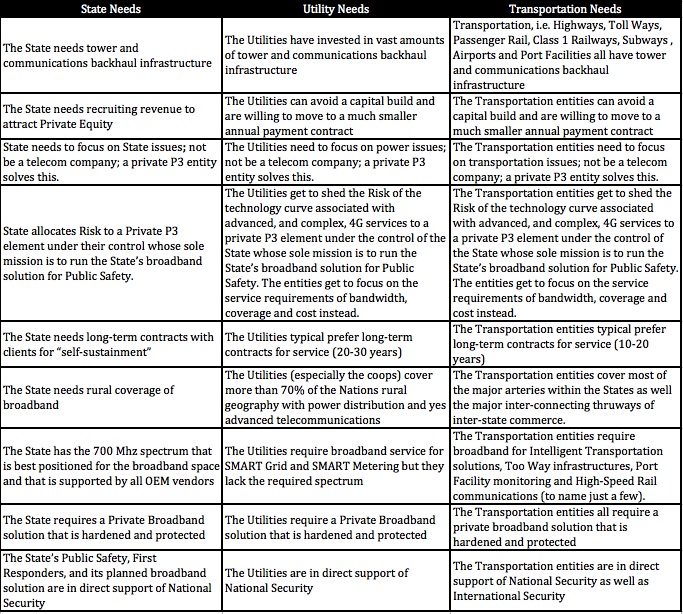
The internal State agencies and entities, that are defined as Public Safety Support and Services organizations, are considered a great recurring revenue stream for a Public Private Partnership model to deploy a statewide Public Safety Broadband solution, which is definitely a great starting point, but its more than just that. The primary reason for Priority 2 Users is an alignment of their business needs that fit perfectly with a business partnership with the State.
As a short list of an example:

I was going to add DoD and the National Guard as well, but I make the point with just these three relationships alone in justifying the build-out of a National Security Interest such as the Public Safety Broadband Network. By not truly incorporating the needs of these players we are only justifying a desire for sadomasochistic tendencies of self inflicted pain and agony associated with the scheduling, timeline and ultimate build out of the Nations Public Safety Broadband Network without the full support of the States and the Public Safety community.  
To put things into perspective; I have six kids and I would not buy an automobile just to satisfy my needs for just one kid.
Just some guy and a blog…

Where will the funding come from to build the Nations Public Safety Broadband Network — FirstNet?

Outside of the fact that the FirstNet Board is now starting to realize that a majority of their time will probably be spent in more of a political role than appointed positions to actually build an executable framework maybe they should really start to look at a business model. One of those templates for execution should be the business model that any given State can follow…. I am talking about a framework for a Public Private Partnership arrangement that the State can use to successfully build its statewide Public Safety Broadband Network. As part of that business plan there needs to be a clear and simple context of where the revenue will come from.

Having spent the better part of the last 10 years putting a Public Private Partnership model together that FirstNet and the State’s can use, I decided to post some easy slides so that everyone can get an idea of where the money will come from to fund this Nationwide Public Safety Broadband Network.

These slides are quite simple to understand but contextually they mold quite well with setting a course for where the money needs to come from.

The funding sources will come from the Prioritized “Public Safety Service” responsible organizations as outlined by the legislation itself it is clear to see that the inclusion of these entities has already been written into the legislation.

Through the Middle Class Tax Relief and Job Creation Act of 2012 (Act) became Public Law 112-96, 126 Stat. 156 (2012). It states in section (27) PUBLIC SAFETY SERVICES —The term ‘‘public safety services’’—
(A) has the meaning given the term in section 337(f) of the Communications Act of 1934 (47 U.S.C. 337(f)); and
(B) includes services provided by emergency response providers, as that term is defined in section 2 of the Homeland Security Act of 2002 (6 U.S.C. 101).In short, section 337(f) of the Communications Act of 1934 (47 USC), it states under sub-section(f) Definitions: The term ‘‘public safety services’’ means services-
(A) The sole or principal purpose of which is to protect the safety of life, health, or property;(B) That are provided-
(i) by State or local government entities;
or
(ii) by non-governmental organizations
that are authorized by a governmental entity whose primary mission is the provision 
of such services; and
(C) That are not made commercially available to the public by the provider
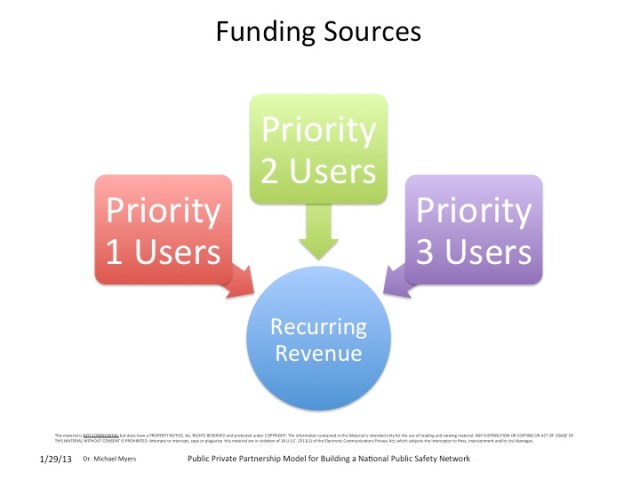
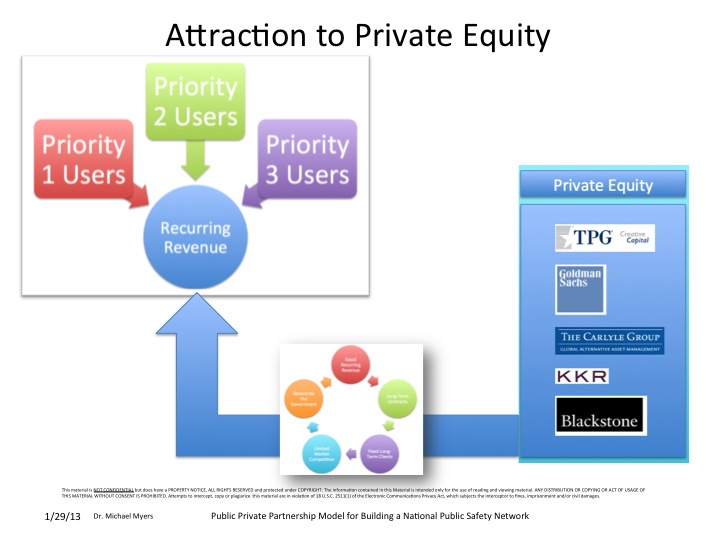
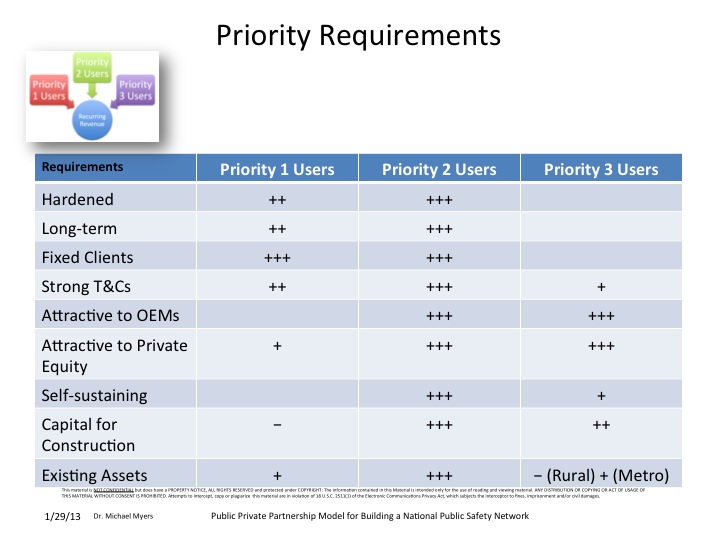
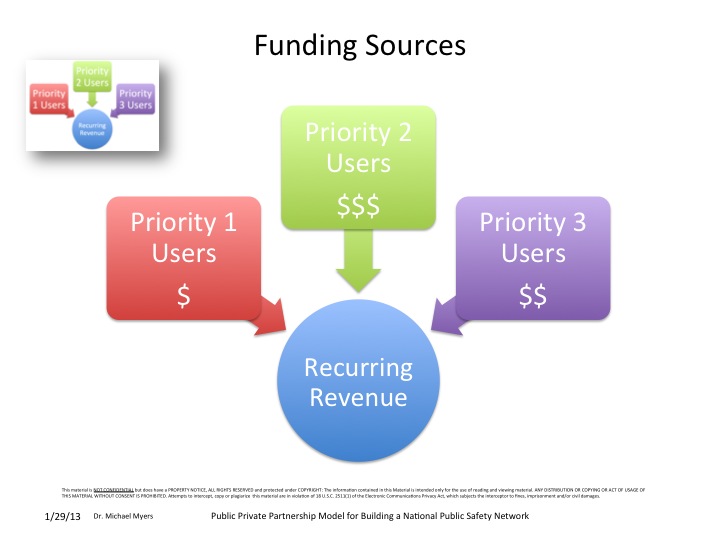
The primary element for funding the National Public Safety Broadband Network will have to come from the inclusion of Private Equity. But Private Equity needs to have a reason for coming to the table. The primary reason Private Equity would be interested is with a long-term recurring revenue stream, but they will also look for fixed string clients that are backed by the Government’s financial support. 
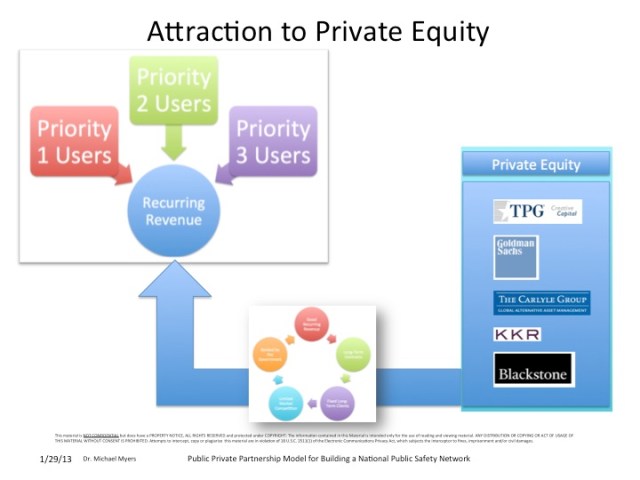
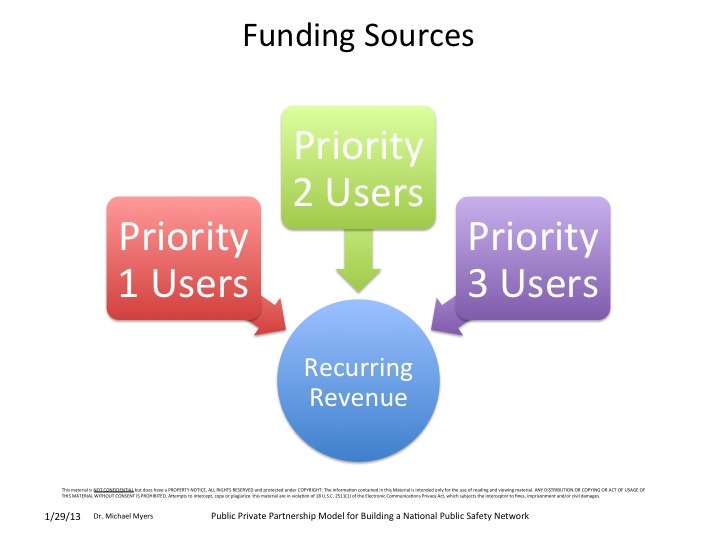
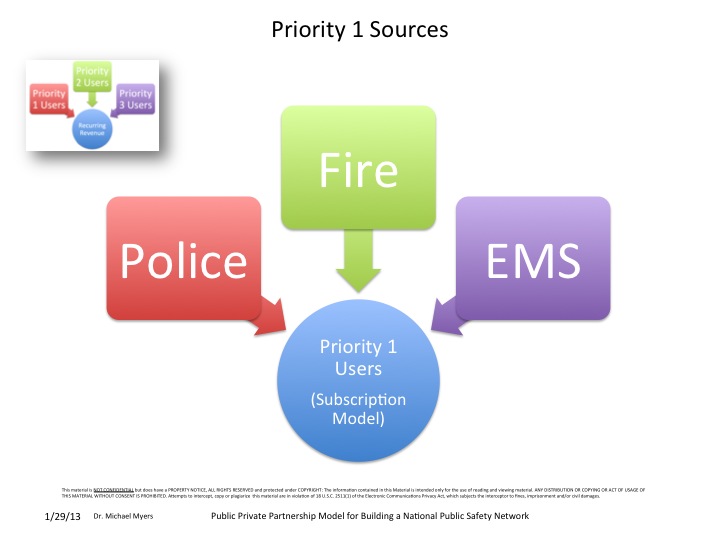
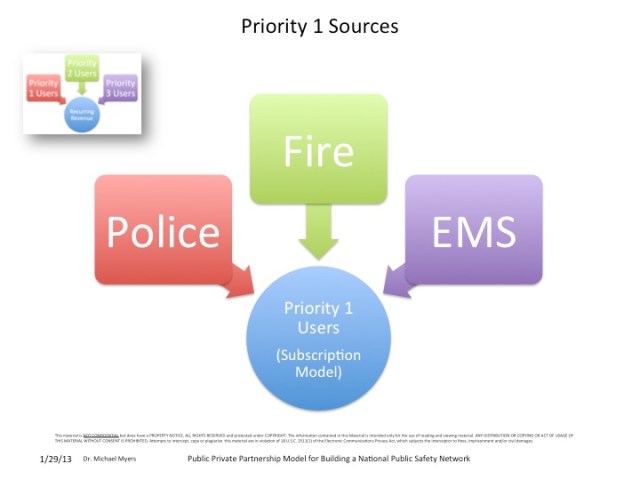
In breaking down the recurring revenue stream Private Equity will be interested in the primary sources of revenue (this is not a complete list but illustrates enough to break-even on the business model). Using the Priority scheme laid out by FirstNet in its original presentation by Craig Farrell, Priority 1 Users are made up of First Responders, i.e. Police, Fire and EMS types (short list). The primary issue with these players is their use of “subscription based” handset sales and monthly usage characteristics. This is the result of having to rely on the commercial carriers to provide them their gear. In essence they had to align with the original business model of a commercial carrier which is a “subscription model”. 
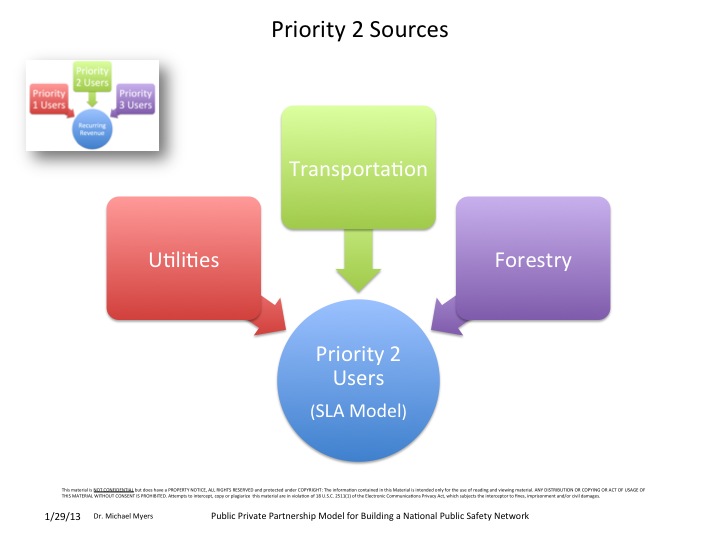
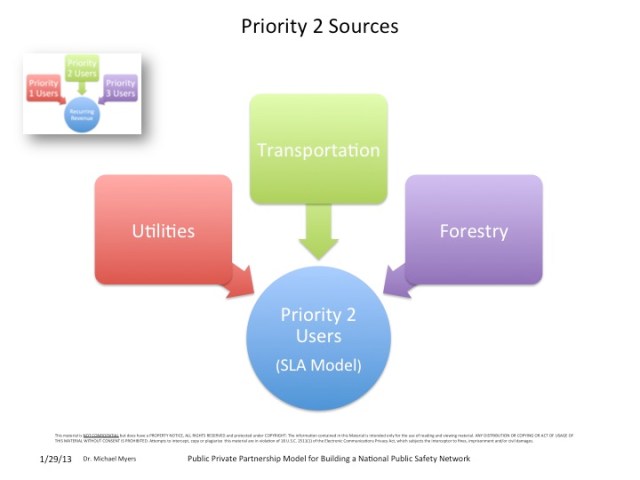
Priority 2 users are actually the new “primary source” of the funding needed to support a statewide build-out of the PSBN. In the end this is a “Private Network” no matter how we look at it, thus we are not restricted to the “subscription model” that the carriers use. What is more attractive is the standing long-term lease arrangement (20-30 years) for broadband services that eliminates the users requirement to spend capital on building their own solution and moving to a fixed operational cost model that strengthens their own internal business needs. Additionally  these Priority 2 users can off-set any existing investments for past communication infrastructure assets as available assets to the statewide PSBN plan. By moving to a fixed “OpEx” model the Priority 2 user also signs up for a fixed SLA (Service Level Agreement) with the State PSBN P3 entity that becomes the primary basis for the recurring revenue stream that attracts Private Equity. 
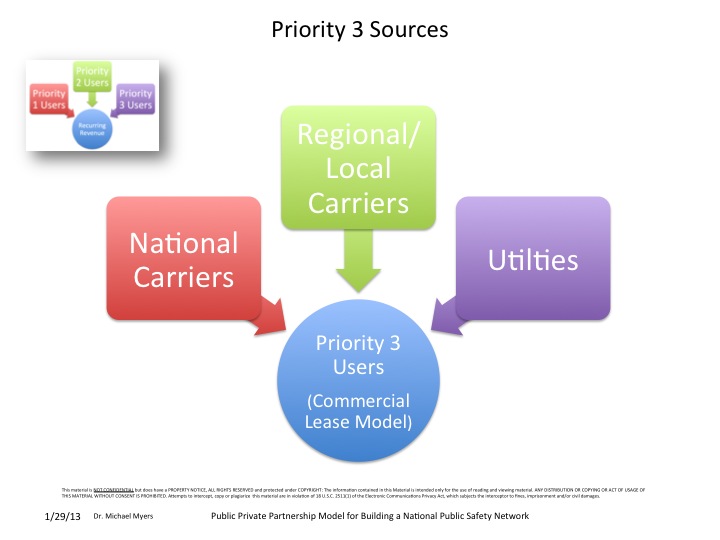
Priority 3 users are the interesting part. Through the PSBN hardened architecture and its P3 entity the commercial carriers (as well as the Utilities) can compete to access the rural broadband customers that fall within the coverage area of the PSBN network. In short, the commercial carriers would bid for the right to access these rural customers, to provide commercial broadband service, through the established architecture of the State’s PSBN architecture. Ingenious! This would mean that we can solve multiple problems with our current “Connect America” plan of which also helps pay for the PSBN architecture itself. Although, this money would not be significant it will be enough to help fulfill the State’s P3 entity with continued re-investment into the statewide PSBN architecture. 
Using the Connect America Fund and the Universal Service Fund to Commoditize Rural Broadband Access Through the National Public Safety Broadband Network (FirstNet)

Just read an interesting article by Walter McCormick of USTelecom Associates, titled “FCC Receives Boost from Sen. Schumer to Advance Broadband Investment”, dated 01-17-2013. I also read an article titled, “FCC Takes Heat For NewBroadband Subsidy Plans As AgencyTries to Give Away $185 Million”. By Karl Brody of DSL Reports. 

As written, “In a letter to Chairman Genachowski, Sen. Schumer requested the Commission to release $485 million from the Connect America Fund (CAF) to expand broadband Internet deployment, some of which could be invested in places like New York’s Hudson Valley region. Of the $485 million, Sen. Schumer noted that $185 million is left over from unspent 2012 funds and $300 million is available this year.  He applauded Chairman Genachowski for proposing new ideas for getting these CAF funds flowing into the economy.”
I have a proposal as well, that is that the FCC should consider the fact that with the commoditization of Internet access maybe it is better served as a common utility rather than a service offering from a commercial carrier carried on commercial infrastructure.
It’s a fact that the commercial carriers are desperately trying to shed pre-existing infrastructure to improve their ROI (return on investment), which is not a bad thing. But it limits their ability to build out to areas that produce little to no return on investment. Yes, the CAF and USF (Universal Service Fund) is supposed to help eliminate this problem, but in reality it just aggravates the issue. Why? Because if the commercial carriers use the money to help build out to these areas they still have to maintain and manage those assets for the long-term, which means they become responsible for the long-term future. In essence they are “left holding the bag”. In reality though you still do not eliminate the issue of ROI…it just prolongs the inevitable.
If we allow the service to be commoditized as a utility service then we envelop the issue of ROI into a much larger asset base of utilities; or into a financially doable model where as the commercial carrier can bid for transport access to the customers as Priority 3 users a consolidated Public Safety Broadband Network (PSBN). In short, we can use the already existing infrastructure of commoditization of the Utilities; and/or we can allow the carriers to access these rural clients through the PSBN infrastructure, thus they avoid the ROI problem by not having to build anything…. just a pure revenue deal. Did you know that there are 31 State Electric Cooperatives in the State of Oklahoma and they cover more than 75% of the rural geographic landmass of the State…and they all have extensive communication infrastructure?
It just makes sense to use the underutilized bandwidth and spectrum on the PSBN (termed as priority 3 usage by the NTIA/FirstNet) for rural broadband access, which means the ability to allow rural, or local regional carriers, national carriers, or even the Utilities to sell broadband access to the rural Americans that lack broadband coverage. How we can achieve such a solution is quite simple…. through a State generated Public Private Partnership that will help build the statewide portion of the National Public Safety Broadband Network.
Regardless of the valiant efforts of Sen. Schumer maybe we should consider that the funds associated with the CAF and the USF should be utilized to extend rural broadband coverage through the National Public Safety Broadband Network as Priority 3 users. Sounds like a great way to fiscally save some money, align better priorities, and adjust the course to where the market is heading. But what do I know I’m…
Just some guy and a blog….

In a short and succinct couple of paragraphs; How do the Carriers and the Utilities play in the Public Safety Broadband Public Private Partnership?

A recent question was asked of me; that is, in a short paragraph, can I explain how the commercial carriers (AT&T, Verizon, etc..) and the Utilities can play in the PSBN Public Private Partnership arrangement? The topics will be presented in a webinar on the 10th of January by FORCE.

Here are those paragraphs:

How the commercial carriers play in the Public Safety Broadband Network is quite simple. The primary reason of the contention today is because of the cost to build out cellular coverage for commercial users to the rural areas. The associated cost doesn’t justify the ROI on the investment. A solution to that, not talking about major metropolitan areas, is for the carriers to wait for the PSBN architecture to be built then, using the priority scheme addressed by FirstNet (that being priority 1-3 users), focus on bidding for access to those priority 3 commercial broadband users that fall within the coverage area of the PSBN. This eliminates the need for the commercial carriers to spend money on building any of the infrastructure, yet at the same time allows them to reap the benefits of pure revenue from new commercial customers further increasing their ARPU profit margins. 
How do the Utilities play in the PSBN? This is a more complex arrangement in that the Utilities will see a great cost advantage in partnering with the State PSBN effort. In short, they can write-off investments made in existing communication infrastructure by leasing or selling those assets to the State P3 PSBN solution; avoid the costly exercise of a capital program to build it themselves which would be in the millions of dollars; they can define the hardening requirements for the State P3 RFP itself; they can fixate on a fixed annual operational payment for service thus eliminating the chaotic behavior of cost overruns for new advancements and upgrades; they can pass the risk of the network upgrades and advancements to the State P3 entity whose business it will be to run the State PSBN solution for them as clients; they can align with the market movers in influencing the OEM manufacturing process for new technology in handsets, radios and the assorted user devices; and ultimately they can access a rich field of broadband spectrum that is in a controlled private, hardened, environment and that meets their requirements that align with their own business goals. 
A third part that both the carriers and the Utilities can prosper from, as well as others, is the ability to also take the stand as a potential private investor in the State’s P3 itself. In essence they could invest money for a proportionate share of the company while in return acquiring a return on their investment of being a client on the network itself. 
of course….
Just some guy and a blog…

FirstNet, a Business Model, and the only way we can build and self-sustain this big network?

It should be easily to see that a simplistic view of what the Public Safety Broadband Network is going to be. In short it’s nothing other than a private LTE network, much like AT&T and Verizon…only in this case you don’t have all the existing old 2G and 3G infrastructure to deal with, no margins on subscription fees, plus we don’t have to be weighted down by the OEMs…or do we?
There is a lot of confusing talk about the complexities associated with feature-sets, interconnectivity and interoperability, but realistically its just a cell phone network on steroids. It has a lot of potential and has the ability to drive a lot of customization and technical advancements that we have never seen. But will we really see them?
In the real world it takes money to make things happen. The only reason we have the advancements of LTE today is due to the fact that the carriers sell services that users want (most of the time). That demand creates revenue, which drives the OEM manufacturing process (equipment manufacturing). In order to differentiate themselves the OEMs create new and better technology advancements that the carriers can use and that the users demand…but what happens when the network is limited to just a few types of users?
If the Public Safety Broadband Network, FirstNet in this case, does not adopt a business model that taps into all its available, potential, clients then how do they expect to create the demand? Sure we can put money out there, taxpayer money, to build the solution, but how do you create the “self sustaining” element? By “self sustaining” I mean the entire ecosystem that is driven by user demands which manipulates the OEM process. We can’t just expect that we will build the network, and even fund its long-term operations, without having the user demand side drive the research and development of the OEM process. If we do then we will have a really big and overly complex broadband network that we can’t even begin to fully use. It’s like we just bought a Ferrari but drive it like a shopping cart around the Walmart parking lot.
After spending the better part of 10 years researching and publishing on this topic; I have the luxury to promote my professional opinion… that there is only one real way to successfully deploy this network, align all the business goals, plus still have enough generated revenue to provide for the network for the foreseeable future…. a Public Private Partnership that is funded by Private Equity and controlled by a representative board of elected share holders. This is the business model that the States are beginning to explore and it’s the best solution that FirstNet should adopt….but…I’m…
Just some guy and a blog….

Public Safety Broadband, FirstNet and the need to Commoditize Internet Access…..a perfect fit?

It is time for a change!
In with the New Year comes the possibility of transition that we have seen in the last 3 years, that is the commoditization of the Internet. I am not the only one that sees the connection between the utilities, the Internet and the Public Safety Broadband Network. As was written in a recent Bloomberg articles titled, “U.S.Internet Users Pay More for Slower Service. By Susan Crawford Dec 27, 2012 5:30PM CT” it is clear to see that there exist a connection.
Monetization is a crucial part of the deployment of the Public Safety Broadband Network and by doing so comes the necessity to build customer base. As has been laid out in the preliminary discussions of FirstNet there is a necessity to prioritize users on the network. There also exist in the legislation the need to provide rural broadband service to those that need it. Undoubtedly those users would be priority three type users. Priority one-users being First Responders and priority two-users being the likes of the Utilities, Transportation, etc..
By the legislation laying out the necessity to provide rural broadband service, and the alignment of the three base priority users, promotes a perfect incentive to commoditize the Internet Access scenario. To a commercial carrier commoditization is a bad word. It cuts their ability to manipulate the margins on the service thus eliminating further advantages of more service offerings. But, in this case the actual commoditized infrastructure will come from the Public Safety Broadband Network. In the context of commoditizing the access piece  this could actually be the turning point. 
Eventually the cost of support starts to outweigh the profit margins, thus commoditization starts to happen. This may be the point we face today when it comes to Internet Access. The balance of market competition, affordable price margins and the demand for service may be at a transition point where as the commoditization of the Internet Access is the best solution. For the carriers they will need to shed infrastructure due to the shift towards content and services as being their prime driver of revenue. For the Public Safety Broadband Network (PSBN) this would be the opportunity for partnering with Utilities to institute the commoditization process of the Internet service model.  What better partner than a Utility who has been playing in commoditized services through its power distribution business?
Being that the business model of the Public Safety Broadband Network will be of a social context rather than strict revenue bearing operation; it only plays too well for a commoditized Internet Access service model to grow roots. Through a State sponsored Public Private Partnership the creation of revenue will come from the stalwart clients that require broadband service and that maintain a Public Safety Service responsibility in times of disaster or emergency response. These clients will not bother with the traditional subscription based model but would rather see a long-term (20-30 year) contract for services that includes their requirements for hardening and coverage. Such contracts would be based on long-term SLAs (Service Level Agreements) fixed on operational cost models. Through those fixed contracts we could see the opportunity of providing commoditized Internet Access service models via the Utility itself, or bid to the commercial Telco markets. It is through the PSBN architecture that the commoditized Internet Access will be garnered yet virtually managed through a commercial service model. Yet one has to remember that these rural broadband users will be priority 3 users thus always under the gun for interruption during an emergency…. which is really no difference than what happens today anyway.
Just some guy and a blog….