BTOP Grant to FirstNet? What About the FCC’s Connect America Fund as well?

Wednesday, 05 Dec 2012 11:26 PM By Todd Beamon and Kathleen Walter
When it comes to the $135 Million promised alluded to by the Feds to help fund the State’s “planning and audits” of the Public Safety Broadband Network…how many people really think it will come to fruition anyway? After all the Federal Government allocated $7 Billion of which $2 Billion would be in the form of direct grants. The remaining $5 Billion has to come from auctioning off spectrum already in use. How long has it taken to get narrow-banding completed? Oh sorry it hasn’t been completed yet. Didn’t that start in the 1990’s? How would one anticipate that $5 Billion in anticipated funds from auctioning off spectrum, that is still in use, would be available anytime soon? Regardless can anyone please tell me what the term “Fiscal Cliff” actually means anyway?
But, if it is imperative that a State must have the grant money then we still have a solution right in front of us. Last year the Broadband Technologies Opportunities Program – better known as BTOP – was in full cycle. Then came FirstNet, which put a halt to all the BTOP grants. As it stands the only “realistic” proportion of federal grants available under FirstNet would be $36 Million ($2 Billion / 56 States and Territories). The original promise (hearsay) was $135 Million per State and Territory ($7 Billion / 56 State and Territories). But if we add the already allocated BTOP grants we could actually see roughly $185 Million for PSBN planning and audits ($150 Million + $35 Million). That’s not all, if we are so captivated in the belief that we can’t build a nationwide broadband network for Public Safety without Government funding then why not allocate the $4.5 Billion from the FCC’s Connect America Fund as well? Realistically though renaming the BTOP as the PSBN grant makes more sense. At least we can rest assured we are looking at reinstalling the $135 million that was already being utilized. It still won’t be enough to even come close to funding a full national build out of LTE in support of Public Safety.
Having been in the industry for over 20 years I can safely ascertain that this is going to cost somewhere between $50-$100 Billion, easily, to build this nationwide solution. To put it in realistic terms just look at the assets in the 10K filings of Verizon, or AT&T, of whom only covers 40% of the United States (96% of the “population mass”). With a FirstNet target of 99% of “geographic landmass” of the United States it doesn’t take a rocket scientist to understand the proportional differences between the terms “geography” and “population”.
If we were to be conservative and depict a $50 Billion price tag, that would mean that each State would be looking at $892 Million as there share to help build it (State taxpayer money), with of course we could see a reduction of the $135 Million from the BTOP (or just $35 Million allocated from the $2 Billion NTIA grant for PSBN). So in essence the States could see a bill of roughly $757 Million trying to be passed through their State Legislature. Don’t know about you, but I saw some pretty vicious fights in the State Legislative sessions just to get approval for a few more dollars to cover SMART Metering alone, which by the way had $4.5 Billion in funding from the Title XIII of the Energy Independence and Security Act of 2007 (EISA), and was a matching funds act that was topped at $200 Million per application. Too bad they used it to also fund WiMax and 3G services to connect their SMART Meters. Now we have all used the term “BetaMax” in the past, but this topic is a whole other article. 
But there is a solution! I’m the type that doesn’t like to complain unless I also come bearing solutions. As I have promoted in the past the secret lies in the Public Private Partnership. How do you turn this entire funding debacle into a positive? By using Public Private Partnerships. Now I just have to figure out how to promote this so that people start to listen.
Just some guy and a blog…

Can the Electric Utilities play in the Public Safety Broadband initiative being led by the FirstNet Board?

There has been a lot of noise defining the Priority (1-3) users of the PSBN and who the residing members can be within those priority schemes. In order to help clear things up I would propose the following that can be found in the legislation already signed by the President back in January.
The primary question I will cover is whether or not a Utility, or Electric Cooperative, is a “Public Safety Services” organization, but the same can be construed for any related State entity that falls beyond the typical realm of “First Responder”. Those entities may be Transportation, Utilities, Forestry, Agriculture, Land Management, etc..
Per the legislation itself it is clear to see that the inclusion of these entities has already been written into the legislation.
Through the Middle Class Tax Relief and Job Creation Act of 2012 (Act) became Public Law 112-96, 126 Stat. 156 (2012). It states in section (27) PUBLIC SAFETY SERVICES —The term ‘‘public safety services’’—
(A) has the meaning given the term in section 337(f) of the Communications Act of 1934 (47 U.S.C. 337(f)); and
(B) includes services provided by emergency response providers, as that term is defined in section 2 of the Homeland Security Act of 2002 (6 U.S.C. 101).
In short, section 337(f) of the Communications Act of 1934 (47 USC), it states under sub-section
(f) Definitions: The term ‘‘public safety services’’ means services-

(A) The sole or principal purpose of which is to protect the safety of life, health, or property;
(B) That are provided-
(i) by State or local government entities;
or
(ii) by non-governmental organizations
that are authorized by a governmental entity whose primary mission is the provision 
of such services; and

(C) That are not made commercially available to the public by the provider
The Law Flow Diagram by Scott Foster

So in closing, it would be nice to hear some clarification by the FirstNet Board that addresses these players in more light. Why is this important? It’s important because these State entities, most selectively the Utilities and Electric Cooperatives alone, cover more than 80% of the geographic landmass of the United States with advanced communication solutions and are deep into the thrills of deploying the latest and greatest. They are coming to realize that they need FirstNet as much as FirstNet needs them. It’s a great opportunity – one that would be too costly to avoid. If FirstNet wants to create a great LTE broadband solution for Public Safety then it needs to bring these organizations into the fold…. officially. The best way to bring them into the fold is via a sound business model that is executed at the State level and within the confines of a sound Public Private Partnership.  

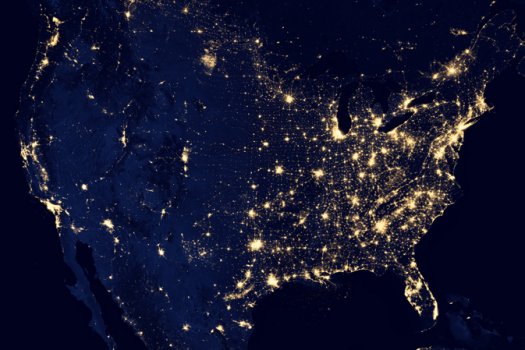
Everyone of these lights in this image below requires power. Everywhere there is power communications is needed. That looks like a pretty good footprint to me. And when those lights go out…who are the first people the First Responders call to help?

Just some guy and a blog…

What should NTIA do with the BTOP Grants?

Now I’m just some guy and a blog, but my two cents is that the NTIA should refashion the BTOP Grants to help the States plan and audit their business case, asset inventory and physical requirements for a statewide PSBN build out. They can simply combine it with the $135 Million planned for FirstNet. The NTIA (FirstNet) could then expand the usage of the grant money to utilize any remaining funds, after the planning and audits, to expand application, or cloud development, in support if IT centralization under the PSBN deployment… or even pay for more handset development. 
If FirstNet goes with my model for the Public Private Partnership (see past blog entries or my response to the NTIA NOI back in November) the additional BTOP won’t be necessary being that Private Equity would actually pay for the entire State build out. It may be just me, but seems useless to continue with State sponsored rollouts of LTE trials and pilots when the more important aspect is planning a States business case that may change or modify those very same plans. Plus, this ultimately saves the taxpayers more money. In addition the work in Denver should be basis for any trials or pilot testing of the vendor solutions.
Just some guy and a blog…