PTC (Positive Train Control) and why it’s important to Public Safety Broadband Plans

This is a topic I can guarantee that most within the Public Safety world have heard nothing about. PTC, or Positive Train Control, is a $11 Billion dollar Federally funded supported consortium of the nations largest rail lines to build a nationwide communications network that controls trains in real-time. Its footprint impacts the deepest of the rural territories and mountain ranges.
Picture this: a class 1 heavy train with a multi-engine consist, something like a BNSF or Union Pacific, pulling a train a mile long through the mountains and rural deserts of the United States. Imagine that train needs to stop because of an obstruction on the track. While stopped a rove of terrorists, who have penetrated our border in a remote location, slithers up to the train and places a timed or remote explosive on about 5 or 6 high pressure propane, or other highly combustive tanker cars with hydrochloric acid. They have set the devices to explode when the train commutes through a city center…like Dallas or Kansas City. Or worse yet, through a rural town to which a local high school or elementary school sits along the tracks. I probably don’t need to explain the results. Here is a youtube video clip of just such a situation, but in this instance it was just a derailment. Imagine if it were intentional.
(the entire video is interesting but the bulk of the explosion happens around the 6 minute mark. Would have been nice if the officer had a vehicle deployed UAV.)

The possible answer to this solution may reside in the Nations First Responder Broadband Network or Public Safety Broadband Network using multiple platforms of technology, i.e. LMR, P25, LTE, etc. It’s a relationship that would have many advantages — both ways — where as both parties can get what they need out of the deal. How that relationship needs to be formed — can best be married in a Public Private Partnership!
Another thing to remember is that, much like Utilities, Class 1 Railroads make a lot of money — money that can be spent to help support the Public Safety Broadband Network deployment and sustainment.
Just some guy and a blog….

Harris County and Charlotte Public Safety Broadband Networks: will they complicate the nationwide buildout for First Responders?

For those that are looking for a discussion point: its in the title.
I recently read the following article by Wayne Hanson, that was reposted from the Government Technology website and was dated August 30, 2012 titled: “Feds Rethink Public Safety Network While Locals Stew”.  Its an interesting article and highlights a point I’ve been trying to make…that is…with a properly executed Public Private Partnership a State may not require any Federal or State tax dollars to design, build, operate or maintain their Public Safety Broadband Networks.
In the article Wayne refers to Harris County and Charlotte and their initiative to build their PSBN solutions; yet at the same time highlights the complications they face in funding their projects. From a different perspective it may be seen that forcing the early build-out may only continue to complicate the task of FirstNet, and a State, and its potential requirement to solicit and obtain private funding to help deploy their solutions. We have to remember, we need the entire national solution to be “self-funded”. How is Harris County going to get an ROI to make “self-funding” happen? From what I can see there is not enough handsets for a subscriber based solution, and they aren’t communicating with any other “revenue” producing State entities, which leads me to believe that complications will follow.
Harris County and Charlotte should be commended for taking the initiative, but not necessarily for the reasons one would typically suspect. In fact, they will make interesting case studies. Case studies that highlight the complexities, above and beyond the technical aspects, and more focused on the procedural hegemonies. By nudging an effort into a bigger statewide solution will only complicate the process. What I don’t understand though is if the Federal Government, i.e. NTIA, needs a test bed for interoperability — I thought that’s what Denver was setup to do.  If that is indeed the case then why is it necessary to allow Harris County or Charlotte to precede when others cannot? Are we in a moment that Napoleon Bonaparte would say, “never interrupt your enemy when he is making a mistake?”  I would hope not. That wouldn’t help anybody out.
Is it actually advantageous to be the first to build? After all, we are talking about a nationwide build out, which means it isn’t going to be operational anytime soon. By the time this gets setup for operations Harris County, and Charlotte, would most likely have to upgrade to Release 10 of LTE, which will not be an easy software upgrade. I may be wrong, but such an upgrade will most likely involve a MIMO upgrade, which could mean new hardware (need to refer to the experts on that front). Plus, the Release 9 and 10 solutions will have different software and service functionalities. Such enhancements may never be available to test until those solutions are upgraded, which could mean that all of their testing, up to that point in time, would be useless. Plus I may be wrong again, and have been in the past, but I believe the interoperability lab in Denver will also be testing these same scenarios, which means procedural duplications as well.
In any case, and it may be just me, but wouldn’t it be better for the State to take the lead? Maybe the State CIOs? By doing so will allow the Governor to interface with all State and Federal agencies, and entities, that claim Public Safety responsibilities, to which they can highlight a combined requirements solutions, procedural protocols and financial interfaces that will benefit all. What happens if Harris County gets finished with its 14 sites and then finds out from the Governor that it did not include all the requirements for Utilities, NIS (immigration) or Transportation? Would they have to redesign, rebuild or start all over again? What if the business case created by the Governor demonstrates that the entire network could be paid-for without tax dollars; yet Harris County just spent Millions doing their own thing? How will the tax dollars be recouped? What about the spectrum — will they have to get off the spectrum? What if their vendor solution was not the solution chosen for the statewide deployment? Maybe it’s a waste of time? I don’t know.
One thing is certain though, if you are waiting for the Federal Government to provide grants to build an entire nationwide LTE network — yet alone a statewide deployment — you will be waiting a long time. Who’s to say what happens in the next election cycle. If there is a change in the administration, what items in the Federal budget do you think the “stop spending” will apply to, especially if there is a way too truly “self-fund” itself through Public Private Partnerships? Then again I’m just some guy and a blog.
What can be done? For starters the States can start to investigate P3 scenarios that will include the requirements for all their internal agencies and entities. Align private investment to utilize the ROI produced from the internal entities then start a high-level design that includes all the requirements…not just a few. As I have illustrated in some earlier postings, it will take at least a year for the private investment community to perform their due diligence, so we need to get going now. I am confident there is a solution in Public Private Partnerships that will fill the “self-funding” requirement and will require no tax dollars…. that’s if, of course, FirstNet and the State want to build it that way.
Just some guy and a blog…

A Business Case for the Nations First Responder Broadband Network or Public Safety Broadband Network: will it cost $500 Billion? Does it Matter?

It’s important to note that the best solution for a successful deployment of the PSBN (Public Safety Broadband Network) is a great business case model.
There is a big push to just build out the network, but one must understand that by going out on the limb, and just building it, doesn’t mean they will come. The technical delight to build lays at the heart of an engineer, but a typical engineer doesn’t get enthused about the cost structures and governance models that drive the financial partnerships that actually help feed the funding engine.
It cannot be stressed enough to illustrate that a sound business model must be generated before the PSBN is built. By business model I’m not just talking about a short-term fix to get funding — it’s more than applying for grants and aligning financing with the OEMs. It’s about the long-term goals of the network itself. We must think outside of the box by fashioning the financial model as a revenue operation; even though at the heart of the design it is not. We must align business strategies with those that have access and must utilize the network. We have to organize financial constructs that will last the entire lifespan of the network itself and beyond. We must energize an ROI message that is attractive to current/future investment strategies and stakeholders. If we fail to capture the essence of a good return on investment scenario; we risk long-term failure instead of success.
We mustn’t leap to the idea that we have to build today without doing our homework. In the end that would not benefit anyone except a few engineers and their desire to see something get built. Every entity that is considered part of the First Responder picture has isolated business plans. A Utilities business plan is to generate and distribute power. The Police have a business plan to protect and serve. The EMS has a business plan to save lives. The Transportation Authority has a business plan to transport people. All of these entities have their own business models that they must adhere too. By mixing these models into a rapid build scenario only complicates and slows the execution and success of their primary goals. By rushing the build-out of the PSBN this is exactly what we are doing – we are mixing all these competing business models into a “one size fits all” scenario.
In order to successfully execute a sound business model — the PSBN must have its own business strategy — a strategy that links all these business models into an efficient standard of implementation. All the States’ entity business models needs must be met, or at least interfaced for the benefit of those models. As an example: the business model of the PSBN must include the business requirements of the Utilities. The Utilities will require a broadband footprint of service capabilities to cover all their sub-stations and SMART Metering devices. Plus, the Utility must have sufficient hardening requirements so that it can carry out its mission. Those requirements should be enveloped into the PSBN model and shared so that all can take advantage of such requirements while interfacing with players such as transportation, agriculture, forestry, Fire, and Police. In essence the business model of the PSBN Public Private Partnership will be all the combined requirements of the States entities that require access to the Public Safety Broadband Network. 

Combining those requirements, and then wrapping the PSBN business model with a sound revenue collection scenario, will not only generate the cash required to design, build and maintain, but it will also attract long-term investment. For example: enveloping all the best requirements of the combined business models opens the opportunity for the P3 SPV (Special Purpose Vehicle, or in short, the newly created private company to run the State’s PSBN), a method to extract an ROI (return on investment). My model calls for fixed annual, or monthly, payments from each State entity to access the established State PSBN through the P3 SPV; which in turn will pay for the network as a Build, Own and Operate model of execution. The P3 SPV will offset its costs through investment and the monthly, or annual, payments of the State’s entities.
Another aspect to look at is the advantages the State entities have when connecting to the PSBN. Having the broadband technology available, each entity could functionally utilize the technology to cover its own current business model at the same time expanding service features.  As an example: a Utility may originally utilize the PSBN to cover all its access points, such as SMART Metering or sub-station access. Later on the Utility could investigate packaging Internet Access to their client base to help accommodate Rural Broadband Penetration representative in the FCCs broadband plan to all Americans. As an added observation; some of these sub-stations are in pretty remote areas, but are within the vicinity of a few rural farming communities. It makes sense to extend that broadband capability from the sub-station to those communities. This opens the door for expanded service offerings with regional, or local, carriers as well as more ROI opportunities for the P3 SPV.
A lot of people get stuck on the vision that because the network “costs” a lot of money to build; loses sight of the fact that those “cost” figures actually represent VALUE. In the end it doesn’t matter if the network costs $5 Billion, or $500 Billion, as long as the money is being put back into the economy and employing Americans. The point to make here is that VALUE puts the money back into our “own” economy.
Just some guy and a blog…

National Security and the Public Safety Broadband Using Public Private Partnership for RFP Considerations

National Security should be one of the main concerns when the term Public Safety Broadband Network (PSBN) is used. It should include any, and all, related necessities that are also part of the National Security solution, such as any related industry function that is itself considered a National Security element, i.e. transportation, utilities, police, fire, etc.
It may be just me, but when I hear the term Public Safety I see an all inclusive national security solutions that envelop the entire ecosystem of infrastructure and economic engines that power and protect the Untied States. I don’t limit its long-term evolution to just the Police, Fire and EMS.
The reason I bring this up is to illustrate a point of which FirstNet, and the States, should consider when reviewing the makeup of the respondents to a States (and the Feds) P3 RFP arrangement. Following the development of the States business plan to execute the PSBN, it is typical that an RFP be solicited to the market.  The normal RFP process will have a typical prime contractor and their subs outlined in a teaming agreement before a proposal is submitted. In this case the prime will be the investment house. The investment team would, acting as the prime, establish a main contractor to act as the Program Manager, which then sub-contracts to team members, as would any typical RFP arrangement. The only difference here is the “prime” is the investment team rather than a general contractor or program management team. The reason being is that the P3 RFP is basically a purchase agreement for the entire RFP to which a Build, Own and Operate (BOO) model can be executed.  
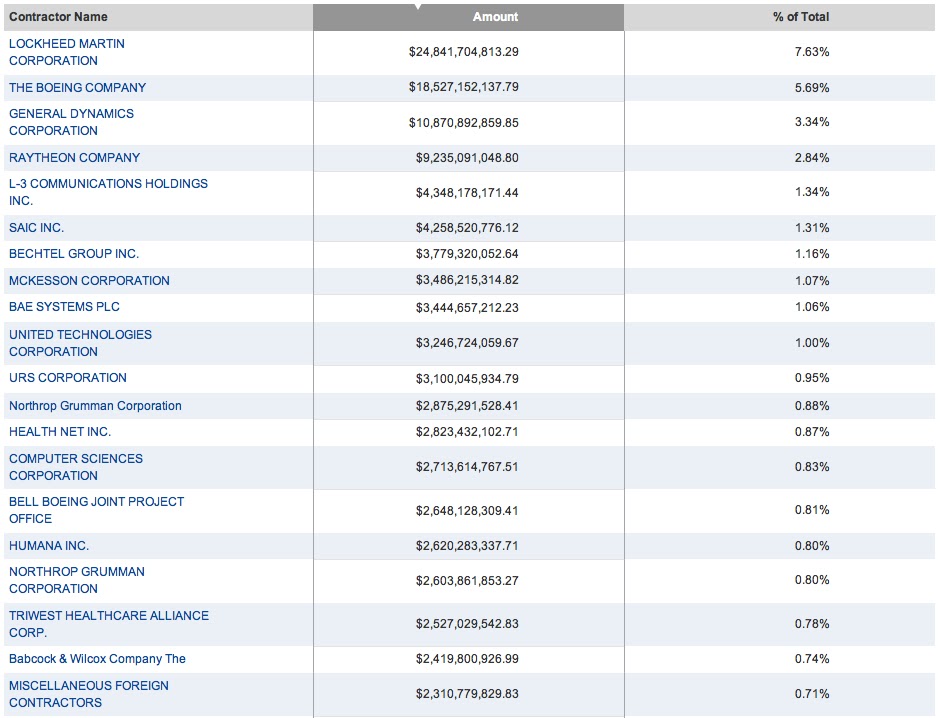
In looking at the main investment team they would make up players such as JP Morgan, Deutschemark, GE Capital and others. The general contractors should be folks like Raytheon or General Dynamics…why? Because the nature of the Public Safety Network will be a National Security Interest and these types of firms are usually the leaders that deliver in this industry.
Here is the breakdown of the top 20 Government contractors (for the Federal Government) as of 2008.  You should note that the major OEMs for manufacturing access and transport gear for both wireless and wireline networks didn’t even rank in the top 100.

Lockheed Martin Corporation
The Boeing Company
Northrop Grumman Corporation
Bae Systems PLC
General Dynamics Corporation
Raytheon Company
Emerson Construction Co Inc
United Technologies Corporation
L-3 Communications Holdings, Inc.
Saic, Inc.
Lockheed Martin Corporation
The Boeing Company
Northrop Grumman Corporation
Bae Systems PLC
General Dynamics Corporation
Raytheon Company
Emerson Construction Co Inc
United Technologies Corporation
L-3 Communications Holdings, Inc.
Saic, Inc.
Here is the top twenty for 2012:

I raise these points to illustrate the teaming arrangements a State, and FirstNet, should consider when deploying our Nations First Responder Broadband Network. Once again, it may be just me, but I would have to say that the PSBN is a National Security concern and thus should be treated as one.
Just some guy and a blog….

NTIA Addresses Where to Spend the $135 Million in Grant Money: for State Business Plans to Initiate the Nations Public Safety Broadband Network

*** Update: In my original post I made a mistake in saying FCC of which I meant NTIA. Sorry for the confusion. Too many acronyms. ***

An interesting bit of information that needs to settle in. I just read the Federal Register and it lays out the use of the $135 Million going to each State and what it can and cannot be used for. In short, it will be used to make the State business plan and perform inventory audits, but the States cannot use it to start physically building their networks. (see below)

Now this is just me, but I view this as a smart, and logical, move given that the majority voted for such steps. It was actually one of my driving points in my response to the NTIAs request in that we need to use the grant funding allocated from the $7 Billion to help States build a business model for their own State broadband needs. Without a business plan for each State (and FirstNet) we have no course of execution or philosophical approach to what we are trying to accomplish. Now it’s time that all the States start learning what a Public Private Partnership means, because this will be the primary basis for the entire business case and will also dictate the requirements that drive the design; which in the end will show us how much this costs and how much we can expect to recover in the way of self-funding its operations. .
I hope you don’t mind my interpretation, and suggestion, but as with the standardization of the technical aspects of the broadband network, and its interoperable features between elements, it is vitally important that a consistent, and standardized, shell of a business model be utilized by all the States and FirstNet. Although the template will not define the specifics of a given States requirements, that has to come from the States input, but it should outline the overall strategy and high-level concept that can be administered in all States. If we don’t utilize a standard template for the business case, and its adaptation of a solid P3 RFP process, a given States deployment and “self-funding” requirement will run short on cash causing financial complications and project delays.  Therefore we need to adapt a solid financial governance model that can sustain the program entirely…most importantly a real solution for recurring revenue to attract investment.
An example: all States should standardize to a sound Build, Own and Operate (Boo) model of a P3 RFP that aligns with the States Business Plan. This P3 RFP would be advertised to interested financial investment houses that in turn would build a team of respondents (Investment Management Team, GC, Project Management, Integrator, OEM, etc..). In response to the States P3 RFP these newly formed investment teams will create a P3 BOO proposal that demonstrates a full investment strategy utilizing the recurring revenue of the State entities. They will present their proposals to the review board that in return would provide access to the awardee for spectrum and the rights to operate the State Broadband Special Purpose Vehicle (SPV). The SPV would then act as the State’s broadband company for Public Safety. This will then position the SPV to fall under the federally created FirstNet SPV…at the top. In essence creating a commercial model of a broadband company of which the FirstNet SPV would act as the corporate headquarters and each State would act as a regional Headquarters.
One thing to point out is that the governance model of the financial controls does not have to, necessarily, follow the guidelines of the technical design, i.e. each State does not necessarily have to maintain a master core. It would most likely need to be reviewed though, because of tracking and billing issues between the State SPV and its direct State entity customers may be complicated where as each State will want to track and control its revenue operations.  
Those State entities, which have viable First Response requirements, will be positioned as paying clients for broadband access from the States P3 plan. The amount of recurring operational payments from the State entities will be dependent upon a fixed percentage of a similar solution design the entity would have executed under a capital program if it had built the same solution itself (ballpark of 10% of the total capital program). Each entity within the State that would require the broadband access would follow the same mold. There will be cost offsetting due to infrastructure sharing arrangements. This provides the long-term, recurring, revenue that the investment community is interested in. The various State entities will dictate their hardening requirements (written into a long-term SLA), which dictates the design for the P3, which then dictates the cost model for the investment offered by the proposal teams. In the end the amount of revenue that comes from the States entities for broadband service will balance the investment scenario the financial services are willing to pay.
This is just my take and obviously just one little piece of a much larger RFP framework that needs to be laid out, and approved, by FirstNet. I suggest that we must remember that the most important piece of a business plan is its fundamental capability to capture a framework of financial governance — which is what I recommend the State start to investigate. Just as the physical deployment takes time, so does the due diligence for the financial community to look at each State opportunity.
Here is the NTIA plan for the $135 Million that will be allocated to the States to get things started.
Based on input received from multiple commenters, eligible costs under the planning grant program will likely include the following categories of expenses:
1. Hiring staff and consultants required for the planning process (such as project managers, program directors, engineers, grant administrators, financial analysts, accountants, and attorneys);
2. Holding planning meetings with state agencies, local and tribal stakeholders, and regional partners;
3. Covering travel costs for state, local, and tribal representatives to attend planning meetings (such as preparing for FirstNet consultations and attending state, regional, and national meetings that address public safety broadband issues);
4. Developing, modifying, or enhancing state plans and governance structures, including efforts to adapt existing public safety governance authorities, such as the Statewide Interoperability Coordinators (SWIC), Statewide Interoperability Executive Committees (SIEC), and Statewide Interoperability Governing Bodies (SIGB), to include public safety broadband stakeholders and expertise, and determining the role of the state Chief Information Officers (CIO), Chief Technology Officers (CTO), or Chief Budget Officers (CBO);
5. Conducting communications, education, and outreach activities with state, local, tribal, and regional stakeholders;
6. Developing standardized MOUs and other types of agreements to facilitate access to and use of existing infrastructure;
7. Identifying potential public safety users for the public safety broadband network;
8. Administrative services and supplies necessary to prepare for and manage the grant program;
9. Legal services related to the planning process; and
10. Training costs related to the planning process.
NTIA does not envision allowing funds awarded under the State and Local Implementation Grant Program to be used for activities related to site preparation, broadband deployment, installation, construction, or the acquisition of equipment used to provide wireless broadband services, including LTE-related activities.
Just some guy and a blog….
Carriers to Build FirstNet and the Nations Public Safety Network

There seems to be a lot of lobbying going on by the carriers to protect their turf markets. It seems the tension is rising and they are becoming increasingly worried about the potential of the Public Safety Broadband Network. Given the nature of the consolidation going on in their own markets, and the convergence to all IP networks, it may be a lesson to late.

 To me the carrier market is all about the money that can be made from providing commercial voice and data service. Nothing wrong with that. As far as it goes with FirstNet though, if the commercial carrier can meet the hardening requirements and the ability to expand the service functionality of Public Safety in whole, which includes all elements of Public Safety, then by all means it should compete to try and win that partnership. But as it stands today they continue to struggle with the cost benefit analysis of building solutions that meet the basic requirements. After all there are those that realize that this was the main reason the D-Block auction failed some years ago. It is also the main reason the carriers refuse to build out broadband to the rural areas today. As I stated…nothing wrong with a decision to be tidy with your budgets and to maintain a good ROI. Actually, if there is anything FirstNet should learn from the carriers is how to run a business by utilizing all the service capabilities of LTE, not trying to limit them.

 I also keep hearing people say that the carriers are the most knowledgable in knowing how to actually build an LTE network. I’ve been in the industry for 25 years and I have yet to see a commercial carrier build it’s own network. If anything what FirstNet should do is start talking to the contractors who design, prep, build and maintain those tower infrastructures for the carriers — they are the real ones who actually build them. What a carrier does best is design a solution that maximizes the utility of those networks to the most lucrative means possible, which is how it should be done.

 In a recent article I read a disturbing statement that the carriers don’t believe Utilities should be part of Public Safety. I find that hard to contemplate given the recent storm damage in Washington DC or the outcome of Katrina (just to name a few). If Utilities were not part of the Emergency Response Centers (that were all rated as First Responders) the carriers themselves would not have been successful in restoring their own power, or even navigating to their established sites. Last I heard even a cell tower needs power. Heck even the NTU on the side of my house needs power. To put it in another perspective, in the last tornado outbreaks in Texas, I didn’t see too many Police of Fire personnel reconnecting power lines, actually what I saw was the Police calling for the Utility to come in first. Had they not then lives could have been lost.

 What about other potential First Responders; how do you tell BART, or MUNI, in San Francisco, or any major mass transit subway, or light rail system in the nation, that’s its own substantial Police force is not a First Responder? Had the MTA in New York not rolled their own Transit Police into the NYPD organization they would still maintain one of the largest Police Forces in the nation, even larger than the City of Charlottes Police Force.

 In the end it would be ill-conceived to believe that the LTE network that FirstNet builds does not meet all the standards attributed to all forms of First Responders. Actually it would be an insult to the tax payers and even the so called “Real First Responders”. What do we gain by limiting the involvement of the PSBN to just Police, Fire and EMS? Where are the economies of scale or the efficiencies towards utilizing every last resource to save money. Let’s do what the carriers do in this case….let’s design and utilize the networks to the maximum its benefits. If we don’t then it will be like buying a Ferrari and driving Miss Daisy, or buying a bus only to transport the driver. Who are we kidding?

 Here is another thought. If a major Utility, or hell, all the Utilities (to include Co-Ops), or even the transportation industry, can not get access to the D-Block spectrum then where will they get it from? If a High Speed Rail system, operating at 150 Mph, can not use human controls and is reliant upon high speed communications, such as LTE, where will they get the spectrum? Who wants to step up to say that 1000 passengers on a train moving at 150 Mph is not a vital asset to protect? Such networks have hardening requirements that fall way beyond what a “real” First Responder needs….will the carriers step up to build those hardened networks with the limited amount of subscribers? If a carrier won’t step up to build out to the rural broadband users, then why would they build it for a single rail, Utility system or even the Police? This PSBN network is a lot more than just video and data feeds to a Patrol car and if our newly appointed FirstNet Board does not realize that..then we are in for a long hard ride that will eventually cost a lot of tax payer dollars and a few short careers.

 Just some guy and a blog….

Using the Public Safety Broadband Network to Deliver Rural Broadband Access to All Americans

It’s always nice to have comments come back on my blog entries and posts…it stirs up the creative thought process. One recent comment was about the use of the USF (Universal Service Fund) and wholesaling the under utilized PSBN broadband access to the carriers as to accommodate broadband access to constituents who reside in rural areas. It got me to thinking about alternative methods of fulfilling those needs.
It will, should, be a given that the rural areas will be covered by the PSBN footprint. This will ensure cohesive coverage for all First Response and Emergency situations…wherever they happen.  These critical traffic patterns will follow strict guidelines of prioritization and control. There will also exist secondary traffic patterns that are related, and necessary, when an event happens, i.e. power outages, traffic controls, etc., but aren’t necessarily classified as critical unless prioritized by the incident commander during an event – which is perfectly doable given the capabilities of LTE. Even with all those traffic patterns there will still be an abundance of bandwidth available for tertiary users, i.e. rural broadband coverage for Americans.
Utilizing a Public Private Partnership, where as a private entity is setup to operate the PSBN for the long-term, will be the necessity to collect service fees and revenue to meet the “self-funding” capabilities required by the Federal Legislation. As part of those revenue-collecting functions, to which State entities would pay for an annual usage fee to ride the PSBN network, we have additional revenue producing scenarios that can be played out for the rural broadband access initiative.
One such scenario will be initiating an RFP process to allocate available, unused, bandwidth, off the PSBN, to a commercial carrier (can be local or regional players as well). In essence just porting all the rural users through the PSBN infrastructure to a waiting carrier and classified as a tertiary service offering that could be pre-empted in any given emergency situation.
Another option will be the wholesaling effect of bidding the service to a local, or regional carrier, for a managed services offering via the Public Private Partnership. Essentially this makes that local or regional provider a team member on the P3 RFP process.
Yet, another option is the functionality of a Utility adding additional annual payments for more PSBN bandwidth; to which they could administer (most likely through another managed service offering) broadband access to their rural footprints for additional service offerings to their power clients via monthly billing patterns. That would be a nice feature; being able to add your Internet access charge to your monthly Utility bill.
These are just three such options and there is no limit to actually allowing all scenarios to operate at the same time. I can think of a bunch more depending on the characteristics and make up of any given State’s entities. 
Just some guy and a blog…

Making the case for Rural Broadband via the Public Safety Broadband Network

“Hell, there are no rules here – we’re trying to accomplish something.Thomas A. Edison 

There seems to be a lot of talk surrounding the FCCs latest arrangement to allocate funding from the Universal Service Fund to pay for broadband access to rural Americans. I have a personal view on this topic being that I have family members that live in the rurals and are stuck to DSL for their Internet access, which is actually better than most…. it was dial-up just a few years ago.
I have constantly made the case that the Rural Broadband legislation should be combined with the Nations First Responder Broadband Network or Public Safety Broadband Network (PSBN). In order to see how this works you need to take off the blinders of viewing a Public Safety Network of yesteryear. We are in a state of technological advancement that is pushing wireless access to speeds far beyond what, cost effectively, wireline access can provide.
Some background first; the typical 3G network is designed using 3 Kilometer circles around the base of its towers. This is the radio footprint. For LTE it is designed to 6-8 Miles and can reach as far as 30 Miles.  Bandwidth for 3G is, at best times, 1.5 Megabits Per Second (Mbps). Just the first generation of LTE is above 890 Mbps in lab trials and is being deployed at roughly 25-100 Mpbs segments. Your best commercially available home connection is at around 25 Mpbs and that covers cable or carrier based service. I don’t know about you, but my service states 25 Mpbs and I’m surprised if I get 12 Mpbs — even worse on the upload speeds.
The main reason the commercial carriers, and cable providers, don’t want to deliver service to the rural areas has to do with basic economics. There aren’t enough customers, which relates to revenue, in the rural areas to justify expanding their platforms to cover those areas.  It’s not rocket science. But, there are those that will take the money anyway, being that it is being thrust at them, and will make the case later in that the Federal and State governments will have to step in to pick up the bill for operations and maintenance if the revenue isn’t there. You have to face the fact that the carriers, and cable operators, are in the business to make money…not provide free broadband service. There is a solution though.
With the amount of bandwidth, and the technical capabilities of the new wireless platforms, i.e. LTE, there is no reason why the PSBN could not justify the necessity to reach those rural clients. After all, their wireless footprint will cover the areas anyway. I can easily see an opportunity to sell those rural broadband users to the cable companies and carriers via an MVNO (Managed Virtual Network Operator) contract. Can you imagine…the role reversal?
Let’s say I am the great State of Texas and I have just completed building out my Public Safety Broadband Network covering more than 96% of the geographic landmass of the State.  Wouldn’t it be nice to recoup some of that money by selling non-priority, and underutilized, network availability access to the rural customers that fall within its footprint? After all there is a “self funding” requirement for long-term operations and support that needs to be paid as laid out in the Federal Legislation. I’m not saying that the State should sell direct access, but rather they should sell wholesale access to those rural customers via the PSBN to the carriers and the cable MSO’s; who in return would pay a monthly, or yearly, contract fee to access those users.
That’s just one example. If we go one step further, a Public Private Partnership (P3) could actually be the profit engine for the State PSBN and they will in turn manage the selling of services to the carriers and cable companies; of which, the P3 would manage the long-term SLAs contracts with all the State entities anyway.
Just some guy and a blog….

An RFP Model for Building, Operating and Maintaining the Nations First Responder Broadband Network or Public Safety Broadband Network Using Public Private Partnerships

Not that it matters, but here’s just one way of viewing a plan for deploying the Public Safety Broadband Network with a Public Private Partnership.
FirstNet is the organization created to build the Nations First Responder Broadband Network, or also know as the Public Safety Broadband Network. Legislation passed by the President allocated the D-Block 700 MHz spectrum for Public Safety use. In short, we are going to build a nationwide network of broadband LTE for Public Safety. Such a network, that when completed, is estimated to cost roughly $70 – $100 Billion.

In this example FirstNet would issue an RFP (Request For Proposal) for an overall Program Manager to focus on the oversight of the nationwide build out. This Program Manager will then formulate a template for the RFP process that would be executed at the State level. Along with that, FirstNet would provide the governance model for execution and would include the technical interoperability mandates that the States must follow.

In working with FirstNet, the States and the Feds, should come up with individual Statewide PSBN Business Plan that would execute a Statewide Public Private Partnership (fulfilling requirements for spectrum usage). As part of the formatted template of an RFP process each State will execute a P3 RFP that will seek an awardee to Build, Operate and Maintain the States Public Safety Broadband Network for at least 20 years (for each State). This will open the door for competition, across the board, yet maintains a rigorous plan of standardization that FirstNet can maintain for the long term. Such awardees would be best suited via large investment brokers executing a standard teaming agreement with a large contractor for project management, engineering and controls; engineering contractors to design, construct, deploy and integrate the Statewide solution; vendors for equipment (microwave, LTE, etc..) and any other team members the P3 Team requires.
The formulated Statewide PSBN Business Plan should utilize all State entities (Police, fire, Transportation, DHS, Utilities, Agriculture, Forestry, etc..) as potential paying clients to access the broadband network (if they have Public Safety characteristics). Those potential clients should utilize a standing long-term SLA contract with the State Public Private Partnership awardee. This SLA will also mandate design requirements for hardening that would incorporate across all State entity needs. The SLA would dictate its Terms and Conditions (T&Cs) and would utilize an annual cost model of 10% of the capital program costs that the entity would have incurred if it had to build, operate and run the same type of solution on its own. This would eliminate the entities need for a capital budget and stabilize their annual budgets to a fixed OpEx model for broadband communications (big cost savings). This would also consolidate any existing commercial broadband services already in existence, and being paid for, and could be incorporated in the P3 (extra savings for the State).
As an example: if a Utility has a requirement for broadband access to support its SMART Meters, and/or sub-stations, it would traditionally move forward with developing its own capital budget to design, build, operate and maintain its own broadband solution (I will use a budget of $500 Million). In this case it should expect to convert to an annual payments model (OpEx) of at least 10% of that capital budget (10% of $500 Million), which comes to roughly $50 Million a year. It’s not outlandish to estimate that it would cost $50 Million annually for the Utility to operate such a solution on its own covering its entire footprint.  But in this case it could off-set costs through its leasing of infrastructure assets back to the P3 for use in its deployment essentially reducing that $50 Million payment. Offsetting of assets would be a “first come first served model” and then boolean into a “best fit model” or vice versa. 
With an OpEx target of 10% from all State entities we can easily see a great source of long-term recurring revenue that would attract private investment, as well as bidders, on the Statewide Public Private Partnership RFP. Such a model far outpaces a “subscriber model” and eliminates a lot of complexities, such as interoperability of back-office solutions, OEM device manufacturer device tracking, plus roaming capabilities. With a minimum of 20 years terms on the RFP this would also attract State entities to use the Private Public Safety Broadband Network as an alternative to costly commercial infrastructure leases at the same time instituting the hardening requirements of its own network needs. In short, it allows for the technical upgrades and feature enhancements without renegotiating the commercial terms of their commercial broadband service.
There are a host of other opportunities as well; Managed Service contracts with the P3 awardee, bids for rural access broadband costumers, OEM contracts for M2M device manufacturing specialized in Public safety and others.
This of course is an oversimplification of the entire process, but its important to keep it simple in its planning stage as to keep it on course.
Just some guy and a blog…

Why would JP Morgan, GE Capital or Blackstone be interested in the Public Safety Broadband Network?

In exploring the concept of a Public Private Partnership, and its ability to fund the Nations First Responder Network, or Public Safety Broadband Network (PSBN), one of the most critical factors will be its “private” component. One must remember that the term “private” is not limited to just the commercial carriers and in most cases won’t even include them. When I think private I think Blackstone, GE Capital, Softbank, JP Morgan and even the Warren Buffet types. This is where the real money is; and where there’s money there’s a desire to make more of it.
Why, as an investor, would I be interested in the Public Safety Broadband Network? From the standpoint of a major private investor I see long-term recurring revenue coming out of a State initiative Pubic Private Partnership for a States Public safety Broadband Plan. What I see is a long-term 20-30 year SLA contracts from a multitude (roughly 30-80 entities per State) of State entities that require the private broadband access available on the PSBN. I see those SLA contracts being paid between $5-$20 (if not more) Million annually. I see a solid foundation of these entities as being stalwart in their own business objectives. At the center of this broadband network I see a single entity, or private company, whose mission in life is just to run the broadband network for those State agencies and entities forming a focused business objective. I see the backing of the Federal Government. I see the further expansion of selling the available and underutilized bandwidth to the carriers so that they can reach their broadband rural access customers. I see a host of M2M device manufacturers designing and manufacturing a host of new devices covering every aspect of the 700 MHz spectrum further institutionalizing the entire wireless business solution for all the foreseeable future. I also see that I am not the only winner; the State entities themselves, all of the Public Safety concerns, a States needs and adherence to Federal rules…. are all winners.
That makes for a pretty good investment. You won’t find that kind of solid return anymore in any market.
If I were a major financial institution I would be very interested in how this network develops.
Just some guy and a blog….