States to Use Public Private Partnerships to fund and maintain Public Safety Network

The National Public Safety Broadband Network is going to be built. The States will carry most of the burden to get them deployed, built, tested, managed and maintained for a long operational roadmap. It’s just a matter of time before everyone starts to understand that the Public Private Partnership model is the best way to fund these entire programs. It’s not a bad thing. Actually it’s a very good thing.
The Public Private Partnership is not a Government owned and run solution…it’s a partnership. After all, just as with any major industry, their talents are designed for their specific business model. The Government’s business is not running a complex telecommunications company; just as Utilities, Police, Fire, Forestry and so on.. What they are good at is allowing for financial support in the way of seed money; seed money that ultimately leads to long-term recurring revenue for all involved. Especially if that money is used to fund an entity whose sole mission in life is to build, operate and maintain that specific telecommunication network for their States needs. 
There aren’t many in the industry; let alone the country; or in that case the world; who has dedicated 7-years to writing a dissertation on the very topic of Public Private Partnerships Advancing Telecommunications. Allow me to show you how this can work.
Just some guy and a blog.

New U.S. Wireless Broadband Network a Boon for States June 27, 2012, 12:11am State CIOs can play a crucial leadership role as states strive to get full benefits from a Federally funded, nationwide wireless broadband network.

The press is getting wind now. I have been spreading the  concept of the P3 model delivering the Pubic Safety Broadband Network for over a year now; its nice to see it starting to gain ground.

http://deloitte.wsj.com/cio/2012/06/27/new-wireless-public-safety-network-is-a-boon-for-u-s-states/

When the Big 5 start to take notice a lot of people start to find credibility and viability into the topic. To me it is quite clear that the P3 model (Public Private Partnerships) is the answer to the Public Safety Broadband Network (PSBN) deployment. Now I expect that the NASCIO (National Association for State CIOs) will start to get involved by pushing the agenda of the P3 money making model to all the State Governors and ultimately the State CIOs. Its about to get a lot bigger.

Signed,

Just some guy who writes a blog.

Public Private Partnership Flow Diagram

CONFIDENTIALITY AND PROPERTY NOTICE: The information contained in this blog is intended only for the use of reading material. ANY DISTRIBUTION OR COPYING OF THIS MATERIAL WITHOUT CONSENT IS PROHIBITED. Attempts to intercept, copy or plagarize this material are in violation of 18 U.S.C. 2511(1) of the Electronic Communications Privacy Act, which subjects the interceptor to fines, imprisonment and/or civil damages. Please contact me if you wish to use the material posted.

CONFIDENTIALITY AND PROPERTY NOTICE: The information contained in this blog is intended only for the use of reading material. ANY DISTRIBUTION OR COPYING OF THIS MATERIAL WITHOUT CONSENT IS PROHIBITED. Attempts to intercept, copy or plagarize this material are in violation of 18 U.S.C. 2511(1) of the Electronic Communications Privacy Act, which subjects the interceptor to fines, imprisonment and/or civil damages. Please contact me if you wish to use the material posted.

The Utilities, Public Private Partnerships and Access to the Public Safety Broadband Network


“You have to ask yourself what amazing things come from just a little bid of greed. You show a path to cash and they will all come out of the wood work”. Friend of mine when I worked at Ericsson.

Anyway, no drug, not even alcohol, causes the fundamental ills of society. If we’re looking for the source of our troubles, we shouldn’t test people for drugs, we should test them for stupidity, ignorance, greed and love of power.” P.J. O’Rourke
The complexities of Public Private Partnerships are unique tools of the trade. There has never been a sole telecommunications Public Private Partnership within the United State except for some small fiber builds back in the late 90’s. Even those were not very successful. Having spent the better part of 2003 until 2009 researching the topic of Public Private Partnerships, and their ability to help deliver the most complex telecommunication initiatives, they are tools that generate a lot of interest when it comes to cash. Although my dissertation topic back in 2009 was cased on the mass transit industry the idea is the same across all common verticals. The primary point is that there is a balance between business case aspirations; the need for technology to sustain operations;  the best method of delivery; the reliance upon commercial technology roadmaps; and ultimately the course of “self-funding” programs and revenue generation that can be equally distributed among those that take part in the overall plan. 
Balance Between Business Case Aspirations
If you work for a major Utility then try convincing the board of that Utility that it needs to be a telecommunication company. Even though it may sound like a reasonable opportunity to many that reside within the industry; I can assure you that the complexities of joining the “technology roadmap” are quite different and can put a major strain on both financial and human resources that go way beyond the original business aspirations of generating and delivering power. It is nothing new, and has been my experience, and the issue is always presented, to which many have succumb to the results; that being which business are we in…power or telecoms? The result is always the same. It doesn’t matter if you are in the Utility business, the mass transit business, the mineral and mining business or even the construction and infrastructure business… the result is always the same. Our primary business case is….
If someone out there can stand-up and demonstrate one successful major telecom job that has been successfully delivered within any other industry that has the revenue potential of what a carrier business model can deliver then please stand up. We need that business case to deliver to all the vertical industries. 
The Need for Technology to Sustain Operations 
I have helped design, build, maintain and operate telecom networks for more than 25 years now. I have worked on telecom solutions for high-pressure gas lines, oil gravity flow pipelines, well-heads, substations, RTUs, petro-chemical plants, major airports, mass transit solutions (to include subways, light-rail and heavy rail solutions), Class 1 Railroads, Highway ITS & tollways, healthcare, financial services, media & entertainment and even highly classified private networks; and oh yes…the telecom industry. That being 1st Generation, 2G, 3G and 4G platforms to include major fiber optic solutions for both backhaul, long-haul transport and metro fiber rings with multiple access scenarios. Across all the vertical industries the same technology is used. It may be called something different and distributed in varying manners, i.e. ITS, MANs, Broadband and/or transport networks, but in the end they all exist and operate on the same principles and commercial viability of the technology. The only thing that really matters is how it is applied to the business needs of those it is deployed for. 
To illustrate: there are those within the Utility industry that believe a “telecommunications expert”, that “has never delivered a utility grid” has nothing to contribute to actual aspects of a power distribution network and thus has nothing to contribute to a Utility company. After all, taking an AMI interface modem that is wireless connected to a pole attachment, then delivered through a 3G cellular network and back hauled via microwave, or WiMax, and into a fiber optic point of presence so that it can be transported with SONET or DWDM transport platform ultimately communicating with a major network operations center and/or datacenter element really has nothing to do with power distribution itself anyway. Therefore I would suggest that maybe those people are right. The point being made is that the technology is the same in all the vertical industries. What is different is the business justification to making it happen and the foresight to build it correctly…the first time.    
The Best Method of Delivery
In respects to the best method of delivery I am referring to the financial modeling tool that can help generate the capital needed to build, operate and maintain the telecom solution for the given industry client. This is where the financial delivery method becomes important. In my research I demonstrated that for a transit agency, or in this case a Utility provider, may NOT be best suited to design, build, operate and maintain a competing, and very complex, telecommunication business model within its owns operating model of the power business. Such a model competes for resources away from the primary object of that organization. 
Another important point is that when Utility takes on its own telecommunications model, within its core business model, it buys into the fact that it must maintain the proper resources that must stay abreast of the latest and greatest in their given field; in this case telecom experts within a power utility company. I have personally witness levels of moral busting occur when young talented IT or telecom guys/gals are hired into a staunchly supported organization of power industry professionals. How do you explain the need to give a young 20 something year old engineer starting at 130k a year and then sit him in a cubicle next to a gentlemen that has been in the electrical industry for 40 years and is barely making 110k a year? I can guarantee that there will be some discourse. Simply the market paradyne does not mix in this case. 
In short, let the Utility provider, transit Agency, or whomever concentrate on its core business to its clients and formulate a plan that allows the client to utilize a private network entity (not a commercial entity) to, not only build its communication requirements, but also take on the risk associated with the ever advancing telecommunication industry. 
The Reliance Upon Commercial Technology Roadmaps
Risk. Its a short yet powerful word, especially when it comes to Public Private Partnerships. As was alluded to above; by taking on your own means to design, build and operate a complex telecommunications solutions, i.e. can’t get much more complex than the latest 4G LTE, you are exposing, not just your entire organization, but your entire business model and the survivability for the future. After all, who wants to spend $500 Million dollars on a new SMART Grid only to be informed a year before completion that the network is no good and you have to move to a brand new technology which will require a total rip and replace program. So how do you not get exposed to the risk? Well you let the risk ride with your P3 model.
A properly executed P3 model (that being Public Private Partnership) you will allow the risk to be carried by a centralized controlling agent, such as a newly generated private company — better known as a SPV or Special Purpose Vehicle. In short, as a Utility you have two options within a P3…you are a client that is getting access to the private bandwidth through long-term service level agreements and/or you have the option to be an investor in the network itself. Outside of the P3 model you can build it yourself, or use commercial services. With the lack of spectrum, and the complexity and costs associated with LTE broadband, to build it yourself will be unwise. Alternatively, to use commercial services you still do not relinquish the risk nor the cost impacts, of long term service availability, plus you may have issues with hardening requirements. 
Ultimately the Course of “Self-Funding” Programs and Revenue Generation
For the sake of conversation we will focus on going with a P3. With a P3 you, the Utility, are a client to the Statewide Broadband Network in support of the National Broadband Public Safety Network. The State and the Federal Government become the tier one owners of the P3 model and thus have controlling stake in the venture and creation of a private entity that will design, build operate and maintain the private broadband network. This SPV, or newly created centralized State private entity, has the sole purpose of running a telecommunication broadband model for all the State entities. Those State entities would be Police, Fire, DHS, DOD, Agriculture, Forestry, Transportation and yes, Public Utilities (water, gas, power, etc..) to name a few. These make up the Public part of the Public Private Partnership. You may note that there is no competing business plans or overlap. The private centralized entity is purely there for the purpose of running the Statewide Broadband Network and in coordination with its higher element the FirstNet Board. The private entity will not do power, transportation or forestry services…only the broadband LTE. 
In support of this model can be the availability of the State entities to also invest into the State P3 model. In essence, whether it is your existing assets, money or resource capability they can all be considered as a viable investment into the private centralized model for the State. Being that this is a “Public” and “Private” partnership, investor controls will always be maintained as proxies through the control of the State and Federal elements, or representatives, of the private centralized entities board, or shareholders. This State and Federal controlling element will never fall below 51% ownership of the P3 itself and thus the private centralized company setup to run the Statewide network. The remaining, or outstanding 49% ownership can be let to the private investments, i.e. GE Capital, Blackstone, or Warren Buffet, if they choose to invest. You should note that extra protection would be in place where as the newly created private venture would be backed by Federal and State resources; just in case the business goes under the State or Federal Government can take over. 
As with any investment you need some type of return; in this case those returns will be generated through the long term SLAs, you as a Utility, will pay for to get access to the broadband network. That along with all the State entities (between 30-40 per state) would generate similar revenue through subsidized operational SLA agreements that let the risk to the private centralized state entity, or created company, that designs, builds, operates and maintains the network you need at the same time is responsible for maintaining its upgrade schedules. Those upgrades will be based on your requirements in your SLAs.  
So there you have it. Quite simple if I may say so myself. Its quite clear to me on the outcome of where this is going. Of course others will truly believe that they can do better and achieve more than listening to some guy on a blog. 😉
CONFIDENTIALITY AND PROPERTY NOTICE: The information contained in this electronic transmission is intended only for the use of the individual or entity named above as reading material. ANY DISTRIBUTION OR COPYING OF THIS MATERIAL WITHOUT CONSENT IS PROHIBITED. Attempts to intercept, copy or plagarize this material are in violation of 18 U.S.C. 2511(1) of the Electronic Communications Privacy Act, which subjects the interceptor to fines, imprisonment and/or civil damages. PLease contact me if you wish to use the material posted.
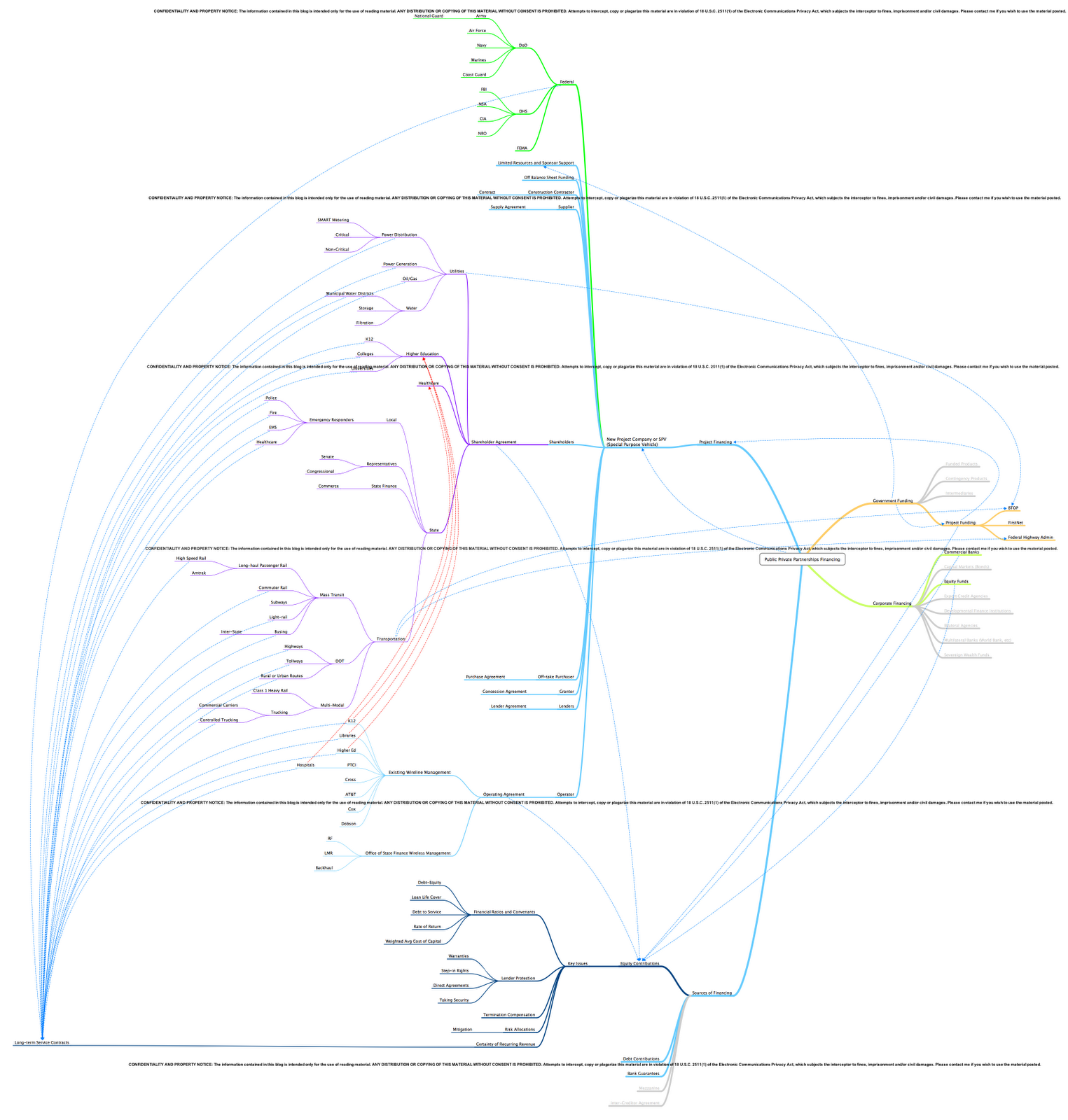
NTIA RFI Response How Will Existing Assets Be Utilized

Leveraging Existing Infrastructure
  1. How should States and local jurisdictions best leverage their existing infrastructure assets and resources for use and integration with the nationwide public safety broadband network?
Response: Through a Public Private Partnership maintained at the State level and supported at the FirstNet level will insure the solid future investment into standing long term contracts. As part of those Public Private Partnerships will be the inclusion of State entities that all have telecommunication assets that may help in the deployment and build out of the broadband plan, therefor it is highly recommended that all State entities tied to Public Safety be included in the overall plan. You should note that some of these entities are actually multi-state in nature and thus could further simplify the process of integration and interoperability between States and regions. 
  1. How should States and local jurisdictions plan to use and/or determine the suitability of their existing infrastructure and equipment for integration into the public safety broadband network?
Response: Each State has multiple entities that require broadband technologies. As with any Public Private Partnership the ability to save costs by utilizing existing resources and assets to offset costs allows for a more efficient business model. Through a process of inventory controls an audit should be conducted. Once the audit has been completed then an asset inventory, or database, of all existing infrastructure and resources can be administer through the State project office for the inclusion into the design and deployment phase. Such infrastructure inclusion is nothing new. Having experience in the deployment of thousands of tower and fiber infrastructures it is advised to maintain as many options as possible. Keep in mind that, sometimes, remediation of an existing site can cost more than just building “greenfield”. 
  1. What technical resources do States have available to assist with deployment of the nationwide public safety broadband network?
Response: There are numerous assets available for any given State, i.e. Agriculture, Forestry, Utilities, Transportation, DoD and others. Through the State agencies that tie into the CIO organization you will find assets of fiber, microwave, cellular and other radio based technologies. You will also find a myriad of control centers, data centers and storage area networks tied together with large complex enterprise solutions. Outside of the physical assets you will find a whole host of technical skill-sets and talents that are very familiar with the execution, deployment and operations of many broadband technologies — to include LTE. 
  1. How will States include utilities or other interested third parties in their planning activities?
Response: As with any large programs there will be a multitude of agencies wanting access to the broadband solution. As for the execution of the program/project their will be a centralized project office for the State, most likely under the control of the State CIO, to which all State entities and agencies will flow through for resources, assets and inputs. Most importantly will be the cost cutting measures of utilizing existing assets that can be utilized to minimize cost and time. As was depicted earlier it would be essential that the Public Private Partnership also be a part of this teaming effort; in essence certain assets within a Utility, for example, could be utilized and through the use of assets they could mitigate a lower annual payment for use of the broadband network. It will be crucial that the controlling board of the Public Private Partnership maintain the equality of the State Agencies and their representation in the matter of access and asset distribution and sharing. 
  1. Should NTIA encourage planning for the formation and use of public/ private partnerships in the deployment of the nationwide public safety broadband network? If so, how?
Response: This will be essential to the success of the deployment and long-term operations of the network. Current estimates for the completed national network will fall somewhere between 50-100 Billion dollars. Access to additional funding and investment sources will be pivotal to making this a success. 
To initiate such an endeavor there would need to be a P3 (Public Private Partnership) Committee/Department created to help with the State based formation of P3 modeling to include private investment opportunities and the reuse and distribution of essential assets to cut and streamline costs. This committee’s, or department’s, primary mission is the case-by-case business case analysis for each and every State deployed network that will tie into the overall national plan. It will be necessary to execute in a similar format as to eliminate complexities and unfair business practices and to insure equality for the investors, public and private, for each and every P3 model initiated.  

NTIA RFI for the inclusion of State sponsored Public Safety Broadband Rollouts

What steps should States take to prepare to consult with FirstNet regarding these issues?
Response: Based on a single national design the entire concept of building the PSBN should be administered under a model of corporate structure; as with any national commercial carrier the FirstNet Board would act as the Headquarters element and the State would act as regions. It is crucial that not only the technical adherence be maintained, but it will be imperative that the strategy follow a strict path of “self funding” functionality. With the corporate structure footprint it develops a simplistic vision that allows for the creation of the governance and that self-funding model very similar to a nationwide commercial corporation with a strategic focus. 
Statistics show that localized market penetration, deployment activities and coverage will make up of more than 70% of the execution, governance and corporate modeling effect. In the end the deployment, maintenance and operation of this network will holistically have to be executed at the local and/or regional stage. On a technical footprint this does not discount the oversight and control of the FirstNet with a centralized national control center to monitor and administer the entire platform; in fact this enhances it functionality and capabilities through a centralized governance, standards and cost/revenue control mechanism by eliminating multiple Headquarter type elements and focusing the direction to one entity. As with any large corporation FirstNet, in acting as a corporate headquarters, would formulate the design standards to build by; procurement procedures to contract under; and deployment methodologies for execution. At the same time FirstNet will maintain and adhere the allocation of budgets (grants) in jump-starting the deployment process. 
One of the main areas of concern, outside of the technical and tactical design and deployment characteristics, will be the “self-funding” mechanism to power the PSBN. As with any corporation their primarily intent is to generate revenue, but they traditionally lack the funding, and spirit, to deploy a solution just for a societal cause, i.e. Public Safety concerns.  What is advantageous from the PSBN standpoint is that it has the governmental backing to build the solution based on societal just cause but also has the capability to act as any private commercial venture with the State agencies, or entities, acting as the customers. This is the point to which is a primary reason for State to Federal consultative services to its FirstNet leadership and execution. Without the States input the Federal impact will be limited, if not impossible, in that the potential contracts from State entities are under the control of the State itself and in fact are one in the same. This relationship is a fact and must be adhered to if the Government wishes to have a successfully deployed, managed and funded program for Public Safety; especially under the auspices of a “single national network”.  Without the ability to “self fund” it will make no difference on what is designed and deployed; eventually it would wither away into a state of disrepair and waste. 
As with any revenue generating plan you need clients. In this case those clients are State sponsored entities that require, or will require, wireless broadband access for their own business objectives. Due to the market penetration and the adaption of LTE broadband, and regardless of the outcome of the PSBN being deployed, those same State entities will still require this wireless access in the future. Traditionally the individual State entities would either have to invest in designing, building and deploying their own solution; which ultimately would increase tax dollars spent on statewide capital programs, both Federally and State. That would mean separate statewide communication programs for Police, Fire, EMS, Utilities, Agriculture and a host of other State agencies, all requiring State or Federal financial support. Or, the State entity would require the commercialization of its business objectives by leasing such wireless services from the commercial carriers further impacting the business case alignment between a State run agency and a commercial carriers prime directive of revenue generation; all of which impacts standards and hardening type requirements. The opportunity we face today is to allow that PSBN network to be the States Private (and protected) National Carrier. 
With the PSBN being administered as a “single national private carrier” would allow the State to be consultative about the use and impacts of State entities by setting up long-term (20-30 year) annual multi-million dollar service level agreements with the PSBN instead of asking, and spending, State and Federal tax dollars to build their own, or lease it from commercial carriers. 
It is further stipulated that the subscriber model must be avoided at all costs. The subscriber model is the traditional business model of a commercial carrier. Such a objective would require cost control mechanisms of billing and operational support controls that are not necessary towards a private network. The revenue to self-fund this program would be based on long-term contracts as stipulated above. In essence the PSBN would act as a long term contract organization between the State regional offices and the State internal agencies (entities). Another important aspect of this setup is that it generates much more recurring revenue for the longer term that provides a reliable self-funding framework. Case in point would be the Department of Water Resources in California which has long standing contracts with 29 water districts and municipalities that have generated a cash positive inlay since its creation. Those contracts are in 50 year terms. 

What data should States compile for the consultation process with FirstNet?

Response: Immediate compilation of the technical and tactical aspects of the local contracts that are utilized for the design, deployment and operations of current network plans. This will be imperative that a State compile a listing of internal State resources and entities that require access to the PSBN. This listing of internal organizations could be vetted through the FirstNet Board for adherence to Public Safety requirements and be further scrutinized for existing infrastructure that could be used as part of the PSBN build within that State. 

On the “self-funding” aspect; the State could start to compile an internal State agency listing that shows what communication plans are currently under contract, under design or in the State Telecommunication Plans. As compiled against this list would be each individual State entities capital and operational costs associated with its current communication needs. This will provide an adequate annual figure for a long-term service contract as it pertains to the incorporation of the PSBN services. As an example: if a State entity currently has planned, or has already invested, millions of dollars into large-scale communication networks that could ultimately be provided through the PSBN network. This would act as a trigger for estimating a fraction of those expenditures that  would be suitable for long-term standing annual service level contracts with FirstNet. This would mean that the FirstNet, or PSBN, would cover the technological curve as well as the risk of maintaining the complex communication solution for the State. 
Another opportunity that is presented with the scenario is the impact of Public-Private Partnering. In essence the picture acquired from the long-term service level contracts are advantageous to private investment where as those contracts are viewed as long-term recurring revenue which acts as a great incentive. Such incentive and private investments could actually help recoup lost tax dollars spent on technologies already deployed; i.e. SMART Grid, LMR, P25, etc..

BTOP and Waiver Puts a Lull on the Market

With the freeze on BTOP grants to the States, and the hold on all waivers for the Public Safety Broadband Network, it has put a big damper on the plans of many. With the state of employment at its current levels it is forcing organizations to rethink there manning of potential bids. Do they go ahead and hire now and then wait? Will they have enough budgets to carry the load until the projects really start to move – if they win? Even though the mandate to get the FirstNet Board online by August…is it too far down the road before actual RFPs are let and awarded? Do the main players take the chance to hold off on hiring the key and essential players currently on the market in the hopes that no one will hire them before time runs out?
From my interpretation it’s a lot like the stock market. Given the fact that we are sitting at all time lows in the employment picture (high unemployment); given the state of financial budgets have been locked down for the last two-years (if not more) due to uncertainties in the market; observing the amount of time we have been sitting at the bottom of the curve; has forced a lot of people to believe in the “doom theory”. Where doom looms I see opportunity. I believe it is time to put our stake on the market and start to view this as a “buy low” opportunity (a bullish view). All the stocks are at their lowest in a decade. It’s time to start buying the market back. In this case it happens to be one of the biggest looming telecommunications booms in over a decade. The commercial carriers have already committed the course.
The success of the coming year will a plethora of RFPs setting the pace for a new market of broadband wireless for both Public and Private ventures. Given the time frame since the last boom in the telecommunication space; and the fact that there has been a brain drain on the employment within this sector for the last 5-10 years; plus the movement of other key technical expertise having moved to “other” industry segments; possibly demonstrates a looming war of available talent for this next telecom boom. These same talents that will be fought for have also grown weary of the telecom space through its volatility and insecurity. They have also become much smarter as to what the ideal company they want to work for should look like. 
Current funding by the Obama Administration was at $7 Billion of which, realistically, only $2 Billion will be delivered. The other portion has to come from the sale of other frequencies. It may be just me, but the current roadmap of installed assets for a given national carrier runs around $20-30 Billion dollars. Not including the capital expenditures required to actually build the solutions. Those same carriers penetrate, roughly, 96% of the population mass. The PSBN will have to cover, roughly, 98% of “geographic mass”. That is a totally different scenario! Plus the fact that the hardening requirements for the PSBN are, roughly, three times that of a commercial carrier, puts a realistic budget of an installed asset base for the PSBN around $70-$100 Billion dollars (conservatively). We should expect that the operational budget (includes operations and maintenance) would be roughly 10% of the total installed asset base, in essence $7-$10 Billion a year. The capital required to build the solution is a whole other task.
Given the size of the market opportunity, and the inherent bridge between commercially available technologies, commercial (private) funding investment opportunities, and the backing of State and National Government entities, it should be clear that we face a great opportunity to deliver many jobs for many years to come.
Everyone is just sitting at the gates like prancing racehorses ready to be put into their race stalls. But it will be hard to put those racehorses in the stalls, let alone have them prepped for a strong race, if you don’t have the expertise to make it happen before it happens. Those that commit today will be best positioned to win the race when it does start…6 months is not that long before the race starts.